

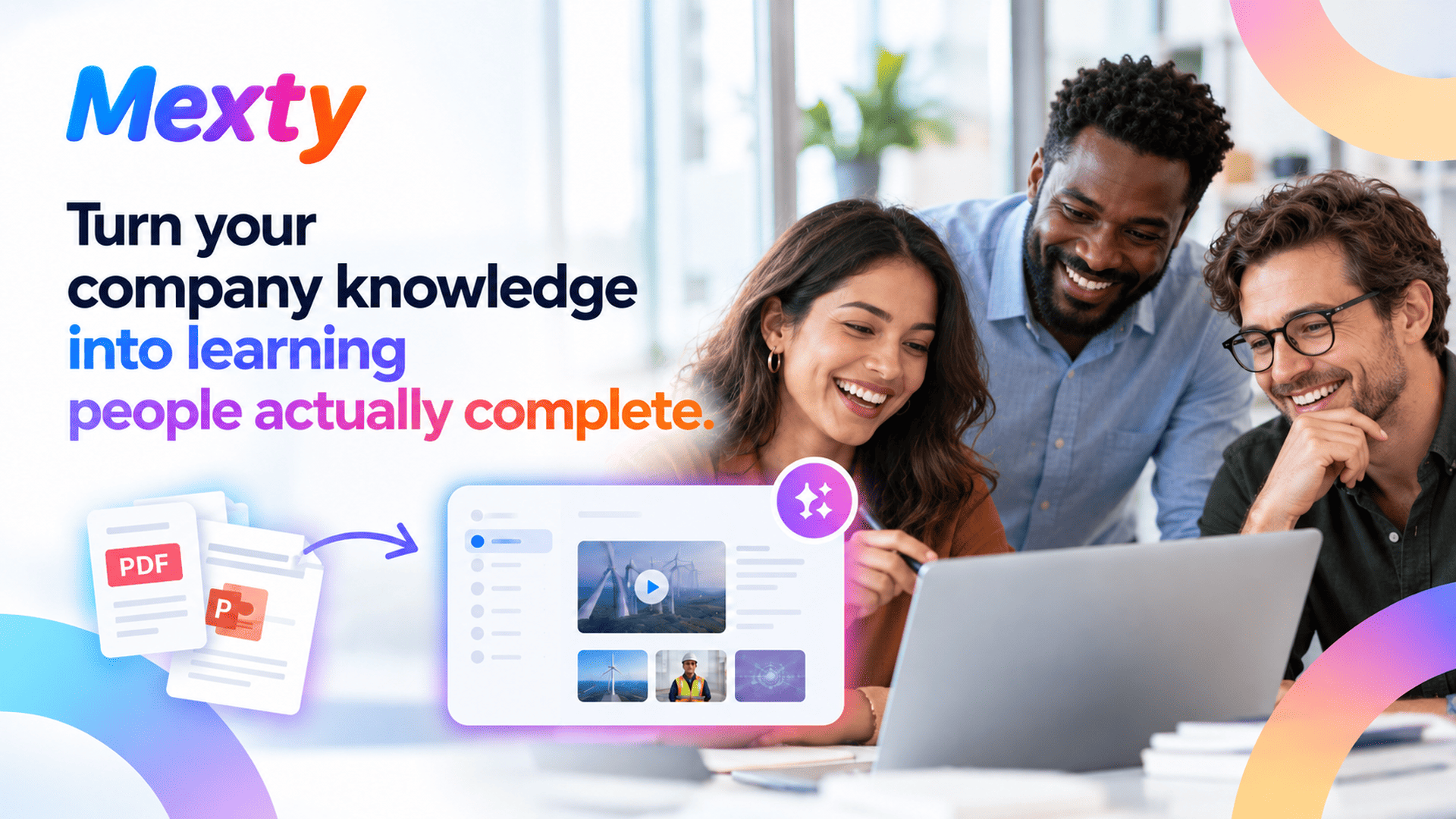
Your Company Already Has the Knowledge. AI Can Turn It
into Learning That Works.
From static PDFs and PowerPoint
presentations to interactive, measurable learning: how AI-native learning
infrastructure helps organizations unlock the value of their existing
knowledge.
Your company doesn't have a knowledge problem. It has
a learning problem.
Think about how much knowledge
already exists inside your organization.
Policies and compliance procedures.
Product documentation. Technical manuals. Onboarding guides. Sales
presentations. Internal expertise accumulated over years of experience.
The knowledge is there.Yet, much of
it remains trapped in documents, shared folders, slide decks, and internal
systems that employees rarely revisit.
When training is required, someone
has to collect this information, restructure it, build a course, create
assessments, distribute the content, and track whether people have completed it
and even after all that effort, one critical question often remains unanswered:
Did people actually learn something they can apply?
This is the challenge facing many
organizations today, particularly SMEs and mid-sized companies that need to
deliver professional training without maintaining large instructional design
teams.
AIis changing the economics of
learning creation. But the opportunity is much bigger than generating courses
faster.
The real opportunity is to
transform existing company knowledge into interactive, measurable learning
while keeping human experts in control.
That is what Mexty
is designed to enable.
The hidden cost of knowledge that nobody learns from
Organizations invest significant
resources in creating and maintaining internal knowledge.
Compliance teams update policies.
Engineers document products and procedures. HR departments prepare onboarding
materials. Sales teams create product presentations and competitive guides.
But storing knowledge is not the
same as transferring it.
Consider a typical employee
onboarding process.
A new employee receives several
PDFs, a collection of PowerPoint presentations, and links to internal
documentation.
The employee is expected to read
everything, understand the relevant procedures, and remember the important
information.
There may be a final acknowledgment
confirming that the documents were received.
But receiving a document does not
prove understanding.
And completing a presentation does
not mean the employee can apply the knowledge correctly.
This creates a significant gap
between knowledge availability and learning effectiveness.
The consequences can be
substantial: inconsistent onboarding, repeated mistakes, longer time to
productivity, increased compliance risk, and additional demands on experienced
employees who must repeatedly explain the same information.
The solution is not necessarily to
create more content.
It is to make existing knowledge
easier to understand, practise, assess, and apply.
From static documents to interactive learning
This is where AI can fundamentally
change how organizations approach training.
Traditionally, transforming a
technical document into an eLearning course required several separate
activities.
An instructional designer would
analyze the source, identify learning objectives, restructure the content,
write explanations, develop interactive exercises, build assessments, and
publish the result.
Depending on the complexity, this
could take days or weeks.
With an AI authoring tool for
L&D, much of the initial production can be accelerated.
For example, an organization can
use AI to transform a validated internal procedure into a structured learning
experience containing explanations, interactive exercises, knowledge checks,
and assessments.
The objective is not simply to Convert
PDF to interactive course format.
It is to convert information into
learning experiences that help people understand, retain, and apply knowledge.
An effective Interactive Course
Creator should make it easier to move beyond passive reading toward active
participation.
Instead of presenting an employee
with a 40-page compliance document, imagine an interactive module that:
- Explains the essential rules in clear,
accessible language.
- Presents
realistic workplace situations.
- Asks
employees to make decisions.
- Provides
feedback on their responses.
- Evaluates
their understanding.
- Identifies
areas requiring further practice.
The original document remains the
authoritative source. The learning experience makes that knowledge usable and
importantly, subject-matter experts remain responsible for reviewing and
approving the content.
Why trusted knowledge matters more than AI-generated
content
One of the biggest concerns
organizations have about using generative AI for training is reliability.
AIcan produce convincing
explanations, but convincing does not always mean correct.
For compliance training, technical
procedures, safety instructions, or product education, inaccurate information
can create serious consequences.
That is why the starting point
matters.
Rather than relying on generic
information generated from the open internet, organizations need AI workflows
grounded in their own validated knowledge.
Mexty is designed around this principle.
Organizations can use approved
documents, internal resources, and trusted knowledge bases as the foundation
for AI-assisted learning creation.
This helps maintain alignment
between the training material and the organization's actual policies, products,
and procedures.
However, trusted sources alone do
not eliminate every risk of AI-generated inaccuracies.
Human review remains essential.
AIcan accelerate the first draft.
Your experts must retain the final word.
That distinction is central to
building confidence in AI-generated learning.
It also represents an important
difference between simply generating content and operating within AI-Native
secure Learning Infrastructure.
The goal is not uncontrolled
automation.
It is faster content production
within a structured environment that supports quality, governance, and human
oversight.
Five practical applications for enterprise learning
The value of AI-native learning
becomes clearer when applied to recurring business needs.
1. Compliance and regulatory training
Compliance training is often
mandatory, repetitive, and difficult to keep current.
Organizations must communicate new
policies, reinforce existing requirements, and demonstrate that employees have
received and understood relevant information.
AI-assisted authoring can help
convert validated compliance documentation into interactive training modules.
Employees can work through
scenarios, test their understanding, and receive feedback.
Learning administrators can track
participation, completion, and assessment results.
This creates a more useful training
record than simply distributing a policy document.
It does not, by itself, establish
legal compliance, but it can provide important evidence of training delivery
and understanding.
2. Employee onboarding
Onboarding is one of the most
common recurring training needs.
Every new employee needs to
understand the company's organization, products, tools, processes, policies,
and expectations.
Instead of relying on disconnected
presentations and documents, HR teams can organize this information into
structured learning paths.
Interactive modules allow new
employees to progress through essential topics, complete exercises, and
demonstrate understanding.
Managers and HR teams can follow
progress and identify where additional support may be necessary.
The potential benefit is a more
consistent onboarding experience and reduced dependence on repeated one-to-one
explanations.
3. Product and customer education
Product knowledge changes
constantly.
New features are introduced.
Specifications evolve. Customer requirements change.
Companies need to keep employees,
partners, distributors, and customers informed.
An Interactive Learning Platform
can help transform product documentation into structured learning experiences.
Instead of sending customers
lengthy technical manuals, organizations can offer interactive tutorials,
demonstrations, product quizzes, and guided learning modules.
The same knowledge can support
internal training and external customer education, with appropriate adaptations
for each audience.
4. Sales and technical enablement
Sales and technical teams need more
than access to product information.
They need to understand how to
explain products, respond to objections, troubleshoot problems, and make
informed decisions.
AI-assisted learning creation can
help turn internal expertise into practical training scenarios.
For example, a technical sales team
could practise identifying customer requirements, selecting suitable solutions,
or responding to realistic technical questions.
Assessments can reveal where
additional coaching is required.
The goal is to move beyond
memorizing product specifications toward developing practical capabilities.
5. Turning internal expertise into reusable learning
Some of the most valuable knowledge
in an organization exists in the experience of its employees.
Experienced engineers, managers,
technical specialists, and customer-facing teams frequently possess expertise
that is difficult to formalize.
When that knowledge remains
undocumented or inaccessible, organizations become dependent on a small number
of individuals.
By capturing and validating expert
knowledge, organizations can transform it into structured learning resources.
This supports knowledge transfer,
business continuity, and the development of new employees.
It can also help organizations
preserve expertise when experienced staff change roles or leave.
One connected workflow instead of multiple
disconnected tools
Creating interactive content is
only part of the training process.
Organizations also need to
distribute learning, manage users, assess understanding, and monitor progress.
This is where disconnected software
environments can become expensive and difficult to manage.
A company might use one tool for
generating content, another for course authoring, an LMS for delivery,
spreadsheets for reporting, and separate applications for assessments.
Each additional system introduces
administration, data transfers, integration work, and potential
inconsistencies.
An AI-native LMS and authoring
platform offers a more connected approach.
Mexty brings AI-assisted content creation together with
learning delivery, evaluations, and analytics in one environment.
Organizations can create
interactive courses, review and approve the content, deliver learning through
the Mexty
LMS, and monitor learner progress.
For organizations that already have
an LMS, SCORM-compatible export provides an alternative deployment path.
This flexibility matters.
Businesses should not have to
replace their entire learning technology environment simply to benefit from AI-assisted course creation.
The objective is to simplify the
eLearning workflow, not introduce unnecessary complexity.
Designed for SMEs, training providers, and eLearning
professionals
Not every organization has a
dedicated team of instructional designers, developers, LMS administrators, and
learning analysts.
Yet training requirements exist
regardless of company size.
SMEs and mid-sized organizations
often face the same obligations as larger enterprises, but with fewer
resources.
They need to onboard employees,
maintain compliance, develop capabilities, and communicate changing product
knowledge.
For these organizations, an
integrated learning environment can make professional training more accessible.
Training providers and academies
face a different challenge.
They need to produce engaging
learning programs efficiently, maintain quality, and serve multiple clients or
learner groups.
AI-assisted creation can reduce
repetitive production tasks while allowing experts to concentrate on
instructional quality and customization.
eLearning agencies and independent
consultants can also benefit.
Instead of spending most of their
time manually converting source documents into slides and basic activities,
they can focus on learning design, interactive experiences, client
requirements, and measurable outcomes.
The objective is not to replace
instructional designers.
It is to give them more capacity to
do the work that requires their expertise.
From course completion to measurable learning impact
One of the most important questions
in corporate learning is whether training actually works.
Many organizations still measure
success primarily through course completion rates.
Completion is useful. It
demonstrates participation.
But it does not necessarily
demonstrate knowledge acquisition, changed behavior, or improved business
results.
A more meaningful approach connects
several levels of evidence:
Participation:
Did employees access and complete the training?
Understanding:
Did they demonstrate the expected knowledge and skills through assessments?
Application:
Are they using what they learned in their work?
Business outcomes:
Is there evidence of improvement in productivity, quality, customer
satisfaction, compliance, or other relevant indicators?
An integrated platform can make the
first two levels easier to monitor through learning activity and assessment
data.
Demonstrating application and
business impact generally requires additional evidence, such as manager
observations, operational KPIs, performance data, or follow-up evaluations.
This distinction is essential when
evaluating ROI in Learning.
Higher completion rates are not
automatically proof of positive ROI.
But connecting learning content,
assessments, and progress data provides a stronger foundation for understanding
where training is effective and where improvements are necessary.
The objective should be to design
learning with measurable outcomes from the beginning, rather than trying to
demonstrate value only after a course has been delivered.
AI should accelerate expertise, not replace it
There is a common misunderstanding
about AI-powered learning.
The assumption is that automation
means reducing human involvement.
But effective learning requires
human judgment.
Someone must determine what
employees need to learn, what knowledge is authoritative, which activities are
appropriate, how competence should be assessed, and whether the training aligns
with business objectives.
These are not merely
content-generation tasks.
They require professional expertise
and organizational accountability.
Mexty's approach is built around a straightforward
principle:
AI does the first draft. Your
experts keep the final word.
AI can help structure information,
generate initial content, suggest exercises, and accelerate course development.
Human experts review, modify,
approve, and improve what learners receive.
Technology handles repetitive
production activities.
People retain responsibility for
quality, pedagogy, and decisions.
This balance is particularly
important when training involves sensitive information, regulatory
requirements, or business-critical procedures.
Conclusion: Your next training program may already
exist inside your company
Companies often assume that
improving training requires producing large amounts of new content.
But the starting point may be much
closer than they think.
The knowledge already exists in
internal documents, procedures, product materials, presentations, and the
expertise of their teams.
The challenge is making that
knowledge accessible, engaging, actionable, and measurable.
AI-native learning infrastructure
offers a new way to approach this challenge.
It connects trusted knowledge with
interactive course creation, expert review, learner delivery, assessments, and
analytics.
It helps organizations make better
use of what they already know.
And it allows learning teams to
spend less time on repetitive production and more time improving learning
experiences and outcomes.
The future of corporate learning is
not about generating more content. It is about transforming existing knowledge
into capabilities that make a difference.
That is what Mexty
is built for.
And it starts with a simple
question:
Which training topic in your
organization is still stuck in a PDF or a PowerPoint presentation?
Explore how Mexty can help transform your existing
company knowledge into interactive, measurable learning.