
Why the Next Horizon for L&D Isn't a Smarter LMS, It's an AI-Native Infrastructure
For years, the LMS has been the center of enterprise digital learning.
Organizations built catalogs, uploaded courses, assigned learners, tracked completions, recorded scores, and generated reports. The model worked because the primary challenge was distributing learning content efficiently at scale.
AI is changing that assumption.
A recent analysis of the future of learning platforms described a “second horizon”: moving beyond adding AI features to existing systems and toward platforms fundamentally rebuilt around AI.
That distinction matters.
The next generation of enterprise learning will not be defined by who adds the smartest chatbot to an LMS. It will be defined by who can connect knowledge, creation, practice, assessment, learner support, analytics and continuous improvement inside one intelligent, governed environment.
This is the shift from a standalone LMS with AI to an AI-Native secure Learning Infrastructure.
Adding AI to an LMS Is Not Transformation
Most platforms are currently operating in what could be described as the first horizon of AI adoption.
Take the existing LMS or authoring workflow and add:
- AI-generated course outlines
- automated quizzes
- content summarization
- chatbot support
- recommendations
- translation
- search
These capabilities can save time. They are useful improvements.
But the underlying architecture has barely changed.
The catalog is still the front door.
The course is still the main unit of learning.
The authoring tool still creates content that is then pushed into another platform.
The LMS still manages delivery.
Analytics still mostly report completion, time spent and scores.
AIis helping the existing system operate faster, but it is not changing the system itself.
That is the difference between an AI-enabled LMS and an AI-native LMS and authoring platform.
The Second Horizon : Learning Designed Around AI
An AI-native platform begins with a different assumption.
AI is not a feature inside the learning workflow.
AI becomes part of the infrastructure connecting the workflow.
That means connecting:
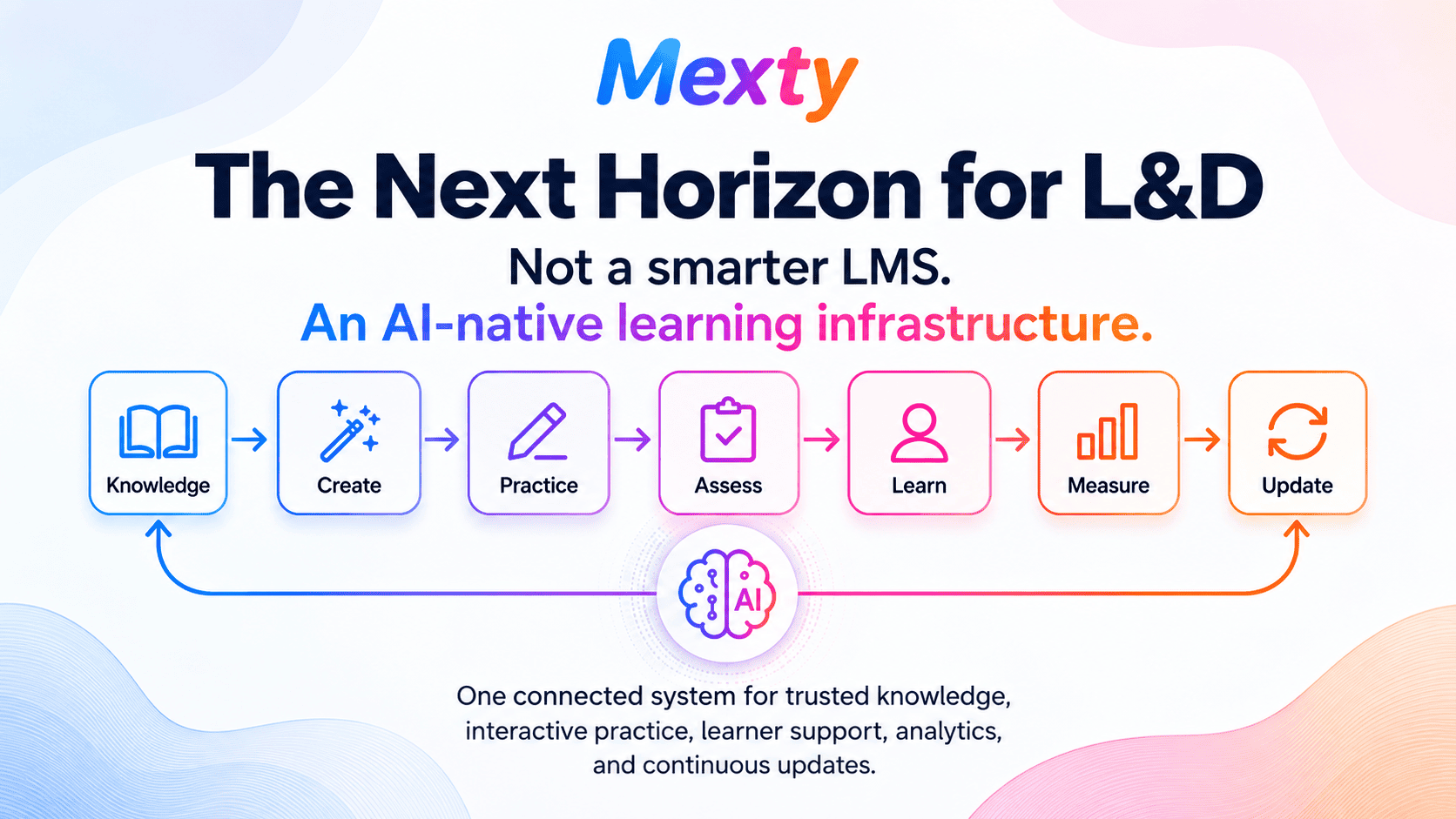
Trusted Knowledge → Creation → Practice → Assessment → Learning → Measurement → Update
Instead of separate systems exchanging files, SCORM packages and reports, each stage can inform the next.
Company knowledge can directly ground learning creation.
Learning interactions can generate data that influences assessment.
Assessment results can trigger additional practice.
Learner questions can be handled by an AI Agent for Learning grounded in approved enterprise knowledge.
Analytics can reveal where learners struggle.
Changes in source documents can trigger reviews of affected training.
The result is not simply faster authoring. It is a learning system capable of continuously connecting organizational knowledge with learner needs.
The Catalog Stops Being the Only Front Door
Traditional LMS design assumes the learner knows what they need.
The learner logs in, searches a catalog, selects a course and starts learning.
But people rarely experience learning needs that way.
A sales representative might ask:
“How should I handle this objection from a customer?”
A new manager might need help preparing for a difficult conversation.
A technician might need to understand an updated procedure.
A new employee might ask how a specific internal process works.
In an AI-native environment, these needs can become the starting point.
Instead of forcing the learner to identify the correct course first, the system can interpret the request and connect it to the appropriate knowledge and learning experience.
It might:
retrieve an approved answer
recommend an existing module
generate a short practice activity
provide a scenario
ask the learner to make a decision
offer targeted feedback
recommend additional learning
connect the learner with an AI assistant grounded in trusted sources
The catalog does not disappear.
It simply stops being the only way into learning.
That is a fundamental shift from content-first learning to need-first learning.
From Content Generation to Interactive Practice
Generative AI has made content creation dramatically easier.
But more content does not automatically create more learning.
A powerful AI authoring tool for L&D should therefore do more than generate pages of text, slides and quizzes. It should make it easier to create the experiences through which people actually develop competence.
That includes:
- decisions
- scenarios
- simulations
- retrieval practice
- problem solving
- role plays
- feedback
- remediation
- repeated attempts
This is where concepts such as Vibe coding for interactive learning become important.
Instead of manually programming every interaction, an instructional designer or trainer can describe the experience they want:
“ Create a branching scenario where a sales manager has to respond to an underperforming employee.”
Or :
“Build an interactive cybersecurity activity where the learner identifies suspicious behavior and receives feedback on each decision.”
The barrier between instructional idea and working experience becomes much smaller.
The goal is not simply to create interactive courses without coding.
The goal is to generate more meaningful opportunities to practice.
Trusted Knowledge Becomes Infrastructure
AI-native learning also changes the role of enterprise knowledge.
Most organizations already have enormous amounts of valuable information :
- policies
- procedures
- product documentation
- onboarding materials
- technical manuals
- compliance guidelines
- sales methodologies
- videos
- internal knowledge bases
Traditionally, this knowledge has to be manually transformed into training.
An AI-native platform can connect learning directly to these trusted sources.
That changes the workflow.
Rather than :
Document → SME → Instructional Designer → Storyboard → Course → LMS
the organization can move toward:
Trusted Knowledge → AI-assisted Creation → Human Review → Practice → Learning
The connection to source material is critical.
Enterprise AI cannot rely on generic model knowledge when accuracy matters. A compliance course should reflect the approved policy. Product training should reflect the latest product documentation. An onboarding experience should reflect how the organization actually operates.
This is why the future requires a Trusted AI authoring platform, not simply an AI content generator.
Learning Becomes Continuous, Not Published
Traditional authoring has a clear endpoint:
Publish course.
But enterprise knowledge does not stop changing when a course is published.
Policies evolve. Products change. Regulations change. Processes change.
Learning content becomes outdated.
An AI-native infrastructure can change the maintenance model.
Imagine this workflow :
Source modified → Difference detected → Training impacted → AI proposes update → Human validates → New version published
The training catalog becomes connected to the knowledge on which it depends.
This could dramatically reduce one of the least glamorous but most expensive parts of enterprise learning: maintaining large catalogs of aging content.
The shift is from periodic course maintenance to continuous learning infrastructure.
AI Agents Extend Learning Beyond the Course
Another limitation of the traditional LMS is that learning support often ends when the module ends.
The learner completes the course, closes the window and returns to work.
But questions usually appear later.
AI agents create the possibility of extending learning into the workflow.
An AI Agent for Learning grounded in approved organizational knowledge can support learners when they need help, explain concepts, suggest practice or direct them toward relevant resources.
This does not eliminate courses.
It changes their role.
A course becomes one component of a larger learning environment rather than the entire experience.
Learning can continue before, during and after the formal module.
Analytics Must Move Beyond Completion
The traditional LMS is very good at answering questions such as :
- Who completed the course ?
- What score did they receive ?
- How long did they spend ?
- Did they pass ?
Those questions remain useful.
But AI-native learning can generate richer signals.
Which concepts create the most errors ?
Where do learners abandon activities ?
How many attempts are required before success ?
Which scenarios create difficulty ?
What questions do learners repeatedly ask an AI agent ?
Where might additional practice be needed ?
This is where an Interactive Learning Platform becomes more valuable than a simple content repository.
The purpose of analytics shifts from proving that content was delivered to understanding how people are learning.
More Adaptive on the Surface, More Controlled Underneath
A need-driven learning experience can appear highly flexible.
But flexibility does not mean abandoning governance.
In fact, the more AI participates in learning, the more important governance becomes.
Enterprise learning infrastructure needs control over :
- approved sources
- AI models
- roles and permissions
- learner data
- human review
- content editing
- versioning
- traceability
- publication rights
- analytics
- security
- compliance
The paradox of AI-native learning is that the learner experience can become more adaptive precisely because the infrastructure underneath becomes more structured.
This is why enterprise adoption requires an AI learning platform with privacy controls and an Enterprise-ready AI authoring tool, not simply access to a generative model.
Human control remains fundamental.
AI can generate, recommend, retrieve, adapt and identify patterns.
But organizations still need to decide what is trusted, what is published and what constitutes acceptable learning.
What We Are Building at Mexty
This is the direction behind Mexty V3.
Mexty is not designed as an LMS to which AI features were added afterward.
It is being built as an AI-native platform for creating interactive learning experiences and a connected learning infrastructure where the different components of enterprise learning can operate together.
That includes :
Knowledge Bases
Trusted enterprise knowledge and Sources of Truth.
AI-assisted and vibe-coded authoring
Courses, activities, scenarios, simulations and assessments.
LMS and Learning Delivery
Learners, groups, assignments, learning paths and access.
Practice and Assessment
Interactive experiences, decisions, feedback and evaluations.
AI Agents
Support for creators and learners.
Analytics
Progress, engagement, scores, errors and improvement signals.
Continuous Updates
Connecting changes in knowledge to changes in learning.
The objective is not simply to simplify eLearning workflow.
It is to connect the learning workflow.
The LMS Does Not Disappear
This shift does not mean the LMS becomes irrelevant.
Organizations still need structured learning paths, assignments, learner records, compliance tracking, reporting and interoperability.
SCORM remains important, which is why being SCORM-compatible and able to work with existing LMS environments continues to matter.
But LMS functionality becomes one layer of a broader infrastructure.
The bigger question is no longer :
“Which platform stores and delivers our courses ? ”
It becomes:
“ Which infrastructure connects our knowledge, our people, our learning experiences and our AI ? ”
That is a much bigger problem.
And potentially a much bigger opportunity.
From Content-First to Need-First Learning
The first generation of digital learning digitized the classroom.
The LMS made that learning scalable.
Authoring tools made digital content easier to build.
Generative AI is now making content dramatically easier to produce.
But the next transformation will not come from producing even more content.
It will come from connecting the system around the learner.
A learner has a need.
The organization has knowledge.
AI can increasingly become the intelligent layer connecting the two through retrieval, creation, practice, feedback, assessment and continuous support.
That is why the next horizon for L&D is not simply a smarter LMS.
It is an AI-Native secure Learning Infrastructure where:
Knowledge → Create → Practice → Assess → Learn → Measure → Update
operates as one connected cycle.
The catalog remains.
The courses remain.
The LMS remains.
But none of them needs to remain the center of the learning experience.
The learner's need can become the starting point instead.
And that may be the real shift from learning platforms with AI features to learning infrastructure that is genuinely AI-native.
About Mexty, an interactive, learning platform ….
Mexty turns learning into personalized experiences designed to drive real-world performance.
Discover how AI-native learning can turn knowledge into action with Mexty.
Meet Mexty : the AI-powered learning platform that turns knowledge into engaging experiences, real skills, lasting behavior change, and measurable results.
That’s where Mexty changes the way learning works.
Go beyond traditional e-learning with Mexty, where AI transforms your expertise into personalized learning journeys that engage, inspire, and drive real impact.
Once you’ve discovered and tried Mexty, we’d love to hear your thoughts !
Share your experience and impressions with us about this new, interactive way to learn and create. Your feedback is very valuable to us.
Don’t miss the latest news. Follow Mexty and visit www. Mexty.ai to discover what’s next !
If you enjoyed this, you’ll love our next articlesIs Your Enterprise Actually Ready to Use AI ? |