

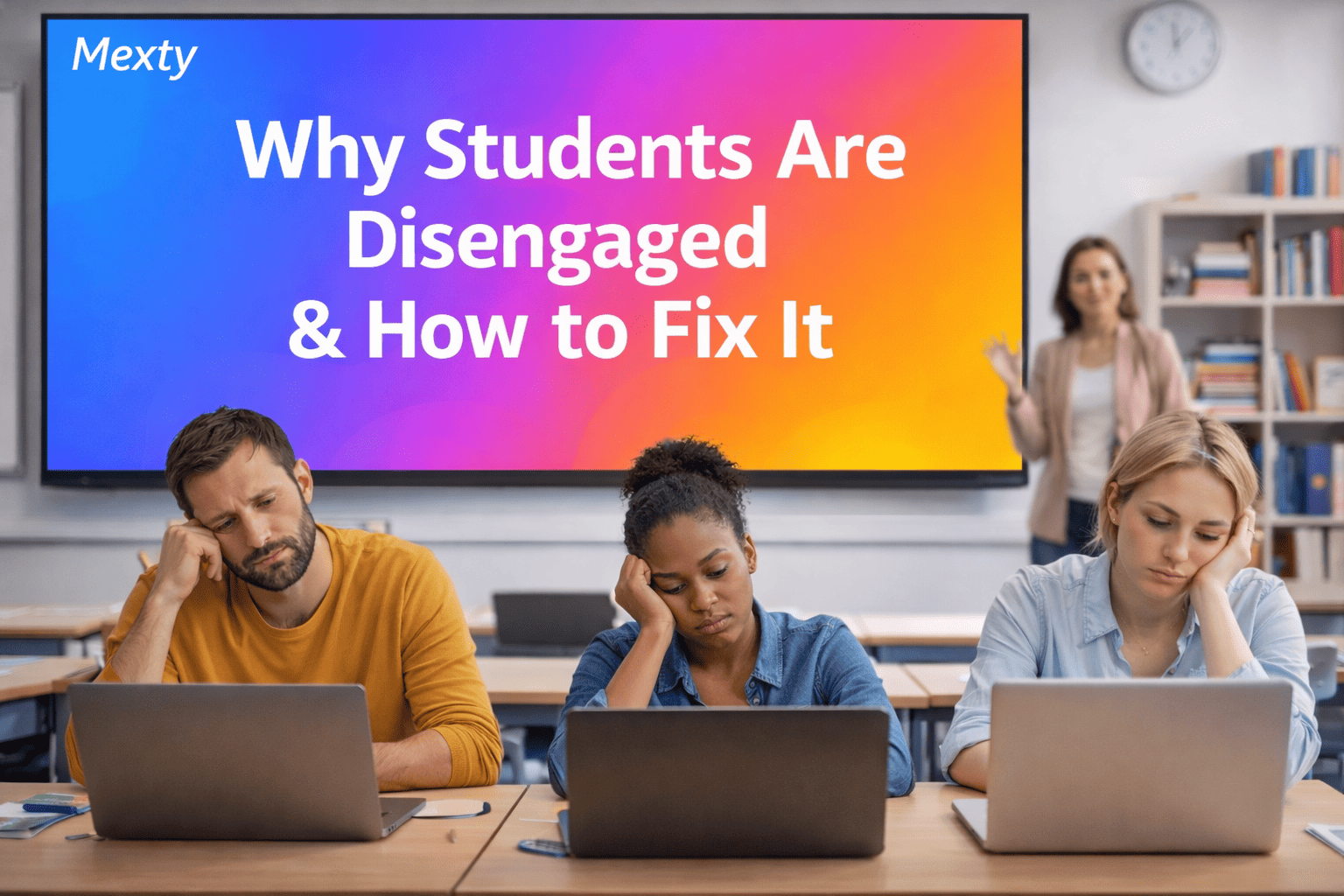
Why Students Are Disengaged & How to Fix It
Understanding the real reasons behind falling student engagement and what educators can do today.
Across the United States, student engagement has become one of the most urgent challenges for teachers, schools, and families. Whether it appears as distraction, emotional shutdown, resistance, or passive participation, disengagement has real consequences: lower performance, reduced confidence, and widening learning gaps.
But disengagement is often misunderstood. It is rarely about laziness or lack of motivation.
More often, students disengage when the learning environment does not fit the way they learn, or when they’re struggling silently without support.
Instead of asking “What’s wrong with the student?”, the real question should be:
“How can we redesign learning so every student can succeed?”
What’s Really Behind Student Disengagement?
1. Learning styles don’t match traditional teaching
Students learn in diverse ways visually, auditorily, socially, kinesthetically, or through hands-on activities. When teaching relies mostly on passive listening and worksheets, many students disconnect because the approach doesn’t support how their brain learns best.
2. Undetected learning differences
Dyslexia, ADHD, processing challenges, autism-spectrum learning profiles, or anxiety can make traditional learning environments overwhelming. When these needs go unrecognized, disengagement becomes a coping mechanism, not defiance.
3. Lack of autonomy & personal relevance
Students disengage when content feels too easy, too difficult, or disconnected from their interests and real-world applications. Choice and meaningful context restore motivation.
4. Instruction doesn’t match digital-native students
Modern learners grow up with interactivity, multimedia, and instant feedback. When learning feels static, attention naturally declines. They need active learning not passive listening.
5. Low emotional safety or confidence
Students who fear failure or judgment shut down to protect themselves. A culture that encourages effort and risk-taking increases participation.
6. Weak real-world connection
Motivation rises when learning feels purposeful and connected to authentic challenges, careers, and personal interests.
What Actually Re-Engages Students
✔ Make learning interactive
Simulations, gamified challenges, polls, and hands-on collaboration transform learning from passive to active. Students become problem-solvers instead of observers.
✔ Use AI tools for students to increase participation
Modern AI tools for students such as adaptive lesson creation, real-time feedback, and accessibility-aware learning design help personalize instruction and reduce frustration. Platforms like Mexty use AI to support diverse learners through visual, audio, and inclusive learning experiences.
✔ Personalize pathways the adaptive learning benefits
Adaptive learning benefits include improved confidence, deeper mastery, and reduced anxiety because students learn at the pace and format that works for them. AI-native platforms like Mexty enable adaptive pathways that meet students where they are instead of forcing uniform progression.
✔ Offer choice & multimodal learning
Let students demonstrate understanding through video, audio, visuals, hands-on building, storytelling, or writing. Choice increases ownership and engagement.
✔ Build emotional safety & belonging
Low-stakes practice, peer collaboration, and supportive feedback help students take risks without fear.
✔ Make learning relevant
Connections to real life, community issues, and problem-solving make learning meaningful and engaging.
Why Interactive Learning Improves Student Engagement
| Benefit | Impact |
|---|---|
| Supports diverse learning needs | Inclusion & confidence |
| Improves attention & retention | Active, sensory participation |
| Builds autonomy | Students take ownership of learning |
| Increases motivation | Curiosity replaces resistance |
| Reduces behavior issues | Participation replaces avoidance |
Student engagement is not entertainment.
It is effective instructional design rooted in how the brain learns.
Research on Student Engagement
74% of teachers report student engagement has declined (Education Week, 2023)
90% of educators say interactive and choice-based activities increase engagement (EdTech Evidence Group, 2022)
Students retain up to 80% more information through active learning than lecture-only formats (National Training Laboratories)
Approximately 1 in 5 students has a learning difference such as dyslexia or ADHD (NCLD)
Classroom use of AI tools for students and adaptive strategies increases participation by 48% and outcomes by 34% (MIT Teaching Lab, 2021)
FAQ – Student Engagement
Why are students disengaged?
Disengagement often stems from teaching methods that don’t align with student learning styles, lack personalization, emotional safety issues, or undetected learning differences.
How do you increase student engagement?
Use interactive learning, AI tools for students, personalized instruction, real-world relevance, and collaborative structures.
What are the benefits of adaptive learning?
Adaptive learning benefits include improved confidence, stronger mastery, reduced frustration, and higher engagement because instruction fits the individual learner.
Final Thought
Disengagement is not a student problem it is a signal from the learning environment.
When learning becomes adaptive, interactive, and inclusive, students don’t just participate they thrive.
AI-native platforms like Mexty are helping educators redesign learning around how students actually learn not how systems were built decades ago.
If you enjoyed this, you’ll love our next articlesData Analytics in E-Learning: From Learner Behavior to Course Outcomes |