

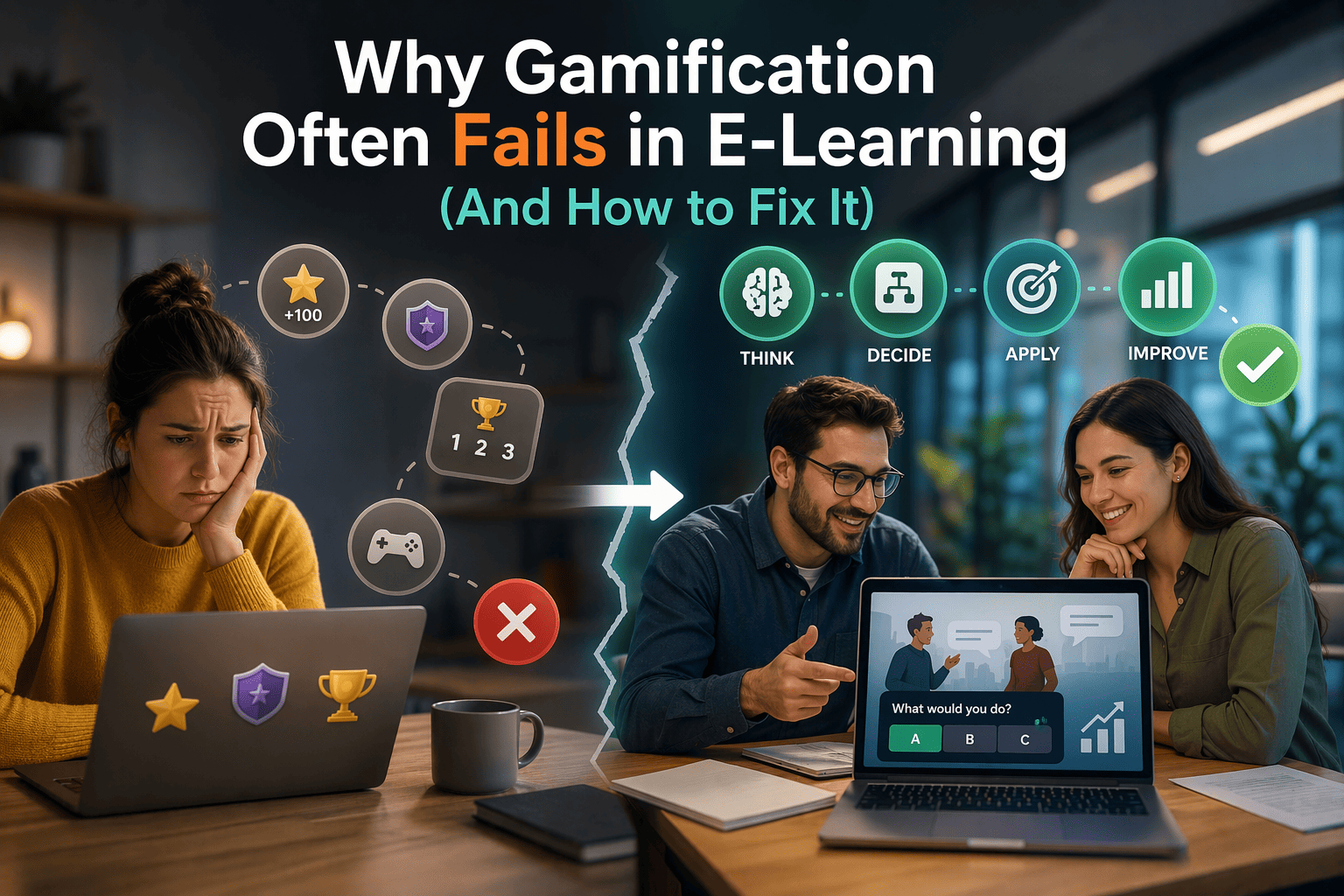
Why Gamification Often Fails in E-Learning (And How to Fix It) From engagement to real learning with AI-native interactive design
Gamification has become a staple in digital learning.
Points. Badges. Leaderboards. Mini-games.
On paper, it works. Engagement goes up. Completion rates improve. Learners interact more.
And yet… something is off.
Learners are active—but not necessarily learning.
This is the paradox of modern e-learning:
👉 we’ve optimized for engagement, not for thinking.
The issue isn’t gamification itself.
It’s how we design it.
The Real Problem: Mixing Different Types of Gamification
Not all gamification is equal.
In fact, most learning experiences confuse three very different layers—each with a very different impact on learning.
1. Motivational Gamification (Engagement Layer)
Points. Badges. Leaderboards. Rewards.
Goal: Engage
⚠️ Risk: Engagement without learning
2. Interactive Gamification (Activity Layer)
Quizzes. Clicks. Mini-games.
Goal: Make learners active
⚠️ Risk: Activity without thinking
3. Cognitive Gamification (Learning Layer)
Scenarios. Decisions. Consequences. Simulations.
Goal: Make learners think
✅ This is where:
👉 the move = the skill
Why Most E-Learning Fails
Most courses combine:
• motivation
• interaction
But stop before cognition.
👉 Learners engage
👉 Learners interact
❌ Learners don’t transfer knowledge
Because they never had to think.
The Shift: From “Fun Learning” to “Thinking Learning”
Gamification should not make learning more entertaining.
It should make thinking unavoidable.
A well-designed learning experience ensures:
• Progress = applying knowledge
• Success = making decisions
• Feedback = understanding consequences
The Real Breakthrough: Vibe Coding Changes Gamification
This is where things fundamentally change.
Until recently, cognitive gamification was hard to build.
Why?
Because it required:
• complex branching logic
• manual scenario design
• technical authoring skills
• long production cycles
👉 So most teams stayed at:
• quizzes
• simple interactions
• surface-level gamification
What is Vibe Coding for Interactive Learning?
👉 Vibe coding for interactive learning is a new paradigm.
Instead of building interactions manually, you:
• describe the learning objective
• define the decisions learners must take
• specify the real-world context
👉 And the system generates:
• the scenario
• the branching logic
• the interactions
• the feedback loops
This is exactly the type of approach enabled by AI-native platforms like Mexty.
From “Building Games” to “Designing Thinking Systems”
This is a massive shift.
Before:
👉 You built screens, triggers, buttons
Now:
👉 You design thinking experiences
With interactive course creation powered by vibe coding on platforms like Mexty, you can:
• turn knowledge into decisions
• turn content into scenarios
• turn learning into action
👉 The game is no longer a layer.
It becomes the structure of learning.
Why Vibe Coding Solves the Gamification Problem
Vibe coding directly addresses the core issue:
👉 It makes cognitive gamification scalable.
1. It forces “move = skill” by design
When you generate a scenario, the learner must:
• analyze
• decide
• apply
👉 There is no shortcut.
2. It removes production constraints
Before:
• building one good scenario = hours or days
Now:
• generating multiple scenarios = minutes
👉 This allows:
• repetition
• variation
• deeper learning
3. It enables adaptive gamification
With an AI-native interactive learning platform like Mexty, you can:
• adjust difficulty dynamically
• personalize scenarios
• adapt learning paths
👉 Gamification becomes intelligent, not static.
4. It connects gamification with assessment
Traditional gamification:
👉 rewards behavior
Vibe-coded gamification:
👉 evaluates thinking
You can:
• detect knowledge gaps
• analyze decisions
• generate remediation
👉 Gamification becomes a measurement tool, not just engagement.
Vibe Coding for SCORM Interactive Courses
One of the biggest barriers to innovation used to be integration.
But with vibe coding for SCORM interactive courses using platforms like Mexty, you can:
• generate advanced scenarios
• export them as SCORM-compatible modules
• deploy instantly in any LMS
👉 No compromise between innovation and compatibility.
Why This Matters for Modern Learning Teams
Teams looking for:
• Articulate Storyline alternatives
• Genially alternatives
• iSpring alternatives
are not just looking for easier tools.
👉 They are looking for a different model.
A model where:
• creation is faster
• interactivity is deeper
• learning is measurable
The New Standard: Cognitive-First Learning Design
The best learning experiences now follow a new rule:
👉 Start with cognition, not content.
Instead of asking:
• “What slides do we need?”
You ask:
• “What decisions should learners make?”
And with vibe-coding approaches powered by tools like Mexty, you can turn that into reality instantly.
The Future of Gamification
The future is not:
❌ more points
❌ more badges
❌ more mini-games
It is:
✅ more decisions
✅ more consequences
✅ more thinking
Final Thought
Gamification should not decorate learning.
It should structure cognitive effort.
And for the first time, with AI-native tools like Mexty and vibe coding:
👉 we can actually build it at scale.
Otherwise?
👉 We’re not optimizing learning.
We’re just optimizing the game.
About Mexty
Mexty is an AI-native interactive learning platform designed to help teams move beyond slide-based learning and build real learning experiences faster.
From interactive course creation with vibe coding to fully SCORM-compatible deployment, Mexty enables a new approach to e-learning—focused on thinking, not just clicking.
👉 Discover why Mexty is becoming one of the Best Elearning Authoring Tools 2026. 🚀
If you enjoyed this, you’ll love our next articles