
Why Every Fresh Learning Designer Needs a Portfolio
Why Every Fresh Learning Designer Needs a Portfolio, and How to Build One with Mexty
Starting a career in learning design can feel like a paradox: you need experience to get opportunities, but you need opportunities to gain experience.
A degree, certificate, or training program proves that you have studied the theory. Employers and clients, however, usually want something more concrete. They want proof that you can design learning. That proof is your learning design portfolio.
A strong portfolio is not simply a website, a collection of screenshots, or a folder of certificates. It shows how you analyse a learning problem, structure information, create practice, design feedback, assess performance, and help learners move from knowledge to action.
For fresh instructional designers, learning designers, trainers, teachers, and L&D professionals, a portfolio can become the bridge between potential and opportunity. is helping new designers build that bridge by offering them the opportunity to create their first portfolio for free using an AI-native platform for creating interactive learning experiences.
What Is a Learning Design Portfolio?
A learning design portfolio is a curated collection of projects that demonstrates your ability to design effective learning experiences. It shows both what you created and why you designed it that way.
A good portfolio explains:
· the learning problem you wanted to solve;
· the target learners and their needs;
· the desired change in knowledge, behaviour, or performance;
· the learning objectives and design approach;
· the activities, feedback, and assessment choices;
· what you learned and what you would improve.
A gallery shows outputs. A portfolio shows thinking.
Your first portfolio does not need real client projects. Fictional but realistic projects are perfectly valid when they demonstrate sound learning design decisions. You might create an onboarding course, cybersecurity module, customer-service scenario, compliance activity, leadership role-play, product knowledge course, AI literacy module, or safety simulation.
Why a Portfolio Matters More Than Ever
The L&D market has changed. Many candidates now have certificates and access to AI tools, so qualifications alone are rarely enough to stand out. Employers want evidence of what you can actually do.
A portfolio helps hiring managers evaluate your practical skills, design judgement, visual communication, understanding of learner needs, and ability to connect objectives with activities and assessment.
Instead of saying, “I know instructional design,” you can show a scenario-based activity, explain how its assessment aligns with the objective, demonstrate how you converted a policy into an interactive course, and describe how you designed feedback to improve performance.
Building projects also develops confidence. You stop seeing yourself only as a student and begin thinking like a designer. You make decisions, test ideas, reflect on the results, and create visible proof of your ability.
This matters even more in the age of AI. AI can generate content, outlines, and basic quizzes quickly. The distinctive value of a learning designer is the ability to create relevant, structured, interactive, and effective learning experiences. Your portfolio should make that value visible.
What should a Fresh Learning Designer Include ?
You do not need twenty projects. Three to five strong examples are usually enough. Each project should briefly present the challenge, audience, objective, design approach, final output, and your reflection.
1. An Interactive Course
Every portfolio should include at least one complete digital learning module, such as onboarding, compliance, product training, or workplace skills. With as an Interactive Course Creator, you can combine structured content, activities, questions, feedback, and learner interaction in one coherent experience.Mexty
A particularly useful example is to Convert PDF to interactive course. Organisations often have long policies, manuals, and procedures that learners struggle to use. Transforming one of these documents into an engaging course demonstrates a practical workplace skill.
2. A Branching Scenario
Branching scenarios demonstrate your ability to design realistic decisions, consequences, and feedback. A learner might handle a customer complaint, respond to a cybersecurity risk, manage a workplace conflict, or follow a safety procedure.
helps simplify branching scenario creation by helping you structure the situation, choices, feedback, and learning logic. This shows that you can design practice, not just information.Mexty
3. An Assessment Example
A good portfolio should show that you can assess the intended skill. If the objective is to handle customer complaints, the assessment should require decisions in a realistic situation, not merely ask learners to define customer service.
With , you can create quizzes, scenario-based questions, evaluations, and feedback activities that demonstrate alignment between objectives, practice, and assessment.Mexty
4. A Learning Path
A learning path combines courses, activities, and assessments into a structured journey. You could design one for employee onboarding, new managers, sales readiness, AI literacy, or compliance. This proves that you can think beyond a single module and organise learning over time.
5. A Job Aid
Not every performance problem requires a course. A checklist, guide, decision tree, template, or quick-reference resource may be more useful. Including a job aid shows that you focus on solving the problem rather than automatically creating training.
How Mexty Helps You Build a Strong Portfolio
helps learning teams create, deliver, track, and improve interactive learning experiences from trusted sources of truth. For fresh designers, it provides a practical way to build professional examples without advanced technical skills or a complex authoring workflow.Mexty
As an AI authoring tool for L&D, goes beyond basic content generation. It helps you structure courses, create interactivity, build assessments, design learning paths, and prepare SCORM-compatible content for real learning environments.Mexty
You can create interactive courses without coding and focus on what matters most: the objective, learner journey, activity design, feedback, and quality of the experience. This also makes an easy interactive course builder for people who are just starting.
Mexty Portfolio projects can include:
· interactive courses and scenario-based learning;
· quizzes, evaluations, and role-play simulations;
· learning paths and AI-supported activities;
· SCORM-compatible examples for LMS delivery.
SCORM compatibility is valuable because many organisations still rely on LMS platforms for delivery, tracking, and reporting. A SCORM-compatible portfolio project shows that your work is not only creative but also workplace-ready.
From Content to Real Learning Experiences
A common beginner mistake is to show only content: a slide deck, a few screens, a quiz, or a certificate. Learning design is not simply information delivery. It should help people change what they know, do, or decide.
With , learners can make choices, answer questions, explore scenarios, receive feedback, and progress through a structured journey. This interactive learning without technical complexity lets fresh designers demonstrate genuine learning design rather than static content production.Mexty
The platform does not replace your judgement. You still decide what learners need to practise, which mistakes are likely, what feedback will help, and how the experience should support improvement. removes technical friction so you can focus on those decisions.Mexty
Building a Portfolio with responsible AI
AI can support a fresh learning designer, but a portfolio should not look like a collection of generic AI-generated courses. It should demonstrate your judgement and your ability to review, edit, validate, and improve the output.
supports knowledge bases and source-of-truth content, helping designers create learning experiences from approved documents, validated information, and internal expertise. This encourages accurate, relevant, and trustworthy course creation.Mexty
You can use AI to clarify objectives, organise content, generate scenario ideas, draft feedback, create question options, improve wording, and adapt content to different learners. You remain responsible for the final learning design. That is the difference between using AI as a shortcut and using it as a professional design partner.
A Simple Portfolio Structure
· Homepage: introduce yourself and the learning problems you want to solve.
· Project 1 - Interactive course: present the objective, audience, structure, output, and design decisions.
· Project 2 - Branching scenario: explain the situation, choices, consequences, and feedback logic.
· Project 3 - Assessment: show how the assessment measures the learning objective.
· Project 4 - Learning path: demonstrate how several learning elements work together.
· Reflection: explain what you learned, what you would improve, and how you would measure success.
This structure helps employers understand both your output and your process.
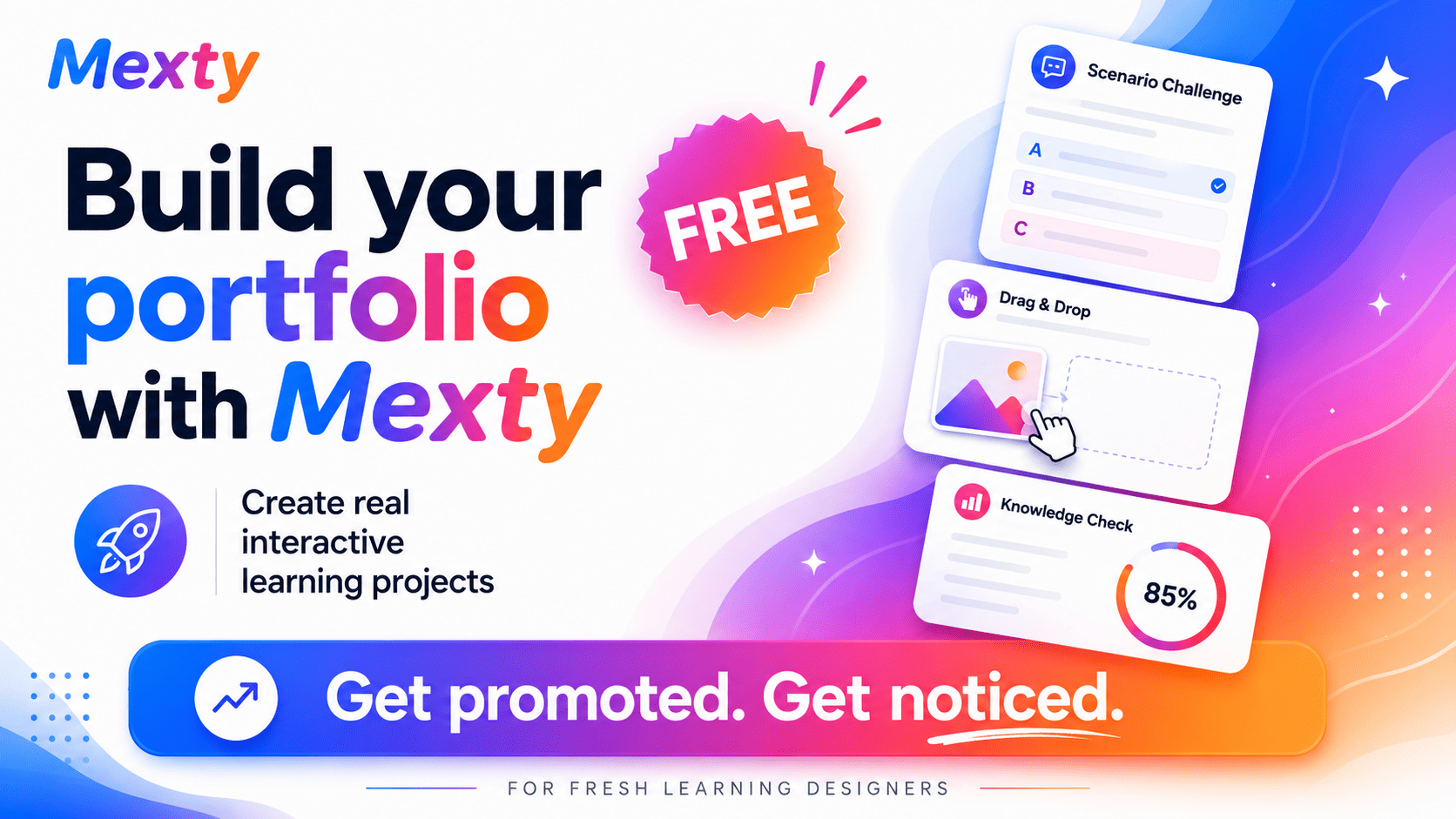
Mexty’s Free Offer for Fresh Learning Designers
Fresh learning designers deserve more than advice. They deserve an opportunity to build real proof of their skills.
is therefore offering new instructional designers, learning designers, trainers, teachers, and L&D professionals the opportunity to build their first professional portfolio for free.
You can create real interactive learning projects rather than static screenshots: courses, branching scenarios, assessments, learning paths, and SCORM-compatible examples. will also support selected designers in promoting their portfolios and sharing their work
The goal is to help you move from “I do not have enough experience” to “Here is what I can create.”
Final thoughts
A learning design portfolio proves your skills, reveals your thinking, makes your value visible, and gives employers and clients a reason to trust you. More importantly, building it makes you a better designer.
Through portfolio projects, you practise the real work: analysing needs, defining objectives, structuring content, creating activities, designing feedback, building assessments, and improving the learner experience.
As an AI-Native secure Learning Infrastructure, helps fresh designers create professional, interactive, and practical learning examples without unnecessary complexity.Mexty
Do not wait for permission to prove what you can do. Build your portfolio. Show your thinking. Create real interactive learning experiences. Get visible. With , you can start for free.Mexty
If you are fresh learning designer and interested, please contact marva.okili@mexty.ai
If you enjoyed this, you’ll love our next articlesNo Portfolio MextyYet? Is Offering New Instructional Designers a Free Way to Build One |