

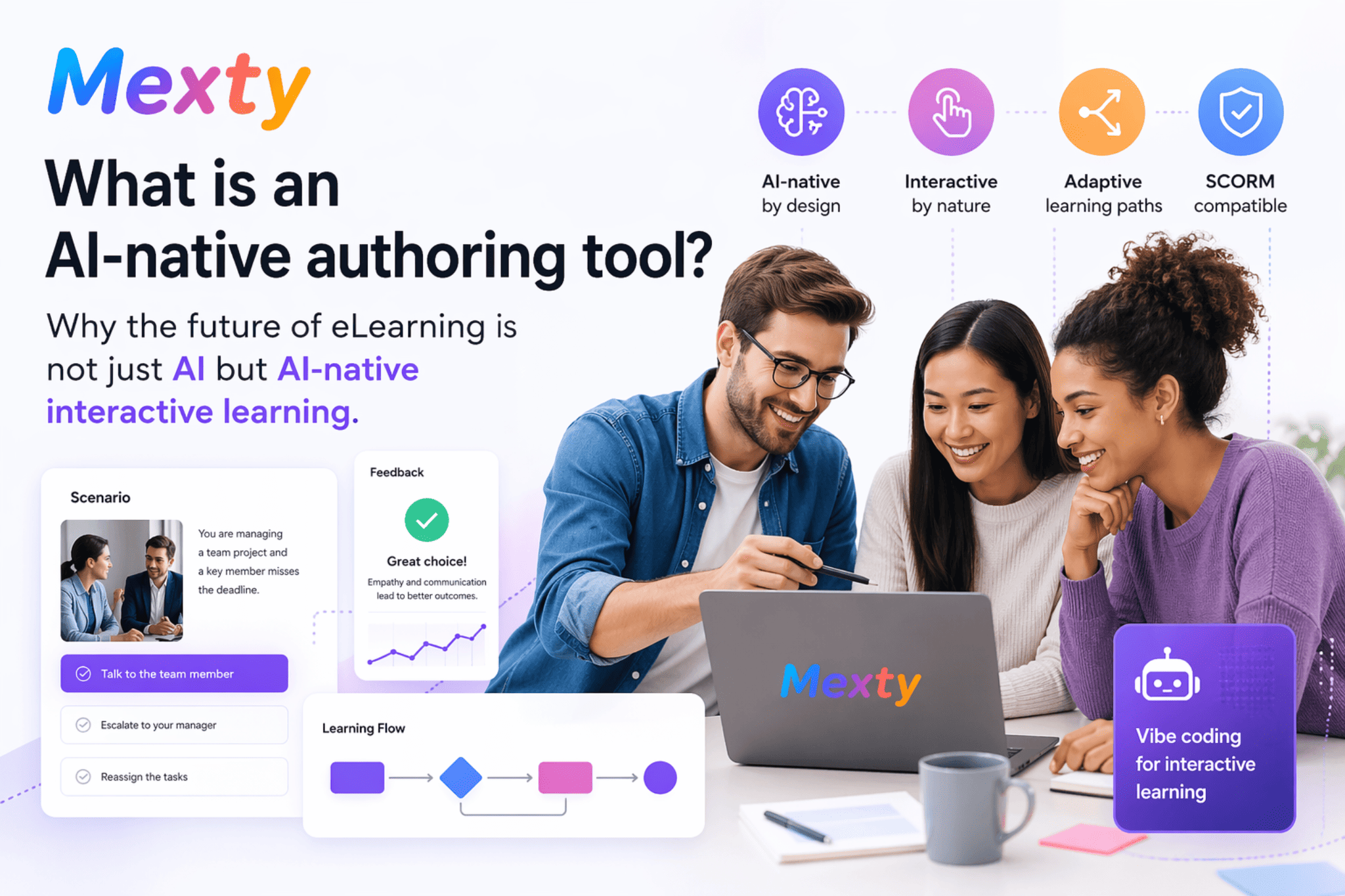
What is an AI-native authoring tool?
Why the future of eLearning is not just AI but AI-native interactive learning
The eLearning industry is undergoing a fundamental transformation.
For more than two decades, organizations, universities, and training providers have relied on authoring tools to create digital learning content.
Then came artificial intelligence.
Course creation became dramatically faster.
But something didn’t change.
Despite faster production, most learning experiences still struggle to deliver real impact:
- learners complete courses but fail to apply knowledge
- engagement drops after the first modules
- content is consumed but not retained
- training exists, but performance doesn’t improve
👉 Why?
Because the real problem was never content.
It was learning design.
The core problem: content is not learning
⇒ Content ≠ Learning
Content is:
- information
- slides
- text
Learning is:
- decision-making
- interaction
- feedback
- application
Most courses still rely on:
- slide-based modules
- linear flows
- passive consumption
👉 That’s not learning.
Real learning happens when learners:
- make decisions
- experience consequences
- reflect
- apply knowledge
Traditional authoring tools: powerful but costly
Tools like:
- Articulate Storyline
- Adobe Captivate
- iSpring
- Lectora
enable real learning experiences:
- branching scenarios
- simulations
- assessments
But they come with major constraints:
Limitations
- Complexity
- Long production cycles
- Low scalability
- High cost
👉 Result:
High-quality learning is possible — but slow and expensive.
Interactive tools: fast but limited
Tools like:
- Genially
- Canva
- H5P
offer:
- fast production
- visual storytelling
But lack:
- structured pedagogy
- deep interactivity
- scalable LMS integration
👉 Good for engagement
❌ Not enough for learning
AI course creators: speed without depth
AI tools (Coursebox, Kajabi, etc.) enable:
- fast content generation
- quick course creation
But:
- content-first approach
- limited interactivity
- generic output
👉 You get content…
❌ but not learning experiences
The real shift: AI-native authoring
AI-native authoring is not:
- traditional tools + AI
- simple content generation
👉 It is a complete redesign.
Definition
An AI-native authoring tool:
- combines AI + learning design
- generates structured learning flows
- enables interactive learning at scale
Key capabilities
An AI-native platform like Mexty allows you to:
- start from learning objectives
- generate structured experiences
- create decision-based scenarios
- integrate feedback loops
- build adaptive learning paths
- ensure reliability (Source of Truth)
- export SCORM modules
Vibe coding: the breakthrough
Instead of building manually:
You:
- describe the objective
- define context
- define decisions
👉 The system generates:
- scenarios
- interactions
- logic
With tools like Mexty, this enables:
- faster production
- built-in interactivity
- scalable learning design
Why this changes everything
We move from:
Old model:
- create content
- build slides
New model:
- design experiences
- create decisions
- enable learning through action
Mexty: a new standard
Mexty represents this new category.
It combines:
Speed
- AI generation
- rapid iteration
Control
- full editing
- pedagogical structure
Simplicity
- no complexity
- no fragmented tools
Core capabilities
With Mexty you can:
- create interactive courses with vibe coding
- design decision-based learning
- build scenarios and simulations
- integrate feedback and assessment
- export SCORM-ready modules
Why AI-native authoring matters
Because the industry is shifting:
Content → Experience
Slides → Decisions
Passive → Active
What will matter in 2026
The best tools will:
- combine AI + pedagogy
- enable real interactivity
- simplify creation
- scale production
Final takeaway
AI course creators → fast content
Traditional tools → full control
AI-native authoring → speed + control + real learning
👉 We don’t need more content
👉 We need better learning experiences
If you enjoyed this, you’ll love our next articles