

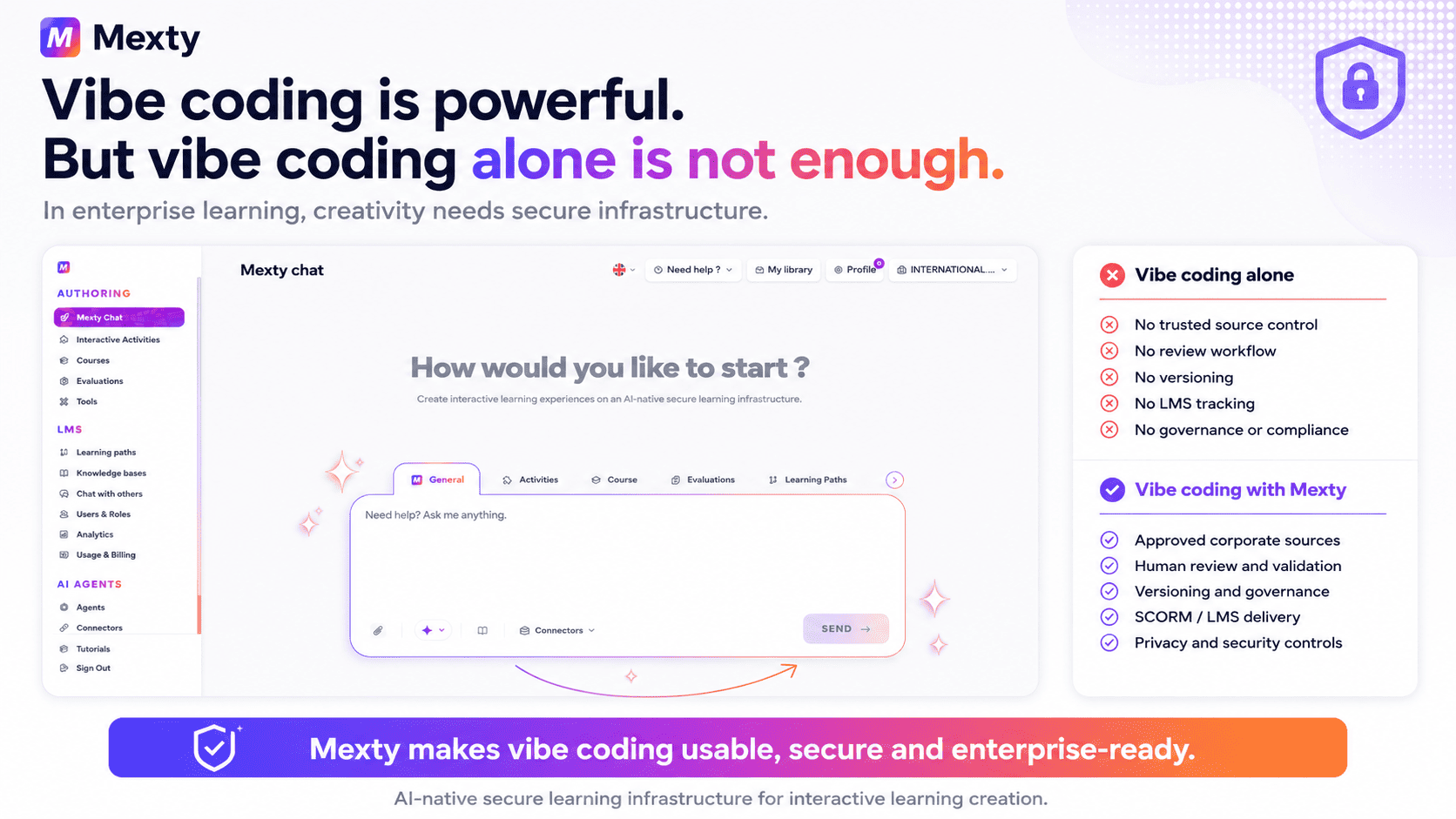
Vibe Coding Is Powerful. But Vibe Coding Alone Is Not
Enough for Enterprise Learning
Vibe coding is one of the most
exciting shifts happening in digital learning today.
For years, learning designers,
instructional designers, trainers, and L&D teams have had creative ideas
that were difficult to bring to life. They could imagine a branching scenario,
an interactive simulation, a decision-based activity, a microlearning
refresher, or a more engaging assessment. But turning those ideas into a real
learning experience often required complex authoring tools, technical skills,
long production cycles, and multiple handoffs between learning, design,
development, and LMS teams.
That is why vibe coding feels so
powerful.
Instead of starting with tool
constraints, the learning designer can start with an intention:
“Create a scenario where a manager
must respond to a difficult feedback conversation.”
“Turn this compliance policy into a
5-minute interactive microlearning module.”
“Build a branching activity where a
sales representative chooses how to respond to a customer objection.”
“Convert this PDF to an interactive
course with knowledge checks, feedback, and practical examples.”
“Create a SCORM-compatible
refresher module for onboarding.”
This is a major change. Vibe coding
for interactive learning allows learning teams to express the experience they
want and let AI help generate the first version. It can reduce friction, speed
up production, and open creative possibilities that were previously blocked by technical
complexity.
But there is a problem.
In enterprise learning, vibe coding
alone is not enough.
Why vibe coding is so attractive for L&D teams
Most L&D teams are under
pressure.
They need to create more learning
content. They need to update training faster. They need to support onboarding,
compliance, product training, sales enablement, leadership development,
customer education, and internal knowledge sharing. They also need to make
learning more engaging, more measurable, and more relevant to real work.
At the same time, many teams still
rely on fragmented workflows.
A policy starts in a PDF. A course
is built in PowerPoint. Interactions are developed in a complex authoring tool.
The final module is exported to SCORM. Updates require going back to the
original file, making changes, re-exporting, re-uploading, and hoping the right
version is live in the LMS.
For many organizations, this
process is slow and fragile.
This is why vibe-coding for
eLearning is appealing. It promises a simpler way to move from idea to
experience. It gives learning designers a faster way to prototype. It can help
create interactive courses without coding. It can simplify branching scenario
creation. It can reduce the dependency on complex authoring workflows.
Instead of spending hours
configuring screens, buttons, interactions, and branching logic, designers can
describe what they want to achieve.
This does not remove the need for
instructional design. On the contrary, it makes instructional design more
important. AI can help produce, but humans still need to decide whether the
experience supports learning, practice, transfer, and performance.
The limitation of vibe coding alone
The challenge is that many vibe
coding workflows are still isolated experiments.
They happen in a prompt box.
They happen outside the official
learning workflow.
They happen outside approved
company sources.
They happen outside review and
validation.
They happen outside version
control.
They happen outside LMS tracking.
They happen outside compliance
governance.
This may be fine for
experimentation. It is not enough for enterprise learning.
In a corporate environment,
learning content is not just creative material. It often includes
business-critical knowledge, regulatory expectations, product information,
safety rules, customer-facing processes, HR policies, cybersecurity procedures,
or compliance obligations.
That changes everything.
A learning module is not useful if
the source is wrong.
A scenario is risky if nobody reviews
it.
An assessment is weak if it
measures the wrong behavior.
A simulation can mislead learners
if it is not grounded in real work.
A course becomes difficult to
manage if nobody knows which version is current.
A SCORM package creates operational
risk if it cannot be traced, updated, or audited.
An AI workflow is not
enterprise-ready if it ignores privacy, security, data protection, and
governance.
This is why vibe coding needs
infrastructure.
Enterprise learning needs more than fast content generation
There is a big difference between
generating content and managing learning.
An AI content generator may help
create text, slides, quizzes, or summaries. That can be useful. But enterprise
learning requires much more than fast generation.
Enterprise teams need to know where
the content comes from. They need to review and edit outputs. They need to
validate learning activities before publication. They need to track what
learners completed. They need to export content to an LMS. They need to manage
versions. They need to update learning when policies, products, or regulations
change. They need to prove what was published and when. They need to protect
learner and company data.
In other words, the question is not
only:
“Can AI generate a course?”
The real questions are:
Can we trust the source?
Can we edit the output?
Can we validate the content before
learners see it?
Can we export it as
SCORM-compatible content?
Can we track learner progress?
Can we manage versions and updates?
Can we audit the workflow?
Can we protect privacy and
security?
Can we align with GDPR, the EU AI
Act, and enterprise governance expectations?
This is where the conversation must
move beyond AI content generation.
The future is not just an AI
authoring tool for L&D. The future is an AI-Native secure Learning
Infrastructure.
What AI-native secure learning infrastructure means
An AI-Native secure Learning
Infrastructure is not just a tool that generates learning content. It is a
controlled environment where learning teams can create, edit, deliver, track,
and govern interactive learning experiences.
It connects AI generation with the
real needs of enterprise learning.
That means learning teams can start
from trusted sources of truth, such as company policies, procedures, product
documentation, compliance manuals, onboarding guides, knowledge bases, or
approved PDFs.
They can use AI to generate
interactive learning experiences, but the workflow does not stop at generation.
The output can be reviewed, edited, validated, versioned, exported, delivered,
tracked, and improved.
This is the difference between a
standalone prompt and a learning infrastructure.
A prompt can generate an idea.
An infrastructure can support a
workflow.
A prompt can create content.
An infrastructure can manage
learning.
A prompt can produce a draft.
An infrastructure can help ensure
that the final experience is secure, compliant, traceable, and usable in a real
enterprise environment.
Why Mexty is
designed differently
At Mexty, we believe vibe coding is powerful. But
we also believe that vibe coding must be grounded in secure, enterprise-ready
workflows.
Mexty is designed as an AI-native platform for
creating interactive learning experiences, but not as a simple AI content
generator. It is built as an AI-Native secure Learning Infrastructure for
enterprise learning teams.
The goal is to help teams move from
complex workflows to interactive learning in minutes, without losing control.
With Mexty, learning designers can start from
approved corporate requirements and trusted sources. They can describe the
learning experience they want. They can generate interactive courses,
microlearning modules, branching scenarios, assessments, simulations, and
learner support experiences. They can edit everything manually. They can review
and validate outputs. They can export SCORM-compatible content or deliver
learning through an LMS-ready authoring platform. They can track learners,
manage versions, and maintain governance over time.
This is what makes Mexty different.
It is not only about faster
production.
It is about secure interactive
learning creation.
It is about giving learning
designers more creative power while keeping enterprise requirements inside the
workflow.
Vibe coding should start from trusted sources
One of the biggest risks with
AI-generated learning is that the output may sound confident but be wrong,
incomplete, outdated, or disconnected from the organization’s actual rules.
This is why trusted sources of
truth matter.
Enterprise learning should not be
generated from generic knowledge when the subject depends on company-specific
policies, processes, products, or compliance requirements.
For example, if a company wants to
train employees on cybersecurity awareness, sales processes, customer support,
HR rules, safety procedures, or product knowledge, the learning experience must
be grounded in approved internal content.
This is where Mexty’s approach
is important.
Vibe coding for SCORM interactive
courses should not begin with an empty prompt. It should begin with corporate
requirements, approved documentation, and reliable knowledge.
This helps learning designers
create content that is not only interactive and engaging, but also accurate and
aligned with the organization.
Human review is not optional
AI can accelerate the first draft.
But it should not be the final judge.
In learning, quality depends on
context, learner needs, cognitive load, practice design, feedback, assessment
validity, and transfer to real work. These are human design responsibilities.
A scenario may be technically
interactive but pedagogically weak.
A quiz may be well written but
measure only recall.
A simulation may be engaging but
unrealistic.
A microlearning module may be short
but not useful.
This is why human review and manual
editing are essential.
Mexty is designed to support human-in-the-loop
workflows. Learning designers can generate content, then review, refine, edit,
and validate it before publishing. This keeps the designer in control.
AI accelerates the workflow.
The learning designer protects the
learning quality.
SCORM and LMS delivery still matter
Some people talk about AI learning
tools as if the LMS no longer matters.
But in enterprise learning, LMS
delivery is still essential.
Organizations need to assign
training, track completion, record scores, manage compliance, and report
learning activity. For many companies, SCORM-compatible content remains a
practical requirement.
That is why vibe coding must
connect to real deployment workflows.
It is not enough to create an
impressive interaction if it cannot be delivered, tracked, or reused inside the
existing learning ecosystem.
Mexty supports this need by helping teams
create SCORM-compatible learning experiences and manage LMS-ready workflows. It
can act as an AI-native SCORM authoring platform for interactive learning
creation, while also supporting broader learning delivery and tracking.
This matters because enterprise
learning is not only about creation. It is also about deployment, measurement,
and accountability.
Governance makes AI learning enterprise-ready
AI in learning creates new
opportunities, but also new responsibilities.
Organizations need to know how AI
was used. They need to know what sources were used. They need to know who
reviewed the output. They need to know which version was published. They need
to know whether learners were supported, assessed, and tracked appropriately.
This requires governance.
Versioning, review, validation,
auditability, privacy, and security are not secondary features. They are part
of what makes AI-powered learning acceptable in enterprise environments.
That is why a secure AI authoring
platform must include more than generation. It must include workflows that help
organizations maintain control over learning content and learner data.
For Mexty, this is central. The platform is
designed to support trusted sources, human validation, secure workflows,
SCORM/LMS delivery, tracking, version management, and governance.
This is also why privacy-first
design matters. A GDPR-compliant AI learning platform must help organizations
use AI responsibly, with appropriate controls around data protection, learner
information, and enterprise security expectations.
AI is pushing learning back to what matters
There is another reason vibe coding
is important.
It may help our industry move away
from some of the wrong priorities.
For too long, eLearning production
has often been dominated by slides, templates, tool constraints, and
development complexity. Teams spent huge amounts of time building screens
instead of designing meaningful practice.
AI changes that.
If AI can help with production,
learning designers can spend more time on the things that matter:
What behavior should change?
What decision should learners
practice?
What feedback will help them
improve?
What scenario reflects the reality
of their work?
What assessment will show real
understanding?
What support will help them apply
learning on the job?
What data will help improve the
learning experience over time?
This is the real opportunity.
Vibe coding is not valuable because
it makes more content possible.
It is valuable because it can make
better learning experiences easier to create.
But only if it is supported by the
right infrastructure.
From complex workflows to interactive learning in
minutes
The promise of AI in eLearning is
not to replace instructional designers. It is to remove unnecessary friction
from their work.
Learning designers should not be
trapped by technical complexity. They should not need to choose between
creativity and compliance. They should not have to sacrifice governance to move
faster.
They should be able to create
interactive courses without coding. They should be able to simplify
instructional design workflows. They should be able to replace complex
authoring workflows when those workflows slow down learning innovation. They
should be able to build scenarios, assessments, microlearning, and simulations
from trusted corporate sources. They should be able to export, track, version,
and govern their work.
This is the future Mexty is
building toward.
An easy interactive course builder
is useful.
A SCORM authoring tool is useful.
An AI authoring tool for L&D is
useful.
But enterprises need more than
isolated tools.
They need an AI-native LMS and
authoring platform that connects creation, delivery, tracking, review,
governance, and security.
Vibe coding opens the creative door. Infrastructure
makes it enterprise-ready.
Vibe coding is powerful.
It helps learning designers move
faster. It opens new creative possibilities. It makes interactive learning
easier to imagine and build. It can help simplify eLearning workflows and
reduce the technical barriers that have slowed down digital learning for years.
But vibe coding alone is not
enough.
Without trusted sources, it can
produce unreliable content.
Without human review, it can create
weak learning experiences.
Without SCORM and LMS integration,
it can remain disconnected from enterprise delivery.
Without versioning, it becomes hard
to maintain.
Without auditability, it becomes
difficult to govern.
Without security and privacy
controls, it is not enterprise-ready.
This is why Mexty combines
vibe coding with an AI-Native secure Learning Infrastructure.
Because the future of eLearning is
not just faster content generation.
It is interactive learning creation
with trusted sources, human review, SCORM/LMS delivery, analytics, versioning,
governance, privacy, and compliance.
Vibe coding opens the creative
door.
AI-native secure learning
infrastructure makes it usable for real enterprise learning.
That is the difference.
If you enjoyed this, you’ll love our next articlesHow to Build an Onboarding Training Program with Mexty V3 |