
The Future of AI in Learning Is Not One Tool. It Is One Connected Infrastructure.
The future of AI in learning will not be one tool trying to do everything.
That idea may sound attractive at first : one AI tool to write content, generate visuals, create voiceovers, build scenarios, design assessments, answer learner questions, export SCORM, track progress, and keep everything aligned with internal knowledge.
But in reality, learning workflows are too complex for a single model or isolated tool to handle well.
Modern learning creation is no longer just about writing text. It increasingly combines trusted knowledge, instructional design, scenario writing, interaction design, visual creation, voice, feedback, assessment, learner support, analytics, and LMS delivery.
Different AI models are better at different tasks. Some are stronger for structured reasoning. Some are better at creative ideation. Some perform well with long documents. Some are better for visual generation, audio, translation, or interaction logic.
This is why the future of learning technology is not “one AI model to rule them all.”
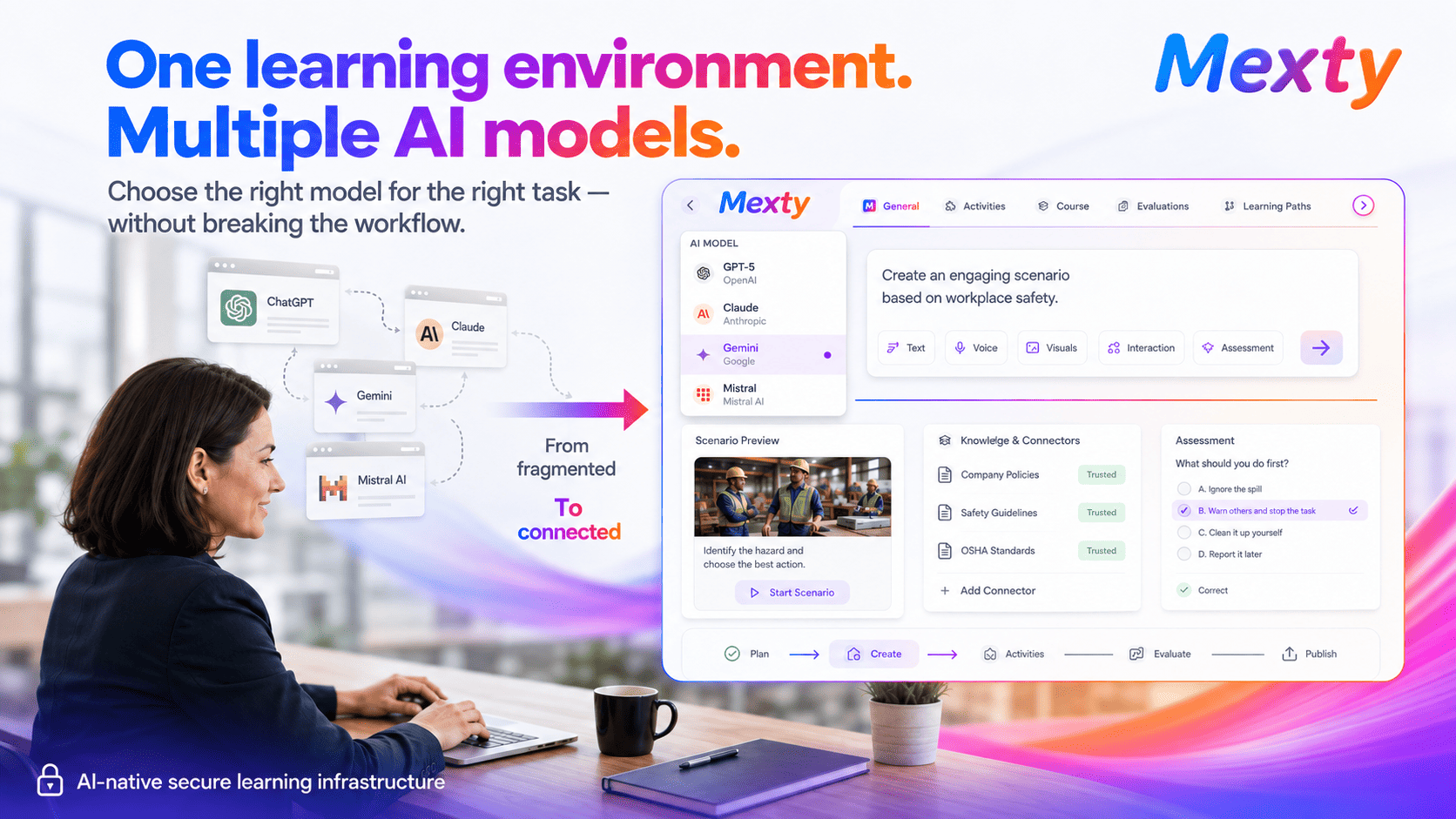
The future is an AI-Native secure Learning Infrastructure that connects the right models, the right tools, the right knowledge sources, and the right governance inside one learning workflow.
That is the shift Mexty is building toward.
The problem with isolated AI tools
Most L & D teams are already using AI, but often in a fragmented way.
One subscription for text generation.
Another tool for images.
Another for voice.
Another for video.
Another for quizzes.
Another for translation.
Another for SCORM export.
Another for LMS delivery.
Another for analytics.
Each tool may be useful on its own. But together, they create a new kind of complexity.
The instructional designer writes content in one place, exports it, edits it somewhere else, generates visuals in another tool, creates voiceovers elsewhere, builds activities in another platform, uploads the final result to an LMS, then manually tracks results and updates the course later.
Every handoff creates friction.
Every export creates risk.
Every login fragments the workflow.
Every disconnected tool makes governance harder.
For individual experimentation, this may be manageable. But for enterprise learning teams, it quickly becomes a problem. Organizations need consistency, traceability, privacy, security, version control, source alignment, validation, and learner tracking.
The real value is not another subscription for another AI tool. The real value is one connected environment where the whole learning workflow can happen.
Why different models matter
No single AI model is best at everything.
A learning team may need one model to analyze a long policy document, another to generate scenario ideas, another to refine tone, another to support multilingual output, another to help structure assessments, and another to support a learner-facing AI agent.
This is not a weakness. It is simply how AI is evolving.
The question is not : “ Which model should we use for everything ? ”
The better question is : “ How do we give learning teams access to the right model for the right task without breaking the workflow ? ”
That is where an AI-native platform for creating interactive learning experiences becomes important.
Instead of forcing creators to jump between tools, copy and paste outputs, or manage disconnected subscriptions, a connected learning infrastructure can give teams access to multiple models within the same environment.
The creator stays inside the workflow.
The content stays connected to the source.
The output remains editable and reviewable.
The organization keeps control.
The learner experience stays consistent.
This is the real value of multi-model learning infrastructure.
From AI tools to AI-native workflows
Using AI inside learning is not the same as building an AI-native learning workflow.
A traditional workflow looks like this :
Write the content.
Create slides.
Build the course.
Export it.
Upload it.
Track completion.
Update manually when needed.
AI can speed up parts of that process, but if each step remains disconnected, the workflow itself does not fundamentally improve.
An AI workflow for instructional design should do more than generate text. It should connect the full learning lifecycle :
source material ;
course structure ;
interactive activities ;
scenario design ;
assessment ;
manual review ;
versioning ;
learner support ;
delivery ;
analytics ;
updates.
This is how AI can Simplify eLearning workflow and reduce the complexity that has traditionally slowed down learning teams.
The goal is not simply faster content. The goal is a better system.
Why trusted knowledge must be connected
Enterprise learning cannot rely on generic AI output.
Training content is often based on internal policies, product documentation, procedures, compliance rules, onboarding guides, knowledge bases, and expert input. If an AI tool invents information or uses outdated assumptions, the risk can be significant.
This is why trusted sources matter.
A modern Secure AI authoring platform should allow creators to work from approved materials and keep generated content aligned with those sources.
When learning teams create a course, scenario, assessment, or AI agent, they need confidence that the output is grounded in the right knowledge.
This is also where MCP-style connections become valuable. By connecting external tools, documents, databases, and knowledge systems into the learning workflow, AI can become more useful without becoming uncontrolled.
The point is not to let AI access everything.
The point is to connect the right knowledge, in the right context, with the right permissions, inside a governed workflow.
The role of governance
AI in enterprise learning needs more than creativity. It needs governance.
Who approved the source ?
Who reviewed the generated content ?
Which model was used ?
What version was published ?
Can the content be edited manually ?
Can the organization trace what changed ?
Can the learner - facing AI agent stay within approved knowledge ?
Can the course be updated when the source changes ?
These questions are not secondary. They are central to responsible AI adoption in learning.
That is why Mexty is designed as a Trusted AI authoring platform, not just a content generator.
An AI-native learning environment should make it easier to create, but also easier to control. Human review, editing, validation, versioning, and governance must stay inside the workflow.
AI should accelerate learning creation, not remove responsibility from it.
Why interactivity changes the value of AI
A lot of AI tools focus on generating content. But learning is not just content.
Learning happens when people act, decide, practice, explain, fail safely, receive feedback, and improve.
That is why Mexty focuses on interactive learning experiences.
The future is not simply : “ Convert this document into a course. ”
The better goal is : “Turn this knowledge into something the learner can use. ”
That may mean a branching scenario, a simulation, a role-play, a decision activity, a quiz with feedback, a practice case, or an AI-supported conversation.
This is where Mexty acts as an Interactive Course Creator and an Easy interactive course builder, helping teams create more active learning experiences without needing complex technical production.
The objective is to Create interactive courses without coding, while still keeping the instructional designer in control.
One subscription, one connected learning environment
The current AI landscape often pushes teams toward tool stacking.
A text tool.
A visual tool.
A voice tool.
An assessment tool.
A delivery tool.
A tracking tool.
A separate AI chatbot.
A separate SCORM workflow.
This is expensive, fragmented, and hard to govern.
For many L&D teams, the promise of AI should not be more subscriptions. It should be fewer disconnected tools and a more integrated workflow.
The real value is one subscription for one connected learning environment where teams can choose the right AI model for the right task, work from trusted sources, create interactive learning, review content, deliver training, and track progress.
That is the logic behind an AI-native LMS and authoring platform.
It is not about replacing every tool overnight. It is about reducing unnecessary fragmentation and giving learning teams a more coherent environment to work in.
Why SCORM and LMS compatibility still matter
Even as learning technology evolves, many organizations still depend on existing LMS ecosystems.
That is why modern AI learning platforms must remain practical. They need to support today’s enterprise realities, including LMS delivery and SCORM requirements.
A LMS-compatible AI course creator gives teams flexibility. They can create modern AI-assisted, interactive learning experiences while still fitting into existing learning infrastructure.
This matters because transformation does not always happen by replacing everything at once.
Sometimes the best approach is to modernize creation first, then gradually connect more of the workflow : assignments, learner support, analytics, updates, and AI agents.
Mexty’s vision
Mexty is built around a simple conviction : the next generation of learning technology will not be defined by isolated AI tools.
It will be defined by connected learning infrastructure.
That means :
multiple AI models in one environment ;
trusted knowledge sources ;
interactive learning creation ;
manual editing and validation ;
secure workflows ;
AI agents for learner support ;
LMS and SCORM compatibility ;
analytics and continuous improvement ;
governance by design.
The goal is to help L&D teams move from fragmented AI experimentation to structured AI-native learning workflows.
Not one tool trying to do everything.
Not ten tools stitched together manually.
But one secure learning environment where creators can build, adapt, deliver, and improve learning experiences with AI, without losing control.
Conclusion: the future is connected
The future of AI in learning is not more isolated tools.
It is not another subscription, another login, another export, another manual handoff.
The future is a connected learning environment where the right model can be used for the right task, trusted knowledge can be connected to creation, and the full workflow can remain secure, governed, and consistent.
That is what an AI-Native secure Learning Infrastructure is really about.
It is not just about generating faster.
It is about building better learning systems.
Systems where creators can design interactive experiences, learners can receive better support, organizations can maintain control, and L&D teams can finally move beyond fragmented production workflows.
This is the shift Mexty is building toward.
About Mexty ….
Mexty turns learning into personalized experiences designed to drive real-world performance.
Discover how AI-native learning can turn knowledge into action with Mexty.
Meet Mexty : the AI-powered learning platform that turns knowledge into engaging experiences, real skills, lasting behavior change, and measurable results.
That’s where Mexty changes the way learning works.
Go beyond traditional e-learning with Mexty, where AI transforms your expertise into personalized learning journeys that engage, inspire, and drive real impact.
Once you’ve discovered and tried Mexty, we’d love to hear your thoughts !
Share your experience and impressions with us about this new, interactive way to learn and create. Your feedback is very valuable to us.
Don’t miss the latest news. Follow Mexty and visit www. Mexty.ai to discover what’s next !
If you enjoyed this, you’ll love our next articlesFrom Listening to Doing: Why Modern e-Learning Needs Action, Exchange, and Practice |