

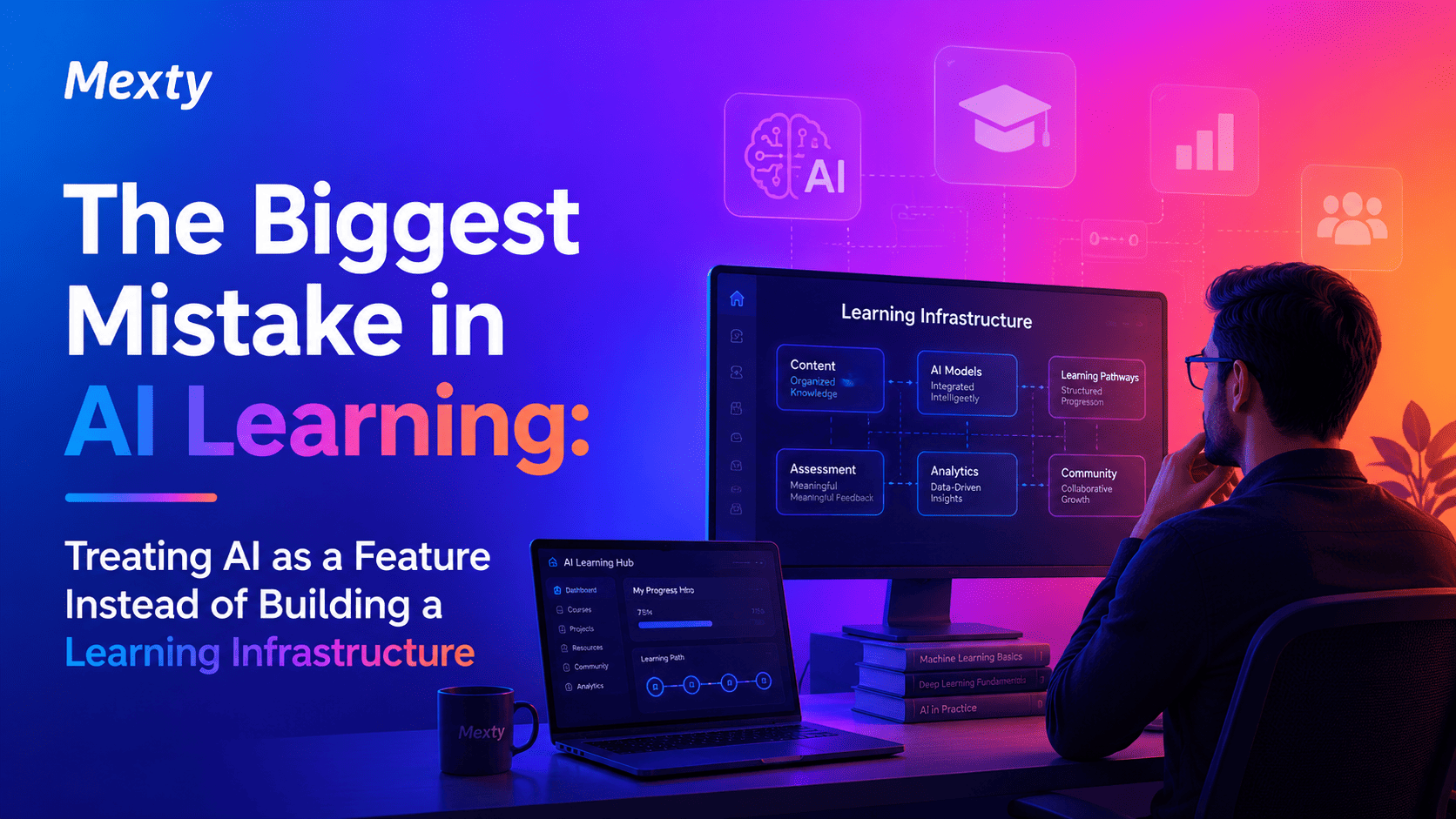
The
Biggest Mistake in AI Learning: Treating AI as a Feature Instead of Building a
Learning Infrastructure
Artificial intelligence is transforming learning and development
faster than any technology before it.
Every week, new AI-powered tools promise to create courses in
minutes, generate quizzes instantly, convert documents into learning content,
and automate large parts of instructional design.
At first glance, this seems like a revolution.
Training content can be produced faster than ever.
But there is a problem.
Many organizations are making the same mistake.
They are treating AI as a feature rather than building a learning
infrastructure designed for AI.
As a result, they are creating more content, but not necessarily
better learning.
The biggest mistake in AI learning today is believing that faster
content generation automatically leads to better learning outcomes.
It does not.
Because AI in learning is not just about generating content.
It is about creating a complete system that supports the entire
learning lifecycle.
AI Alone Does Not
Create Learning
Many
organizations are currently experimenting with AI-generated learning content.
An AI
tool can:
·
Generate slides
·
Create quizzes
·
Produce learning objectives
·
Summarize documents
·
Convert PDFs into courses
These
capabilities are impressive.
But
they only solve a small part of the challenge.
Learning
is not content.
Learning
is a system.
Without
structure, AI quickly becomes another content generator:
·
Fast, but generic
·
Impressive, but disconnected
·
Useful for demos, but difficult
to scale
The
real challenge is not creating more content.
The
challenge is creating learning experiences that improve performance, accelerate
competency development, and generate measurable business impact.
This
requires something much bigger than content generation.
It
requires a learning infrastructure.
What Is a Learning
Infrastructure?
A
learning infrastructure is the system behind learning.
It
governs every stage of the learning process:
·
Where knowledge comes from
·
How content is created
·
How learning paths are
structured
·
How learners interact with
content
·
How progress is tracked
·
How courses are deployed
·
How learning impact is measured
·
How privacy, security, and
compliance are managed
Most
discussions around AI focus on content creation.
But
content creation is only one component of a successful learning ecosystem.
The
organizations generating the greatest value from AI are building systems that
connect knowledge, learning design, deployment, analytics, governance, and
business outcomes.
This is
the difference between an AI tool and an AI learning infrastructure.
Why Traditional
Authoring Workflows Are No Longer Enough
Many
traditional authoring tools are now adding AI features.
The
typical approach looks like this:
Traditional workflow + AI layer = AI-powered authoring
But
this approach misses the point.
Traditional
authoring workflows were designed for a world where humans manually created
everything.
Content
was built slide by slide.
Interactions
were developed manually.
Branching
scenarios required extensive development effort.
Publishing
often involved multiple tools and complex workflows.
Adding
AI to this process can speed up content generation.
However,
the workflow itself remains unchanged.
The
result is often:
·
More content
·
More courses
·
More assets
But
not necessarily better learning.
AI
changes the entire process.
It
changes how knowledge is captured.
It
changes how learning experiences are designed.
It
changes how learning paths are personalized.
It
changes how performance data is analyzed.
It
changes how learning systems evolve over time.
This
is why simply adding AI to traditional workflows is not enough.
Organizations
need a new workflow designed specifically for AI-powered learning creation.
The Rise of
AI-Native Learning Infrastructure
The
next generation of learning technology is emerging around a different idea.
Not
AI-enhanced authoring.
Not
AI-generated courses.
But
AI-native learning infrastructure.
An
AI-native platform for creating interactive learning experiences is designed
from the ground up to integrate AI throughout the entire learning lifecycle.
Instead
of treating AI as a feature, AI becomes part of the system itself.
This
means AI supports:
·
Knowledge grounding
·
Content creation
·
Interaction design
·
Learning path generation
·
Human review
·
Deployment
·
Analytics
·
Governance
·
Compliance
This
shift represents one of the most important developments in modern learning
technology.
The Components
of an AI Learning Infrastructure
A
true AI learning infrastructure requires several key capabilities working
together.
1. Source of Truth Grounding
One of the
biggest concerns with AI is hallucination.
If AI generates
content without a reliable source of knowledge, errors become inevitable.
Modern learning
systems need a source of truth that grounds AI outputs in trusted content.
This ensures
consistency, accuracy, and compliance.
2. AI-Native Authoring
Traditional authoring
tools often bolt AI onto existing workflows.
AI-native authoring
integrates AI directly into the learning creation process.
This allows
instructional designers to create, modify, refine, and improve learning
experiences faster while maintaining control.
3. Interactive Learning
Design
Effective
learning requires interaction.
Organizations
increasingly need:
·
Simulations
·
Branching scenarios
·
Decision-based activities
·
Role-playing exercises
·
Practical applications
The future
belongs to an Interactive Learning Platform capable of generating and managing
these experiences at scale.
4. Human Control and
Manual Editing
AI
should accelerate creation.
Humans
should maintain control.
The most
effective systems allow complete manual editing of:
·
Content
·
Quizzes
·
Scenarios
·
Learning flows
·
Assessments
·
Visual assets
·
Interactions
Human
expertise remains essential for quality assurance and instructional
effectiveness.
5. Learning
Paths and Competency Development
Learning
is not a collection of courses.
Learning
is a progression.
Organizations
need systems capable of structuring competency-based learning journeys that
adapt to learner needs and business objectives.
6. Learning Analytics
Without measurement,
learning cannot demonstrate value.
Advanced learning
analytics help organizations understand:
·
Skill progression
·
Learner engagement
·
Competency development
·
Knowledge gaps
·
Performance improvements
These insights help
connect learning outcomes to business impact.
7. Deployment and LMS
Integration
Creating
content is only part of the challenge.
Organizations
must also deploy, manage, and track learning efficiently.
This
requires:
·
LMS integration
·
Enterprise deployment workflows
·
Reporting capabilities
·
Content version management
A modern
platform should be fully SCORM-compatible while supporting seamless deployment
across enterprise learning ecosystems.
Why Security and
Compliance Matter More Than Ever
Many
AI discussions focus on productivity.
Enterprise
organizations focus on risk.
As
AI becomes embedded into learning systems, security and compliance become
essential requirements.
Organizations
increasingly require:
·
GDPR compliance
·
AI Act alignment
·
ISO 27001 standards
·
SOC 2 controls
·
Data privacy safeguards
·
Governance frameworks
This
is why the next generation of learning technology must function as a Secure AI
Authoring Platform rather than simply an AI content generator.
The
future belongs to systems that combine innovation with governance.
Moving Beyond Content
Generation
Many
organizations are currently searching for:
·
Articulate Storyline
Alternatives
·
Genially Alternatives
·
iSpring Alternatives
The
reason is not simply cost.
The
reason is workflow.
Teams
are looking for ways to:
·
Simplify eLearning workflows
·
Simplify instructional design
workflows
·
Replace complex authoring
processes
·
Create interactive courses
without coding
·
Reduce Storyline dependency
AI is
accelerating this transition.
Organizations
increasingly want an AI authoring tool for L&D that removes technical
complexity while maintaining instructional quality.
The goal
is not simply faster development.
The goal
is a better workflow.
How Mexty Fits
Into This Transformation
urlMextyhttps://www.mexty.ai
was built around this new reality.
Rather
than treating AI as a feature layered on top of traditional authoring, Mexty is
designed as an AI-native learning infrastructure.
It
combines:
·
AI-native authoring
·
Interactive learning creation
·
Scenario-based learning
·
Source of Truth grounding
·
Learning paths
·
Competency development
·
Learner analytics
·
SCORM-compatible deployment
·
LMS integration
·
Enterprise-grade security
As
an AI-native SCORM authoring platform for interactive learning creation, Mexty
helps organizations move beyond static content and toward measurable learning
experiences.
Its
approach supports a modern AI workflow for instructional design, allowing teams
to create interactive learning without technical complexity while maintaining
full human control over the final experience.
Instead
of focusing only on content generation, Mexty focuses on learning systems.
This
distinction is increasingly important as organizations scale AI across learning
and development initiatives.
Learn
more at urlwww.mexty.aihttps://www.mexty.ai.
The Future of
Learning Is Infrastructure
The
future of learning is not AI-generated content.
The
future of learning is AI-powered learning infrastructure.
Organizations
that focus only on generating content will create more courses.
Organizations
that build learning infrastructure will create better outcomes.
The
winners will be those that combine:
·
AI-native authoring
·
Interactive learning design
·
Human oversight
·
Learning analytics
·
Secure deployment
·
Compliance and governance
This
is the real shift happening in learning technology today.
Not
AI on top of old workflows.
A
new infrastructure built specifically for AI-powered learning creation.
Because
AI should create faster.
Humans
should remain in control.
And
learning systems should be designed to generate measurable impact, not just
more content.
If you enjoyed this, you’ll love our next articlesAI Under Control: Why Learning Quality Still Depends on Human Precision |