

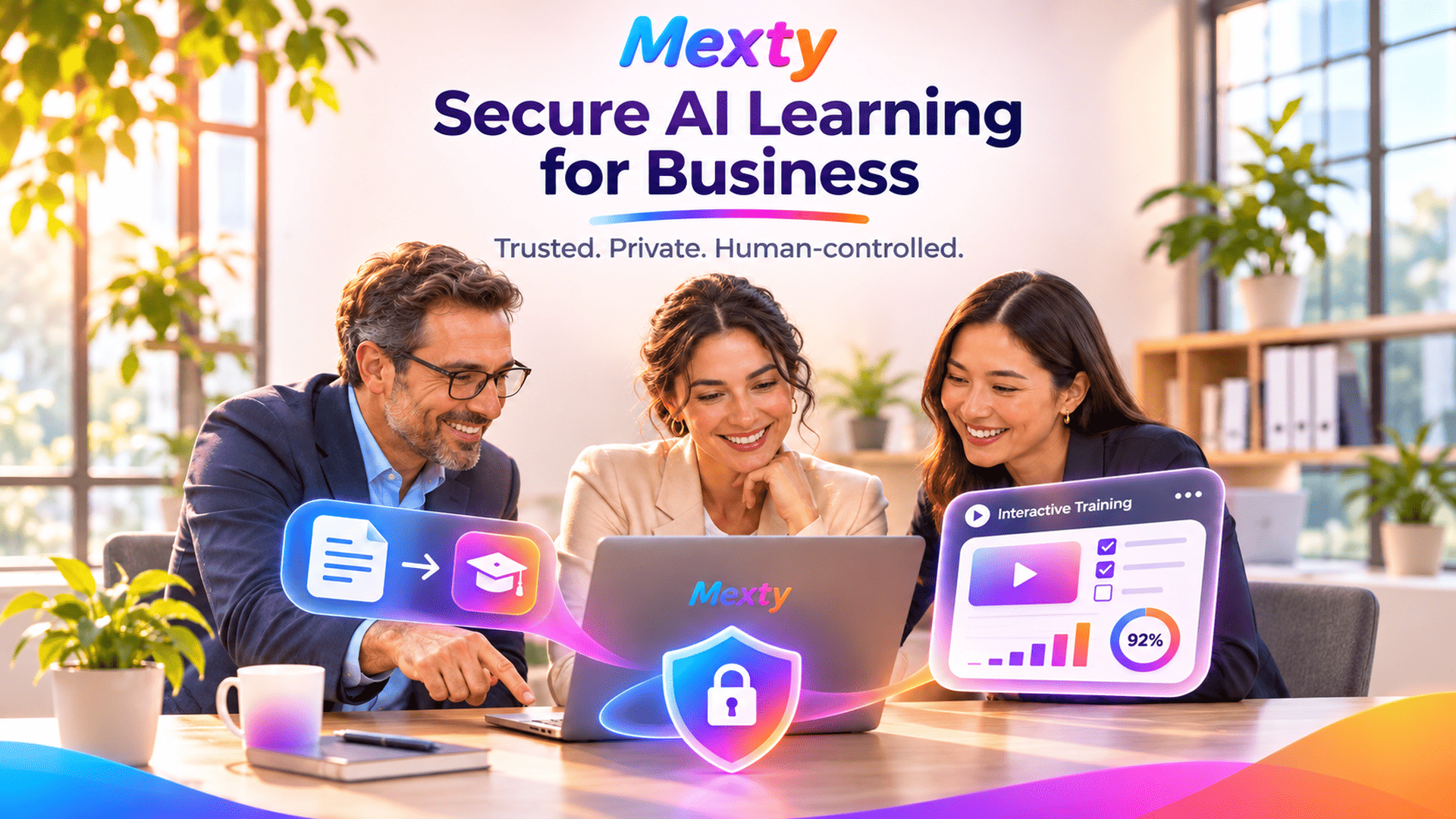
AI is transforming
corporate learning, but businesses need more than faster content creation.
Discover how Mexty helps
SMEs and enterprises use AI to create trusted, secure, and measurable learning
experiences while maintaining control over their knowledge, data, and
compliance responsibilities.
AI is
transforming corporate learning. But can businesses trust the environment ?
Artificial intelligence is
creating extraordinary opportunities for corporate learning.
Organizations can now
transform internal documents into interactive courses, accelerate employee
onboarding, create practical compliance training, and provide more personalized
learning experiences.
Tasks that previously
required days or weeks of instructional design can now begin in minutes.
But as businesses
accelerate AI adoption, an important question emerges :
How can organizations
benefit from AI without compromising their confidential information,
intellectual property, regulatory obligations, or control over what employees
learn ?
For a company, introducing AI into learning is not simply a technology decision.
It is also a question of
trust, governance, security, and responsibility.
Employees need reliable
information. Business leaders need confidence that sensitive knowledge remains
protected. Compliance teams need visibility into how AI is used and how
learning content is validated.
And organizations need to
ensure that AI supports human expertise rather than replacing human judgment.
This is why the future of
corporate learning requires more than an AI course generator.
It requires AI-Native
secure Learning Infrastructure, where trusted knowledge, human control,
privacy, interactive learning, and measurable outcomes are connected by design.
That is the approach
behind Mexty.
1. The hidden risks of
using generic AI tools for corporate training
Imagine an HR manager at a
company with 150 employees.
The company needs to train
its workforce on internal policies, customer data protection, cybersecurity,
and operational procedures.
The HR manager decides to
accelerate course production using a publicly accessible AI chatbot.
They upload internal
documents, ask the AI to summarize the policies, generate a training outline,
and create a quiz.
The result looks
professional.
But several questions
remain unanswered.
Where is the uploaded
information processed ?
What are the provider's
data retention and training policies ?
Could confidential
information be exposed ?
Are the generated
explanations accurate ?
Do the assessments
genuinely reflect the company's procedures ?
And who has approved what
employees will ultimately learn ?
These concerns are
particularly important for organizations handling customer information,
proprietary technical documentation, financial records, employee data, or
regulated business processes.
Not every AI service presents
the same risks, and many enterprise AI tools provide substantial security
controls.
Nevertheless, using AI
to generate training content does not automatically make the resulting learning
process secure, reliable, or compliant.
Businesses need a
controlled approach that addresses the entire learning lifecycle.
2. Trusted knowledge : AI
should learn from your company's approved information
One of the most important
requirements for corporate AI learning is content reliability.
A generic AI model may
produce a plausible explanation based on its training data, even when it does
not know the specific policies or procedures of an organization.
For compliance, safety,
technical training, or product knowledge, that is not enough.
Employees need to learn
what their organization actually requires.
Mexty
addresses this challenge through its Source of Truth approach.
Instead of relying
exclusively on generic AI-generated information, organizations can build
learning experiences from their own validated documents, procedures, and
knowledge bases.
For example, a company can
provide :
- Approved compliance policies and regulatory procedures.
- Internal
employee onboarding documentation.
- Product
specifications and technical manuals.
- Customer
service processes and operational guidelines.
- Sales and
product training materials.
Mexty's
AI-assisted authoring can use these sources to structure content, develop
learning activities, and generate assessments.
This is a fundamental
capability of a Trusted AI authoring platform.
However, grounding content
in approved sources does not eliminate every potential AI error.
AI may still misinterpret
a document, omit important conditions, or generate an inappropriate question.
Trusted sources must
therefore be combined with human verification.
The objective is not to
remove experts from the process. It is to make their knowledge easier to
transform into effective learning.
3. Human control : AI
assists, experts decide
There is a common
misconception that AI-powered learning means fully automated content creation.
But learning is not simply
the production of information.
Someone must determine
what employees need to understand, which behaviors must change, how
competencies should be evaluated, and whether the content accurately represents
business requirements.
These decisions require
human expertise.
With Mexty, AI assists with course structure,
interactive activities, explanations, and assessments.
Subject-matter experts can
then edit, review, adapt, and approve the material before it reaches learners.
A compliance manager can
verify that the content reflects applicable internal policies.
An HR manager can ensure
that onboarding materials accurately represent the organization.
A technical expert can
review product training for accuracy.
An instructional designer
can improve the pedagogical approach and assessments.
AI accelerates
preparation. Humans retain responsibility for the decisions that matter.
This is particularly
important for organizations seeking an Enterprise-ready AI authoring tool,
where learning content must be reliable, maintainable, and subject to
organizational oversight.
Human control is not a
limitation on AI innovation.
It is what makes AI
innovation more trustworthy.
4. Privacy by design :
Protecting the knowledge behind the learning
For many companies,
internal knowledge is among their most valuable assets.
Customer relationships,
product documentation, operating procedures, commercial strategies, and
accumulated expertise contribute directly to competitive advantage.
An AI-powered learning
environment must therefore protect more than learner records.
It must also protect the
underlying business knowledge used to create training.
Mexty has
been designed around a privacy-first approach.
Its principles include
private-by-default projects and a commitment that customer content is not used
to train AI models.
These protections are
central to the value of a Privacy-first AI authoring tool.
For SMEs, this is
especially important.
Smaller organizations may
not have dedicated information-security teams or the resources to evaluate and
integrate numerous AI products.
They need practical,
accessible tools with clear protections and governance.
A responsible AI
learning platform with privacy controls should help organizations define
who can access sensitive content, which information can be shared, and how
learning materials are managed.
It should also provide
transparent information about data processing and retention.
Businesses should not have
to expose their intellectual property simply to benefit from AI-assisted
training creation.
5. GDPR and the EU AI Act :
Responsible AI learning requires governance
For European companies,
security and privacy cannot be separated from regulatory responsibilities.
The General Data
Protection Regulation (GDPR) establishes obligations around the processing of
personal data, including lawful processing, transparency, security,
accountability, and individual rights.
The EU AI Act introduces a
risk-based framework for AI systems, with requirements that vary according to
their use and classification.
Organizations deploying AI in corporate learning must therefore consider how their systems are used, what
data they process, and which obligations apply.
Mexty is designed
to support alignment with GDPR and applicable EU AI Act requirements, incorporating
privacy, transparency, human oversight, and governance into its platform
approach.
This matters because
responsible AI should be part of the system's design rather than addressed only
after deployment.
For businesses looking for
a GDPR-compliant AI learning platform, it is important to assess both
the provider's safeguards and the organization's own implementation.
No software subscription
automatically guarantees compliance in every business context.
For example, using AI to
generate training material may raise different regulatory considerations from
using AI to evaluate employees in ways that materially influence
employment-related decisions.
The applicable
requirements depend on the specific use case.
Technology can support
regulatory compliance, but organizational accountability remains essential.
This principle should
guide every enterprise AI learning strategy.
6. Enterprise-grade
security should be accessible to SMEs too
Security has traditionally
been associated with large enterprise software investments.
But smaller companies
handle sensitive information too.
A 30-person technology
company may own valuable intellectual property.
A 70-person consulting
firm may process confidential customer documents.
A 200-person manufacturer
may manage proprietary production procedures and technical specifications.
Their need for security is
no less legitimate simply because their organizations are smaller.
Mexty's
security framework includes ISO 27001 certification and completed SOC 2 Type II
assurance.
These independently
assessed frameworks help provide confidence in the organization's information
security controls and processes, within the scope covered by the respective
assessments.
But certifications alone
are not the complete answer.
A Secure AI authoring
platform must also be practical to use, support appropriate access
controls, and enable organizations to govern their content throughout its
lifecycle.
The broader goal is to
make trusted and secure AI-powered learning accessible without requiring a
large IT or Learning and Development department.
Enterprise-grade
expectations should not require enterprise-sized budgets.
7. From secure content
creation to interactive, measurable learning
Security is essential, but
businesses also need learning experiences that actually work.
A protected PDF is still a
PDF.
An accurately generated
presentation is still a presentation.
Employees need
opportunities to practise, make decisions, receive feedback, and demonstrate
understanding.
This is where Mexty's Interactive Course Creator
becomes important.
Organizations can turn
approved documents into learning experiences that include practical scenarios,
interactive activities, simulations, and assessments.
For example, a company can
Convert PDF to interactive course content to transform a data protection
policy into a series of realistic workplace decisions.
Instead of simply reading
that customer data must be protected, employees might be asked:
" A customer requests
an urgent transfer of confidential information from an unfamiliar email
address. What should you do ? "
The learner selects an
action, receives feedback, and understands the reasoning behind the appropriate
decision.
This is a stronger
learning experience than simply asking employees to confirm that they have read
the policy.
An effective Secure
interactive learning platform should combine the protection of company
information with the ability to develop and assess practical competencies.
And it should remain easy
enough for business experts to create and maintain these experiences without
specialized programming skills.
8. One connected
environment instead of disconnected AI tools
Many organizations
approach AI learning by introducing separate tools for different activities.
One application generates
content. Another creates interactions. A third distributes courses. An LMS
manages learners, while a separate system produces reports.
Each additional tool
introduces potential complexity.
Information may need to be
transferred between systems, permissions must be managed, and responsibilities
can become fragmented.
An AI-native LMS and
authoring platform provides a more connected approach.
Mexty
combines AI-assisted authoring, interactive activities, learning delivery,
assessments, and learner analytics in one environment.
Organizations can create
and review training, publish it through the Mexty LMS,
and monitor employee progress.
For businesses that
already use an LMS, Mexty's SCORM-compatible
export capabilities provide another delivery option.
This flexibility allows
companies to modernize their training workflows without necessarily replacing
their existing learning infrastructure.
The advantage is not
simply convenience.
A connected workflow makes
it easier to maintain consistency between the knowledge being taught, the activities
employees complete, and the results organizations measure.
It also reduces the need
to manage multiple disconnected solutions.
9. Four practical
applications for secure AI learning in SMEs
The value of secure,
governed AI learning becomes particularly clear when applied to recurring
business needs.
Employee onboarding
HR teams can transform
approved company policies, organizational information, procedures, and
onboarding documents into interactive learning paths.
New employees receive more
consistent information, while managers retain oversight of learning objectives
and progress.
Compliance and regulatory
training
Compliance specialists can
create training based on validated policies, including practical decision
scenarios and assessments.
The LMS can record
participation and assessment performance, helping organizations maintain
evidence of training activities.
Technical and product
training
Engineering and product
teams can transform proprietary documentation into structured learning
experiences without unnecessarily distributing confidential materials outside
approved environments.
Subject-matter experts
validate the technical content before publication.
Internal knowledge
transfer
Experienced employees can
contribute their expertise to reusable learning resources.
This helps organizations
preserve essential knowledge, support business continuity, and reduce
dependence on a small number of individuals.
Across all four use cases,
the principle remains the same:
AI helps make company knowledge
accessible. Business experts remain responsible for its accuracy and
appropriate use.
10. Measuring learning
effectiveness without losing human judgment
The ultimate objective of
corporate training is not simply course completion.
It is to improve the
knowledge, skills, and decisions employees bring to their work.
Mexty's
learning environment enables organizations to track activities, assessments,
and progress.
This creates a foundation
for identifying knowledge gaps and improving learning experiences.
For example, if employees
consistently struggle with a compliance scenario, managers can review the
training, clarify the relevant policy, or provide additional support.
But learning analytics
should be interpreted responsibly.
An assessment score does
not automatically represent an employee's overall professional capability.
Likewise, increased
training completion does not necessarily demonstrate improved business
performance.
Organizations should
evaluate learning results alongside relevant operational indicators and human
observations.
This is essential when
considering ROI in Learning.
The aim should be to
understand whether training contributes to better decisions, fewer errors,
faster onboarding, or improved performance not to make automated judgments
about employees based solely on limited learning data.
AI can provide valuable
insights. Humans must remain accountable for how those insights are interpreted
and used.
Conclusion:
The future of corporate learning must be secure, trusted, and human-controlled
AI is changing how
organizations create, deliver, and improve training.
It can accelerate course
production, make internal knowledge more accessible, support interactive
learning, and provide better visibility into employee progress.
But these advantages will
only create sustainable value if businesses can trust the environment in which
AI is used.
That requires more than a
powerful generative AI model.
It requires reliable
knowledge sources, privacy safeguards, security controls, human oversight,
responsible governance, and meaningful learning experiences.
These principles should
apply to every company, regardless of size.
At Mexty, our ambition is to make this
approach accessible to SMEs and enterprises through one connected AI-native
learning platform.
Because the future of corporate learning is not about generating more courses with AI.
It is about helping
organizations turn their knowledge into measurable capabilities without
compromising privacy, security, trust, or human control.
Innovation and
responsibility should advance together.
Start using AI for
corporate learning with confidence
Discover how Mexty helps businesses transform approved
company knowledge into interactive training, deliver it through a connected
learning platform, and maintain human control throughout the process.
Your knowledge. Your
people. Your control. AI-powered learning designed around trust.