

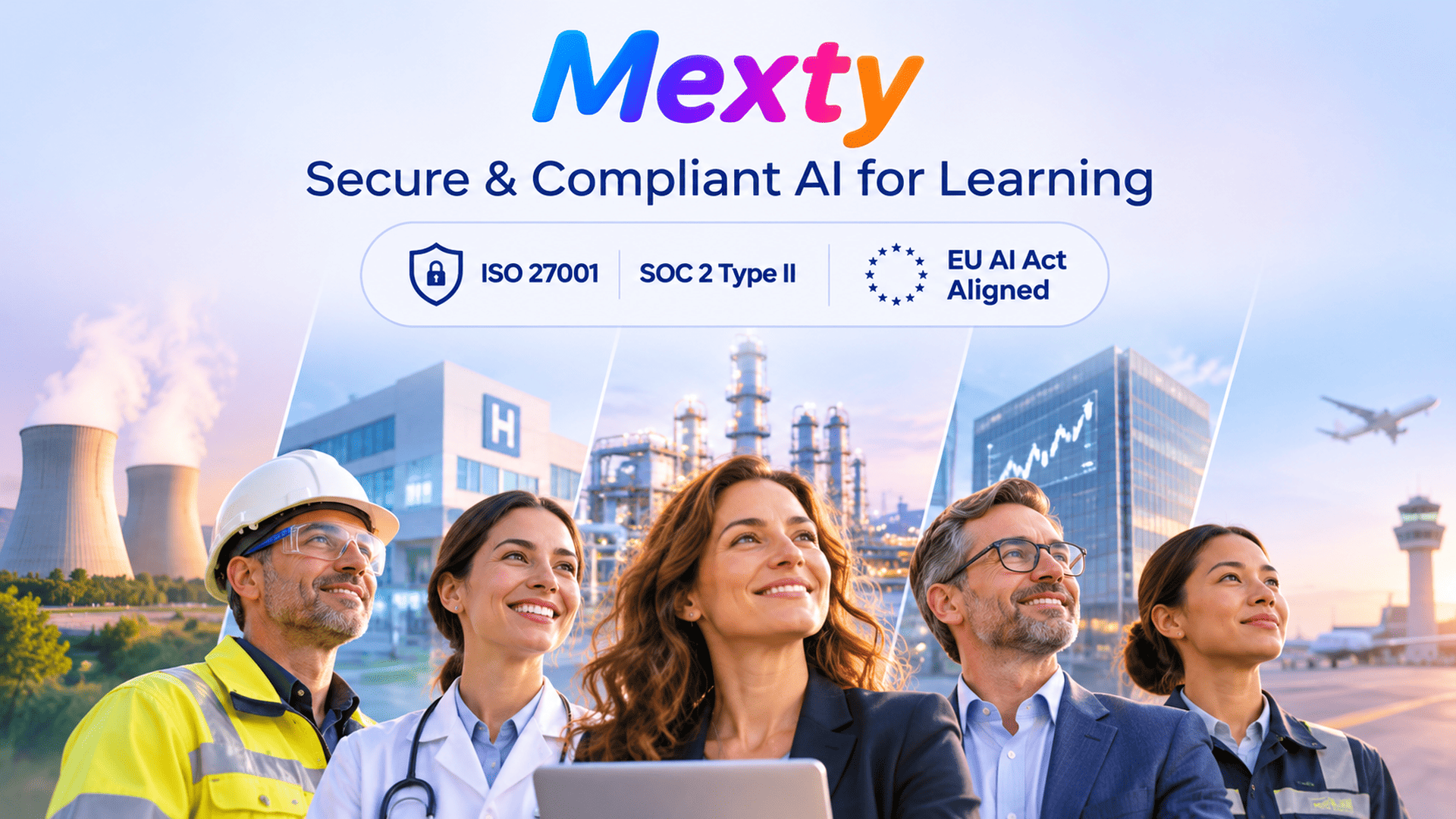
Secure
AI for Learning : Why High-Stakes Industries Need More Than Faster Course
Creation
Artificial intelligence is
changing how organizations create learning.
Courses can be generated
faster. Existing documents can be transformed into interactive experiences.
Assessments, simulations and scenarios can be produced in a fraction of the
time previously required.
But in high-stakes
industries, speed is not enough.
When learning supports
work in nuclear energy, healthcare, financial services, aviation, manufacturing,
energy or other highly regulated environments, the questions become very
different.
It is no longer simply: How
quickly can we create a course ?
Organizations also need to
ask :
- Where does our information go ?
- Which sources
is the AI using ?
- Who can access
our data ?
- How do we
validate what AI produces ?
- Can we trace
and control the learning content ?
- Can we change
AI providers without losing our knowledge or learning assets ?
For these organizations,
AI-powered learning needs to be built on three foundations:
security, governance and
human judgement.
High-stakes
learning is different
In many learning
environments, an inaccurate sentence may be inconvenient.
In a safety-critical
environment, it can be much more serious.
A nuclear engineer,
healthcare professional, technician, financial specialist or aviation employee
may need to understand complex procedures, evaluate different situations and
make decisions where errors have consequences.
Training therefore has to
go beyond transferring information.
It needs to help people :
- understand complex systems ;
- connect theory
with real operational situations ;
- practise
decision-making ;
- compare
different approaches ;
- identify risks ;
- demonstrate
competence ;
- and develop
professional judgement.
This is why simply giving
employees access to a general-purpose AI tool is not enough.
Organizations need an AI-Native
secure Learning Infrastructure where AI supports learning without removing
control from the experts responsible for accuracy.
AI
should work from trusted knowledge
One of the fundamental
challenges with generative AI is that a fluent answer is not necessarily a
correct answer.
This becomes particularly
important when creating technical, regulatory or compliance training.
Instead of asking AI to
rely only on general model knowledge, organizations should be able to ground
learning in validated information.
At Mexty, this is addressed through the
concept of a Source of Truth.
Organizations can use
their own :
- internal procedures ;
- technical
documentation ;
- policies ;
- regulatory
references ;
- product
documentation ;
- expert
knowledge ;
- validated
training materials.
The AI can then work from
this controlled knowledge base when supporting course creation.
This does not eliminate
the need for human validation.
It makes that validation
more meaningful because the AI starts from information the organization already
trusts.
For high-stakes learning,
this difference is essential.
Human
experts must remain in control
AI can accelerate course
production.
It can help organize
information, suggest activities, generate scenarios and support assessment
creation.
But AI should not become
the final authority.
A Secure AI authoring
platform should keep subject-matter experts, instructional designers and
compliance teams in control of what is published.
They need to be able to :
- review AI-generated content,
- modify it
manually,
- validate it
against trusted sources,
- approve the
final learning experience,
- and update it
when regulations or procedures change.
This is particularly
important because regulations are rarely static.
A new requirement may
affect not only a paragraph in a course, but also the examples, exercises,
assessments, scenarios and reference materials connected to it.
AI can help identify and
accelerate those changes.
Human expertise determines
whether they are correct.
Security
becomes part of learning design
For enterprise learning,
cybersecurity and data protection are no longer separate technical subjects.
They influence which
learning technologies organizations can safely adopt.
A company considering an AI
authoring tool for L&D should understand how documents, learner
information and internal knowledge are handled.
This is particularly
important when training contains :
- intellectual property ;
- confidential
procedures ;
- customer
information ;
- product
roadmaps ;
- technical
specifications ;
- security
processes ;
- regulated
information.
A Privacy-first AI
authoring tool should therefore be designed around controlled access,
governance and data protection rather than treating them as afterthoughts.
Mexty
combines this approach with ISO/IEC 27001 certification and SOC 2 Type II
attestation, alongside GDPR requirements and an approach designed around EU
AI Act expectations.
For European
organizations, choosing a GDPR-compliant AI learning platform is not
simply a procurement checkbox.
It is part of building
confidence in how AI is introduced into learning.
The EU
AI Act raises the governance bar
The EU AI Act also changes the conversation around enterprise AI.
Organizations increasingly
need to think about AI governance, transparency, human oversight and AI
Literacy alongside technical capability.
Learning teams therefore
have a new responsibility.
They are not only using AI
to produce training.
They may also be helping
employees understand how AI should be used within the organization.
A Trusted AI authoring
platform can support both dimensions :
using AI to create
learning, and creating learning that helps employees use AI responsibly.
This can include training
around :
- approved AI tools ;
- confidential
information ;
- verification of
AI-generated outputs ;
- hallucinations
and bias ;
- human review ;
- company AI policies ;
- appropriate and
inappropriate use cases.
The technology itself
cannot make an entire organization compliant.
But it can help companies
implement a more structured, documented and controlled approach to AI-enabled
learning.
From
content creation to a complete learning environment
Security is important, but
organizations also need learning to work operationally.
Creating a course is only
the beginning.
The learning experience
then needs to be delivered, assigned, assessed and measured.
This is why the
distinction between a simple AI content generator and an AI-native LMS and
authoring platform matters.
With Mexty, organizations can combine :
- AI-assisted authoring,
- interactive
activities,
- scenarios and
simulations,
- assessments,
- learning paths,
- knowledge
bases,
- AI agents,
- LMS delivery,
- and learner
analytics.
Instead of creating
training in one tool and then transferring it into another environment,
organizations can use an LMS-ready authoring platform that connects
creation and delivery.
Courses can also remain SCORM-compatible,
allowing organizations to use content within existing LMS ecosystems when
required.
For regulated
organizations with established learning environments, interoperability matters
just as much as innovation.
Interactivity
matters in high-stakes training
AI-powered learning should
not result in more passive content.
A PDF converted into ten
screens of text is still essentially a PDF.
High-stakes learning
benefits from active practice.
An Interactive Course
Creator can help organizations turn technical knowledge into :
- decision scenarios,
- branching
exercises,
- simulations,
- interactive
problem-solving,
- case studies,
- knowledge
checks,
- and realistic
assessments.
This is where an Interactive
Learning Platform becomes particularly valuable.
Instead of asking learners
simply to remember information, organizations can ask them to apply it.
What would you do in this
situation ?
Which procedure should be
followed ?
Which information is
missing ?
What risk does this
decision create ?
When should the situation
be escalated ?
These activities help
develop the professional judgement that cannot be created through content
consumption alone.
AI
agents also need governance
The next phase of learning
technology will increasingly include AI agents.
An AI Agent for
Learning can potentially support learners, answer questions, guide practice
or provide contextual assistance.
But the same governance
principles apply.
In regulated environments,
an AI agent should not simply answer anything from unrestricted general
knowledge.
Organizations need to
consider :
What information can the
agent access ?
What source is supporting
its response ?
What happens when
confidence is low ?
When should the learner be
referred to a human expert ?
How is the interaction
governed ?
The more powerful AI becomes, the more important these questions become.
Avoiding
AI lock-in
There is another issue
organizations should increasingly consider: dependency on a single AI model.
AI providers, regulations,
pricing structures, availability and geopolitical conditions can change.
An enterprise learning
strategy should therefore avoid making the organization's knowledge and
training architecture dependent on one model whenever possible.
The important asset is not
the AI model itself.
It is the organization's: knowledge,
learning content, workflows, assessments and data.
An AI learning platform
with privacy controls should help organizations maintain control of those
assets and preserve flexibility as the AI ecosystem evolves.
That flexibility may
become increasingly important for international organizations operating across
different regulatory and geopolitical environments.
The
future is not AI replacing expertise
There is sometimes a
temptation to frame AI as a way to remove experts from the learning-production
process.
In high-stakes industries,
that would be exactly the wrong objective.
The opportunity is
different.
AIcan reduce the time
experts spend on repetitive production work so they can spend more time on:
- validation,
- analysis,
- decision-making,
- learning
design,
- risk
assessment,
- and continuous
improvement.
An Enterprise-ready AI
authoring tool should therefore augment expertise rather than attempt to
replace it.
The principle is simple :
AI accelerates. Humans
remain accountable.
Secure
AI can make learning more powerful
The most important
question for enterprise learning is no longer simply:
Can AI create this course ?
Increasingly, the
questions are :
- Can we trust the sources ?
- Can we protect
our information ?
- Can experts
retain control ?
- Can we measure
what learners actually understand ?
- Can the
learning evolve when regulations or procedures change ?
- Can we remain
flexible as AI technologies evolve ?
For organizations
operating in high-stakes environments, AI should not mean giving up control.
It should allow them to
create better learning while strengthening governance around how knowledge is
created, delivered and used.
That is the direction Mexty is building toward: AI-powered
learning that remains secure, governed, measurable and human-controlled.
If you enjoyed this, you’ll love our next articles
Secure AI Learning for Business : How to Embrace AI Without compromising Privacy, Trust or Human Control
|
|