

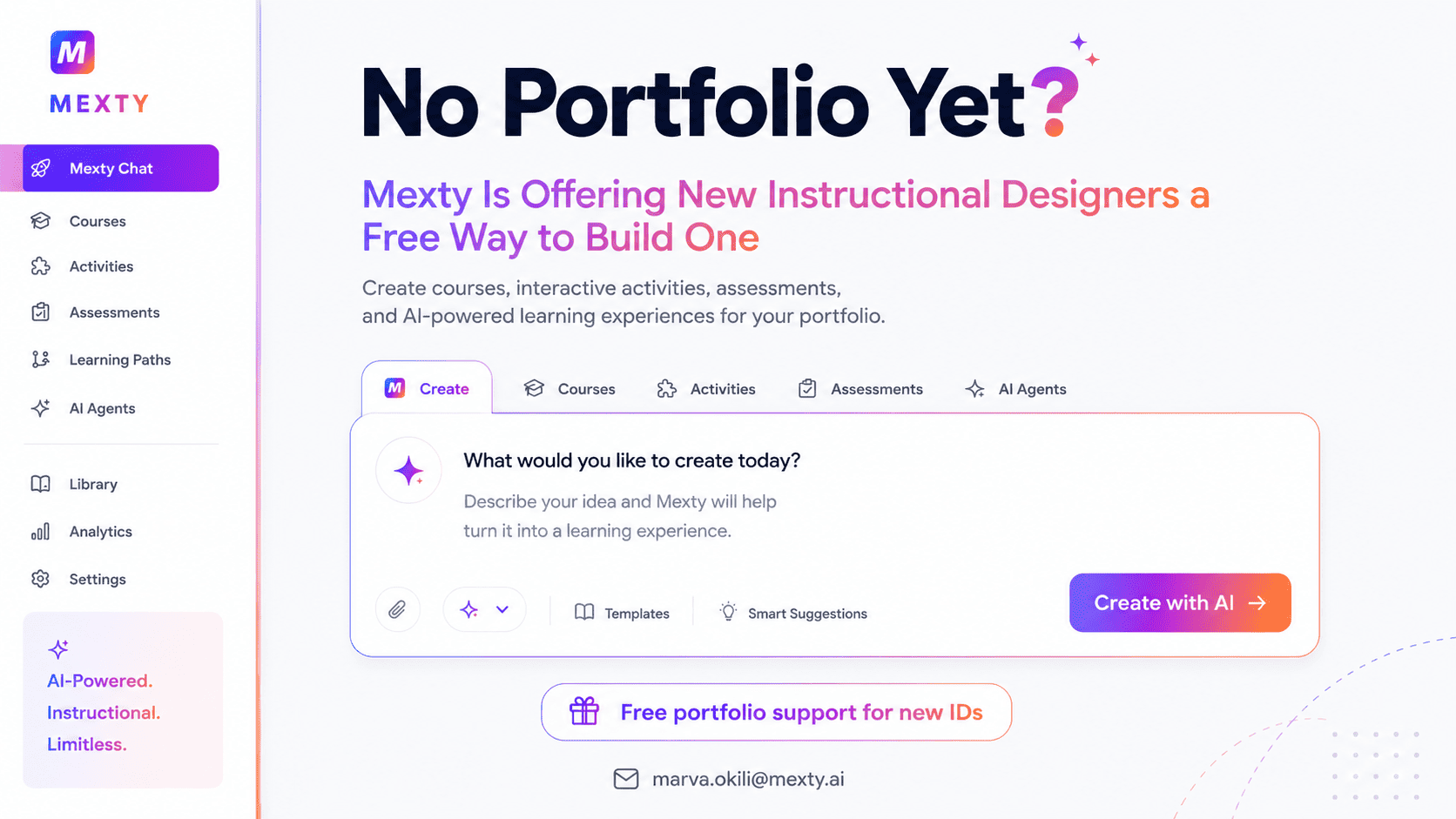
No Portfolio MextyYet? Is Offering New Instructional Designers a Free Way to Build One
For new instructional designers, one reality has become impossible to ignore: a portfolio is no longer optional.
Whether you are fresh out of school, transitioning from teaching, moving from corporate training into learning design, or making a full career pivot into L&D, employers want more than claims. They want proof. A CV can tell them what you studied. A LinkedIn profile can highlight your interests. A cover letter can explain your motivation. But a portfolio shows what really matters: how you think, how you design, and how you turn ideas into learning experiences.
That is what makes a portfolio so powerful. It is not just a collection of work samples. It is evidence of instructional judgment.
A good portfolio shows how you approach learning objectives, how you structure content, how you design practice, how you build assessment, how you use feedback, and how you think about learner engagement. It demonstrates that you can move beyond information delivery and create an actual learning experience.
The problem is that many new instructional designers know they need a portfolio, but they do not know how to build one.
And even when they do know how, the barriers are real.
Why a portfolio matters more than ever
Instructional design is a field where the work is easier to understand when people can see it. Hiring managers, consultants, agencies, and L&D leaders are often reviewing many candidates with similar degrees, similar short courses, and similar credentials. The portfolio is what helps one person stand out from the crowd.
A strong portfolio answers questions such as:
Can this person transform content into learning?
Can they design more than slides?
Do they understand practice and application?
Can they create assessments that measure something meaningful?
Can they design for engagement without losing instructional quality?
Can they think beyond aesthetics and focus on learning impact?
For experienced designers, client projects often answer those questions. But for new instructional designers, that is the challenge: they may not yet have real client work to show.
Some have done academic projects, but those may not reflect the kinds of deliverables employers expect. Others may have designed internal training in a former role, but confidentiality prevents them from sharing it. Career changers may have deep expertise in teaching, facilitation, operations, or business analysis, but not yet a polished digital portfolio to make that expertise visible in instructional design terms.
That is why the portfolio gap is so frustrating. You need a portfolio to get opportunities, but you often need opportunities to build a portfolio.
Why building a portfolio is harder than people think
On the surface, “build a portfolio” sounds simple. In reality, it is anything but.
First, it takes time. Good instructional design work does not appear in an hour. Even a short module requires thought: identifying objectives, selecting a format, structuring the experience, writing prompts or content, creating activities, designing assessment, refining feedback, and making everything coherent.
Second, it can be expensive. Many new IDs assume they need access to costly tools or subscriptions just to produce something credible. That can feel discouraging, especially for someone between jobs, just out of school, or testing whether instructional design is the right long-term direction.
Third, it requires confidence. Many new designers hesitate because they believe they need a “perfect” project before they can publish anything. They worry their work is not polished enough, strategic enough, or sophisticated enough.
Fourth, it requires examples and structure. A lot of people know they want to create a sample onboarding course, a short compliance module, or a branching scenario, but they do not always know how to translate that idea into a finished deliverable.
Finally, many portfolios are weakened by the tools themselves. Too often, people end up creating static samples that look like presentations instead of learning experiences. Beautiful screens are not enough. A hiring manager does not just want to see layout. They want to see learning logic.
This is exactly where the right platform can make a major difference.
What employers actually want to see
One of the most important mindset shifts for new instructional designers is this: a strong portfolio should not just show what you can build. It should show how you think about learning.
Employers do not only want visual polish. They want signs of instructional reasoning.
They want to see that you can:
define clear learning outcomes
connect content to real job performance
create opportunities for practice
provide meaningful feedback
design assessments with purpose
build engagement without adding unnecessary complexity
use scenarios, reflection, and decision-making intentionally
In other words, a strong ID portfolio is not a gallery of screens. It is a demonstration of learning design capability.
This is why interactive work matters so much. If you can show not only a concept, but also a complete learner experience, your portfolio becomes far more persuasive.
Mexty Where can strongly help
This is Mexty where can strongly help new instructional designers.
Mexty is an Interactive Learning Platform and AI authoring tool for L&D designed to help people create real, portfolio-ready learning experiences faster and more easily. Instead of stopping at static content or one-dimensional samples, it helps instructional designers build richer learning assets that better reflect the realities of modern L&D work.
MextyWith , new IDs can do far more than create slides.
They can:
Convert PDF to interactive course
Create interactive courses without coding
build scenarios and assessments
design interactive activities
add an AI Agent for Learning
create SCORM-compatible modules
Simplify branching scenario creation
publish complete learning experiences
showcase instructional thinking, not just visual screens
That is a major difference.
A portfolio built with richer learning outputs allows a new designer to show not just that they can organize content, but that they can design interaction, practice, feedback, and application.
From idea to prototype, faster
For many new instructional designers, one of the hardest parts of portfolio building is momentum. It is easy to stay stuck in the planning phase, endlessly refining ideas but never turning them into visible work.
Mexty helps reduce that friction.
Because it is an AI-native platform for creating interactive learning experiences, it supports a faster path from concept to prototype. That means a designer can move more quickly from “I think I want to build a customer service scenario” to a real sample with branching decisions, feedback, and assessment.
This matters because the goal of a portfolio is not perfection. The goal is demonstration.
A promising portfolio piece might be:
an onboarding module for a fictional company
a microlearning lesson on cybersecurity
a branching scenario for handling customer objections
a compliance course with knowledge checks
a short assessment-driven learning path
an interactive lesson built from a reference document
The faster new IDs can move from concept to usable sample, the more likely they are to actually build a meaningful body of work.
That is Mexty one of the reasons is so practical. It helps Simplify eLearning workflow and Simplify instructional design workflow for people who are still building confidence and experience.
A portfolio should show complete learning, not isolated parts
One common weakness in beginner portfolios is that they show fragments rather than full experiences. For example, someone may present a storyboard, a slide mockup, or a written description of an activity. Those things can be useful, but they do not always reveal how the full learning experience works.
Employers increasingly want to see something more complete.
They want to see how a learner would move through an experience:
what they see first
how they interact
when they practice
how feedback is delivered
how assessment is handled
what the end result feels like
This is Mexty where can be especially valuable. It is not just an Easy interactive course builder. It gives new designers the opportunity to build more complete learning experiences, including courses, activities, assessments, and AI-supported elements.
That helps transform a portfolio from “here is a design sample” into “here is a working learning experience.”
And that is much more compelling.
Showing modern instructional design skills
The instructional design market is changing quickly. Today, it is not enough to know how to write objectives and create a quiz. Those still matter, of course, but employers are also looking for designers who understand interactivity, learner engagement, digital delivery, and AI-supported workflows.
That does not mean every new ID must become a developer.
In fact, one of the most exciting shifts in the market is the rise of tools that make Interactive learning without technical complexity more accessible. With the right platform, new instructional designers can create richer experiences without having to master complex code-based workflows.
Mexty supports that shift.
It helps users practice Vibe coding for interactive learning by describing what they want to create and then shaping the output into a more polished learning experience. That makes it easier for beginners to experiment with ideas, iterate quickly, and focus on design thinking rather than getting stuck in tool mechanics.
In that Mexty sense, is not just a production tool. It is also a learning environment for the designer.
It allows new IDs to practice the core skills employers value most:
learning objectives
scenario design
reflection prompts
assessment strategy
feedback logic
learner engagement
application to real work
evaluation thinking
These are the foundations of strong instructional design. And they are exactly what a portfolio should make visible.
Beyond static slides: building work that feels real
The best portfolios create credibility because the work feels real.
Not necessarily because it came from a paying client, but because it reflects the kind of thinking and structure that real-world projects require.
A static deck may show that you can organize information. But a fuller learning sample shows that you understand how people learn by doing, deciding, reflecting, and improving.
This is Mexty why can be a strong option for new designers compared with older, more rigid approaches. It supports the creation of interactive experiences that are easier to demonstrate and more relevant to current L&D expectations.
For people exploring Articulate Storyline Alternatives, Genially Alternatives, or iSpring Alternatives, that matters. Many new IDs are looking for ways to create credible portfolio pieces without getting trapped in unnecessarily complex workflows. They want tools that help them create faster, but still allow them to show serious instructional thinking.
That is where an AI-Native secure Learning Infrastructure can provide an advantage. It creates a more modern and flexible path to building portfolio-worthy work.
Why this matters for career changers too
This opportunity is not only for people fresh out of university.
It is also highly relevant for career changers.
Many excellent future instructional designers come from teaching, facilitation, HR, customer enablement, operations, consulting, or subject-matter expert roles. They already know how to explain concepts, support learners, manage change, or structure information. What they often lack is not capability. It is a visible portfolio that translates those strengths into the language of instructional design.
Mexty can help bridge that gap.
A former teacher can use it to build an interactive onboarding course.
A trainer can create a scenario-based sales learning experience.
A subject-matter expert can transform a policy or handbook into an interactive module.
A facilitator can design a short assessment or branching practice activity.
In each case, the portfolio becomes a bridge between prior experience and a new professional identity.
That is powerful.
A free portfolio creation opportunity for new IDs
To support the next Mextygeneration of instructional designers, is offering a free portfolio creation opportunity for new instructional designers who contact us.
If you are early in your journey, this is a chance to build something real.
If you are fresh from school, trying to enter instructional design, or making a career pivot into L&D, this opportunity can help you move from theory to visible proof.
And that proof matters.
Because employers do not just want to hear that you are passionate about learning design.
They want to see what you can do.
They want to see how you think.
They want to see whether you can design learning that helps people practice, decide, reflect, and improve.
That is exactly the kind of work a strong portfolio Mexty should contain. And that is exactly the kind of portfolio can help you build.
Final thought
The future of instructional design belongs to people who can make learning visible, practical, and meaningful.
For new IDs, a portfolio is one of the clearest ways to show that ability. But too many talented people are blocked by lack of tools, time, cost, or confidence.
That is why accessible portfolio-building matters.
And that Mexty is why wants to help.
If you are a new instructional designer and want support creating your portfolio, reach out to:
marva.okili@mexty.ai
Let’s help more new instructional designers show what they can really do.
If you enjoyed this, you’ll love our next articles
Vibe Coding Is Powerful. But Vibe Coding Alone Is Not Enough for Enterprise Learning |