

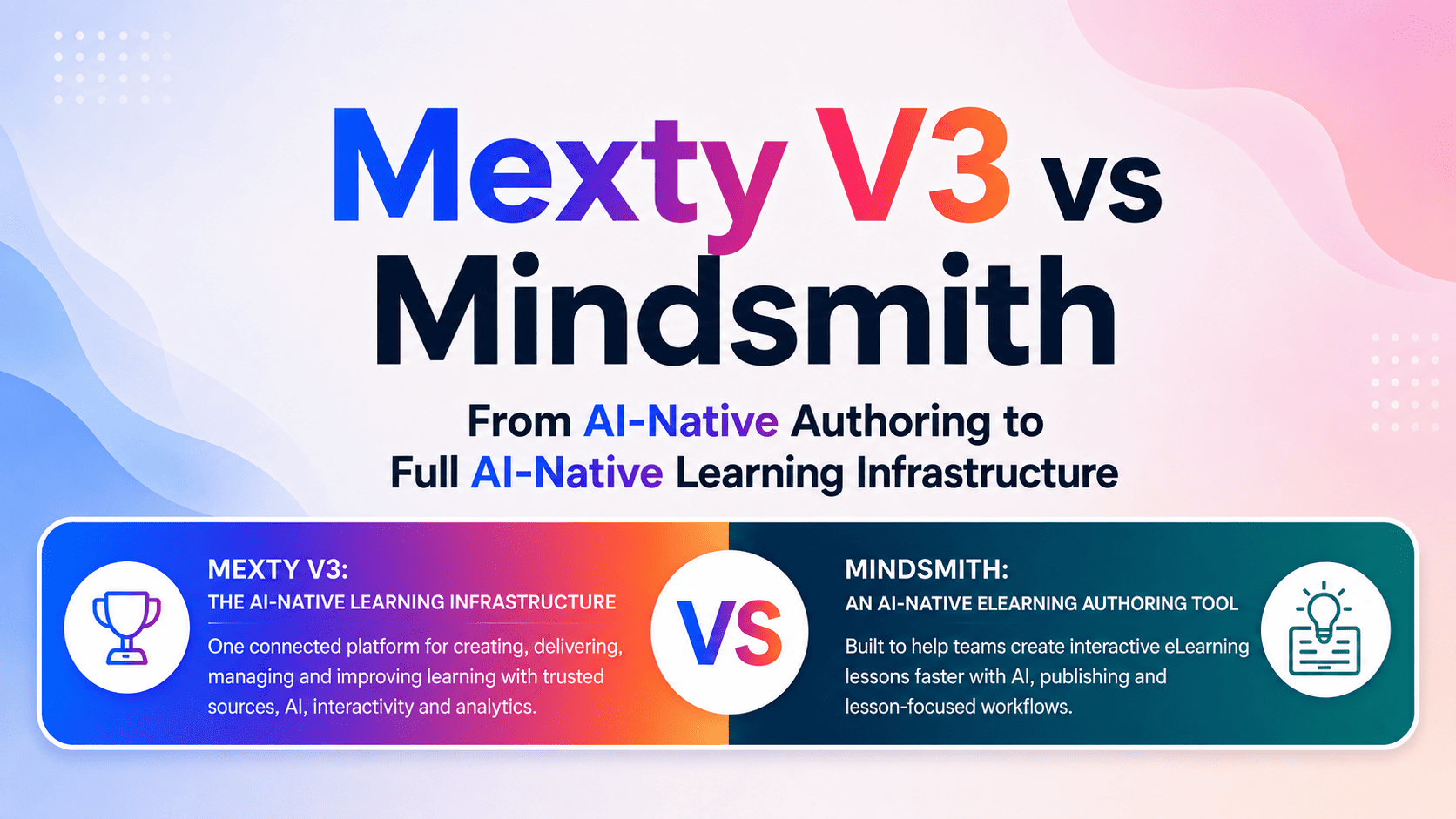
Mexty vs Mindsmith: From AI-Native Authoring to Full
AI-Native Learning Infrastructure
Mindsmith is one of the most interesting new players in the AI eLearning authoring space. Unlike older tools built around slides or manual course production, Mindsmith is already positioned as an AI-native eLearning authoring tool. Its official materials describe AI-supported lesson creation, translation, voice and text dialogue inside lessons, SCORM and LTI sharing, links, embeds, and analytics.
This makes Mindsmith much closer to
Mexty
than traditional tools such as Storyline, Captivate, iSpring, Genially, or
Elucidat.
Both platforms recognize the same
market shift: AI is collapsing the distance between a learning idea and a
working eLearning prototype. Learning teams no longer want to spend weeks
moving from documents to storyboards, from storyboards to courses, from courses
to LMS packages, and from LMS packages to learner data.
They want to move faster.
They want AI to support the full
workflow.
They want interactive learning
without technical complexity.
But there is still an important
difference.
Mindsmith is primarily an AI-native eLearning authoring tool.
Mexty is designed as an AI-Native Learning
Infrastructure: a secure, source-grounded, AI-native LMS and authoring
platform that connects creation, knowledge, interaction, assessment, learning
paths, AI Agents, learner assignment, analytics, and governance in one
environment.
1. Mindsmith: Strong AI-Native eLearning Authoring
Mindsmith’s strength is that it was
built for the modern AI-assisted learning designer.
It helps teams generate, structure,
edit, translate, and publish interactive eLearning faster. Its official website
highlights AI features such as voice and text dialogue inside lessons,
translation in more than 65 languages, SCORM and LTI sharing, links, embeds,
and analytics.
Mindsmith also promotes itself as
an AI-native authoring tool that helps users move from idea to interactive
lesson quickly. Its help center describes Mindsmith as an AI co-pilot for
creating better training faster, for both instructional designers and subject
matter experts.
This makes Mindsmith a relevant AI authoring tool for L&D and a strong option for teams that want to
accelerate eLearning production.
It can also support LMS deployment.
Mindsmith’s official site references SCORM, LTI, links and embeds as sharing
and integration options, and its updates page includes standalone xAPI package
export.
For teams mainly focused on
creating interactive lessons faster with AI, Mindsmith is a serious tool.
2. Mexty :
Beyond Authoring
Mexty starts from a broader ambition.
The question is not only:
“How do we create an AI-Generated
lesson faster?”
The question is:
How do we turn trusted company
knowledge into interactive learning experiences?
How do we choose the right AI model for each task?
How do we create activities, full courses, assessments, and multi-month
learning paths?
How do we assign learners and monitor progress?
How do we support learners with personalized AI Agents?
How do we keep the workflow secure, private, compliant, and enterprise-ready?
This is why Mexty is positioned as an AI-native
platform for creating interactive learning experiences, but also as an Interactive LMS platform and AI-native LMS and authoring platform.
Mexty is not only about creating a lesson. It supports the
full learning lifecycle:
source of truth,
AI model selection,
interactive activities,
courses,
assessments,
learning paths,
learner assignment,
progress monitoring,
AI Agents for Learning,
analytics,
and secure governance.
This makes Mexty more than an Interactive Course
Creator. It is a secure learning infrastructure for enterprise teams.
3. Source of Truth as the Core Workflow
Both Mindsmith and Mexty understand that AI must be useful
inside real learning workflows.
But Mexty puts source of truth at the center
of its positioning.
Enterprise learning cannot rely on
generic AI output. A compliance course must reflect approved policies. A
product training course must reflect current documentation. An onboarding
journey must explain how the company actually works. A cybersecurity module
must align with internal procedures and risk controls.
Mexty allows users to work from trusted sources: PDFs,
company policies, SOPs, knowledge bases, internal documentation, videos,
onboarding materials, product manuals, and connected systems.
This is especially important when
teams need to Convert PDF to interactive course experiences.
The goal is not simply to generate
a lesson from a prompt. The goal is to transform approved knowledge into
structured learning: interactive activities, explanations, scenarios,
assessments, learning paths, and AI learner support.
This is where Mexty becomes a Trusted AI authoring
platform and Privacy-focused AI course creator.
Mindsmith also supports AI-assisted
eLearning development, but Mexty’s differentiation is that the source-grounded
workflow connects not only to course creation, but also to learning paths,
learner management, AI Agents, analytics, and enterprise governance.
4. Model Choice and AI Control
A major Mexty differentiator is model
flexibility.
In many AI authoring tools, users
work inside the AI system selected by the vendor. This can be useful, but
enterprise teams increasingly need more control.
Different AI models can be better
for different tasks. One model may be better for summarization. Another may be
stronger for scenario writing. Another may be better for assessments,
multilingual output, technical content, or creative learning design.
Mexty allows users to choose the AI model that best fits
the task, such as GPT, Claude, Gemini, Mistral, or another available model
depending on the platform configuration.
This is important because the AI
market evolves quickly. The best model today may not be the best model
tomorrow.
An AI-Native Learning
Infrastructure should not lock learning teams into one model. It should
allow them to select, compare, and change models based on task, quality, cost, policy,
and governance needs.
This is a key difference between a
generic AI authoring workflow and an enterprise-ready AI infrastructure.
5. Vibe Coding for Interactive Learning
Mindsmith is already aligned with
the idea that AI can help create interactive lessons quickly.
Mexty extends this idea into vibe coding for interactive
learning.
In software, vibe coding means
describing what you want and letting AI help build a working prototype. Mexty applies the same logic to
learning.
A trainer, teacher, or
instructional designer can describe the experience they want:
“Create a drag-and-drop activity
from this policy.”
“Build a branching scenario for customer support.”
“Turn this PDF into a 20-minute interactive course.”
“Create a certification assessment from this knowledge base.”
“Generate a six-week onboarding learning path.”
“Create a learner AI Agent based on this course.”
This is interactive course
creation with vibe coding.
It helps teams move from idea to
working learning experience faster. Instead of manually building every screen,
quiz, scenario, and activity, users can generate, review, edit, and improve.
For LMS environments, vibe
coding for SCORM interactive courses becomes especially important. Learning
teams can describe the experience, create it, edit it, and prepare it for
LMS-compatible deployment.
This is where Mexty becomes an AI-native SCORM authoring platform for interactive learning creation.
6. Interactive Learning Without Technical Complexity
Mindsmith helps users create
eLearning faster with AI. That is valuable.
Mexty’s objective is to simplify the full interactive
learning workflow.
Mexty helps users create:
interactive activities,
quizzes,
drag-and-drop exercises,
branching scenarios,
games,
full courses,
tailored assessments,
learning paths,
AI tutor experiences,
and AI Agents for Learning.
This makes Mexty an Easy interactive course
builder and Interactive Learning Platform designed to reduce
technical friction.
The goal is to Create
interactive courses without coding and deliver Interactive learning
without technical complexity.
For teams that want to simplify
eLearning workflow and simplify instructional design workflow, this
matters. They do not only need faster lesson generation. They need a connected
learning workflow from content creation to learner impact.
Mexty’s value is to move teams from complex workflows to
interactive learning in minutes.
7. SCORM, LMS, and Deployment
Mindsmith supports SCORM and LTI
sharing, as well as links and embeds, according to its official site. It also
publishes updates around xAPI packages.
This makes Mindsmith a credible SCORM
authoring tool and modern AI authoring platform for LMS-connected learning.
Mexty also recognizes that SCORM-compatible
publishing remains essential.
Many organizations still rely on
LMS platforms for completion tracking, compliance evidence, certification,
reporting, and learner records.
Mexty is designed as an LMS-ready authoring platform,
LMS-compatible AI course creator, and LMS-compatible interactive
learning platform.
The difference is strategic.
Mindsmith is strong in AI-native
lesson creation and publishing.
Mexty aims to unify the broader lifecycle: authoring, LMS
logic, learning paths, learner assignment, AI Agents, analytics, source
control, model choice, and governance.
This is why Mexty is positioned as an AI-native
LMS authoring platform and AI-native LMS and authoring platform, not
only an authoring tool.
8. Learning Paths and Learner Monitoring
A single lesson is useful, but
enterprise learning often requires more.
Onboarding may last several weeks.
Sales enablement may require product knowledge, objection handling, practice,
assessment, and certification. Compliance learning may require refreshers,
tracking, and evidence. Leadership development may unfold over months.
Mexty is designed to support these longer journeys.
Teams can create learning paths,
assign learners, track completion, monitor scores, and identify who needs
support.
This moves Mexty beyond standalone course authoring
into an Interactive LMS platform.
For learning leaders, this matters
because impact is not created only when a course is published. Impact comes
from completion, practice, reinforcement, assessment, learner support, and
visibility.
Mexty connects these layers inside one AI-native learning
infrastructure.
9. AI Agents for Learning
Mindsmith includes AI voice and
text dialogue inside lessons, which is a strong feature for making lessons more
dynamic and conversational.
Mexty’s concept of AI Agent for Learning extends
learner support beyond a single lesson interaction.
A personalized AI Agent can be
grounded in trusted company content and made available to learners and
trainers. It can answer questions, explain difficult concepts, provide
examples, guide learners through learning paths, recommend practice, and
support learners who are falling behind.
For trainers, AI Agents can help
update content, generate new activities, adapt materials, and support
continuous improvement.
This transforms learning from a
static content object into a living support environment.
The course is no longer the
endpoint. It becomes one part of an ongoing learning system.
10. Security, Privacy, and Enterprise Readiness
AI-native learning requires trust.
Learning platforms may contain
internal policies, employee data, assessment results, product information,
compliance procedures, customer enablement materials, and confidential business
knowledge.
This is why enterprises need a Secure
AI authoring platform, Privacy-first AI authoring tool, and AI learning platform with privacy controls.
Mexty’s positioning as a GDPR-compliant AI learning
platform, Secure educational AI platform, and Enterprise-ready AI
authoring tool is central to its value.
Enterprise teams need control over:
which sources are used,
which AI models are selected,
who can access or edit content,
how learner data is handled,
how courses are updated,
how AI Agents are grounded,
and how governance is maintained.
This is what differentiates a
secure AI-native learning infrastructure from a simple AI content tool.
11. Benchmark Summary
|
Dimension |
Mindsmith |
|
|
Core strength |
AI-native eLearning authoring |
AI-Native Learning Infrastructure |
|
Main workflow |
AI-assisted lesson creation and publishing |
Source-grounded AI workflow from knowledge to learning impact |
|
AI role |
AI co-pilot for faster lesson development |
AI-native workflow across creation, interaction, assessment, learning
paths, AI Agents, analytics |
|
Starting point |
Lesson idea, prompt, content, media |
Trusted sources of truth: PDFs, policies, knowledge bases, videos,
documents, integrations |
|
Model choice |
Vendor-managed AI workflow |
User model selection and multi-model flexibility |
|
Interactivity |
AI-supported interactive lessons |
Vibe coding for interactive learning and structured learning design |
|
SCORM/LMS |
SCORM, LTI, links, embeds, xAPI options |
SCORM-compatible, LMS-ready AI-native learning workflow |
|
Learner support |
AI voice/text dialogue inside lessons |
Personalized AI Agents for Learning across the learning journey |
|
Learning paths |
Primarily lesson/course authoring focus |
Built into the learning workflow |
|
Analytics |
Analytics available |
Learner monitoring and learning impact insights |
|
Strategic fit |
Teams needing fast AI-native eLearning authoring |
Teams needing secure AI-native creation, LMS logic, learning paths,
agents, and governance |
12. Why Mexty
Matters for 2026
Mindsmith is a strong AI-native
eLearning authoring tool. It represents the same broad shift that is changing
the entire authoring market.
But the Best Elearning Authoring
Tool 2026 will not only be the tool that creates lessons faster.
The best authoring tools in 2026
will help teams transform trusted knowledge into interactive, measurable,
secure, continuously updated learning experiences.
This is why organizations are
comparing Mindsmith, Articulate Storyline Alternatives, Genially Alternatives,
iSpring Alternatives, and other AI-native tools.
The next category is not only
authoring.
The next category is secure
AI-native learning infrastructure.
Mexty V3 is built for that category.
It is an Interactive Course
Creator, an AI authoring tool for L&D, an AI lesson creator
for teachers, a Secure interactive learning platform, and an AI-native
LMS and authoring platform.
Conclusion
Mindsmith is a strong and modern
AI-native eLearning authoring tool. It helps teams create better eLearning
faster, with AI built into the lesson development workflow, SCORM/LTI sharing,
translation, dialogue, and analytics.
But Mexty is positioned one layer broader.
It is built not only to create
AI-native lessons, but to support the full learning infrastructure: trusted
sources, model choice, interactive activities, assessments, learning paths,
learner assignment, AI Agents, analytics, privacy controls, and LMS-compatible
deployment.
That is the Mexty advantage.
Not just AI-native authoring.
A secure, AI-native learning
infrastructure for creating, deploying, supporting, and improving learning from
trusted knowledge.
If you enjoyed this, you’ll love our next articlesMexty vs Easygenerator: From Easy Course Creation to AI-Native Learning Infrastructure |