

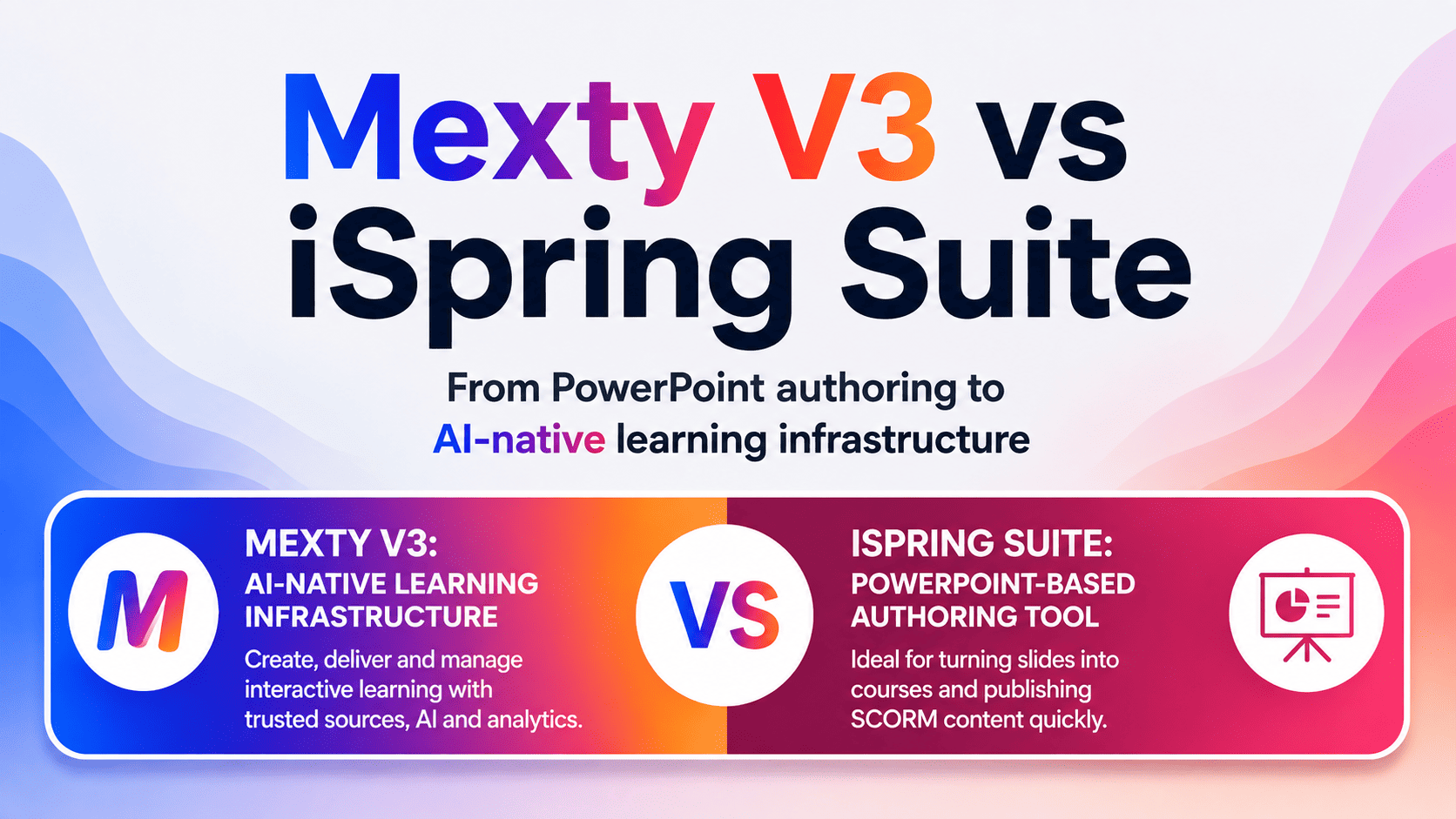
Mexty vs iSpring Suite: From PowerPoint-Based Authoring to AI-Native Learning Infrastructure
iSpring Suite has built a strong position in the eLearning market by making course creation familiar and accessible. Its core strength is clear: many teams already know PowerPoint, and iSpring allows them to turn PowerPoint-based content into professional eLearning modules, quizzes, role-plays, video tutorials, and SCORM-compatible packages for LMS deployment.
For many organizations, this has been a practical and efficient approach.
But enterprise learning is changing.
The rise of AI is not only changing how content is written. It is changing the entire workflow between a learning need and a working learning experience. Learning teams no longer only need to convert PowerPoint slides into online courses. They need to transform trusted knowledge into interactive, measurable, secure, continuously updated learning experiences.
This is where the difference between iSpring Suite and Mexty V3 becomes important.
iSpring Suite is a strong PowerPoint-based SCORM authoring tool.
Mexty is an AI-Native Learning Infrastructure designed to handle modern learning creation, deployment, learner support, analytics, and AI governance in one connected workflow.
1. The iSpring Workflow: Familiar, Efficient, but Still PowerPoint-Centered
The main value of iSpring is familiarity.
If a team already works in PowerPoint, iSpring makes it easier to convert existing presentations into eLearning. Users can add quizzes, role-plays, narration, video tutorials, and then publish the result to an LMS in formats such as SCORM, xAPI, cmi5, or AICC.
This is useful for teams that want to replace basic slide sharing with trackable online learning.
However, the workflow remains largely PowerPoint-centered.
That means many learning teams still start from slides, decks, documents, and static content.
They may create a storyboard in Word or PowerPoint, design slides, add interactions, build quizzes, publish to SCORM, upload to the LMS, and then track completion elsewhere.
This is simpler than many traditional authoring workflows, but it is still not fully AI-native.
The learning experience is often built around converting existing slide-based material into online training, rather than generating a full learning journey from source of truth, learner needs, AI model selection, interactive activities, assessments, AI Agents, and analytics.
2. Mexty: One AI-Native Workflow for Modern Learning
Mexty starts from a different assumption.
The future of learning is not only PowerPoint-to-SCORM.
The future is source-to-learning.
In Mexty, users can begin with a document, a policy, a PDF, a video, a knowledge base, a product manual, a compliance procedure, or a simple learning objective. From there, the platform helps create structured learning experiences:
interactive activities,
full courses,
assessments,
learning paths,
learner assignments,
AI Agents,
and analytics.
This makes Mexty an AI-native platform for creating interactive learning experiences, not just a tool for converting slides into LMS-ready content.
The workflow becomes:
define goals and source of truth,
generate course structure,
create interactive activities,
integrate assessments,
publish or export,
assign learners,
support them with AI Agents,
monitor results,
and update content when knowledge changes.
Instead of separating creation, interactivity, assessment, LMS deployment, learner support, and reporting across multiple tools, Mexty brings them into one secure interactive learning platform.
3. Source of Truth vs Slide-Based Starting Point
One of the major differences between Mexty and iSpring is the starting point.
iSpring is very strong when the starting point is PowerPoint. If your organization already has slide decks and wants to turn them into SCORM-compatible courses, iSpring is a natural option.
But modern enterprise learning increasingly starts from broader knowledge sources:
PDF policies,
SOPs,
product documentation,
knowledge bases,
videos,
internal procedures,
web resources,
compliance documents,
and evolving company expertise.
Mexty is designed around trusted sources of truth.
This matters because AI-generated learning is only valuable if it is grounded in accurate and approved knowledge. A generic AI prompt can produce content, but enterprise learning requires control.
Mexty allows users to choose the sources they want the AI to work from, making it a trusted AI authoring platform and a privacy-focused AI course creator.
This is especially important when teams need to convert PDF to interactive course content.
The goal is not just to convert a document into an eBook or slide-based module.
The goal is to transform static knowledge into:
interactive activities,
knowledge checks,
assessments,
scenarios,
and learning paths.
4. AI-Native Creation vs AI-Assisted Authoring
iSpring has added AI capabilities to accelerate content creation. This is useful for generating ideas, improving text, creating quizzes, and helping authors move faster.
But there is an important difference between AI-assisted authoring and an AI-native learning infrastructure.
AI-assisted authoring means AI helps inside an existing workflow.
AI-native learning means the entire workflow is designed around AI, trusted knowledge, interactivity, learner support, analytics, and continuous updates.
Mexty is built as an AI workflow for instructional design. It does not only help write course text. It helps structure content, create interactions, generate assessments, build learning paths, support learners, and monitor outcomes.
This is why Mexty is more than an AI authoring tool for L&D.
It is an AI-native LMS and authoring platform.
5. Interactive Course Creation with Vibe Coding
The biggest shift in learning creation is the collapse of the barrier between idea and prototype.
In the past, creating interactive content required manual production. Even with user-friendly tools, a learning designer still had to define screens, create slides, build interactions, configure quizzes, and test everything.
Mexty introduces the logic of vibe coding for interactive learning.
Instead of manually building every element, the user describes the learning experience they want:
"Create a branching scenario for customer support training."
"Build a drag-and-drop activity from this compliance policy."
"Create a product knowledge quiz with feedback."
"Turn this PDF into a 20-minute interactive course."
"Create a six-week onboarding learning path."
This is interactive course creation with vibe coding.
It allows teams to create interactive courses without coding and deliver interactive learning without technical complexity.
For LMS environments, vibe coding for SCORM interactive courses becomes particularly powerful:
Users can describe the learning experience, generate it, edit it, and publish it in an LMS-compatible format.
This is where Mexty becomes:
an easy interactive course builder,
and an AI-native SCORM authoring platform for interactive learning creation.
6. SCORM and LMS Compatibility
iSpring has a strong reputation as a SCORM authoring tool. Its ability to publish PowerPoint-based content into SCORM, xAPI, cmi5, and AICC formats is one of its major strengths.
Mexty does not reject this requirement.
Many enterprises still need SCORM-compatible learning content. LMS platforms remain central for completion tracking, certification, compliance reporting, and learner management.
That is why Mexty is designed as an LMS-ready authoring platform and LMS-compatible AI course creator.
The difference is that Mexty is not only focused on packaging course content for the LMS.
It also supports the broader learning lifecycle:
creation,
interactivity,
assessment,
learner assignment,
AI support,
analytics,
and continuous updates.
This positions Mexty as an LMS-compatible interactive learning platform and AI-native LMS authoring platform.
For organizations that want to modernize without abandoning existing LMS infrastructure, this is critical.
7. Learning Paths, Assignments, and Learner Monitoring
iSpring can work within an LMS ecosystem, especially when paired with iSpring LMS. This supports training delivery, user management, and reporting.
Mexty goes further by integrating authoring and learning management logic into the same AI-native workflow.
Learning teams can create not only courses, but also multi-step learning paths.
These paths can include:
courses,
interactive activities,
assessments,
checkpoints,
and AI Agent support
over several weeks or months.
This is essential for:
onboarding,
compliance,
product training,
sales enablement,
leadership development,
and technical certification.
Mexty is therefore not just an Interactive Course Creator.
It is also an Interactive LMS platform where teams can:
assign learners,
monitor progress,
track performance,
and identify who needs support.
8. AI Agents for Learning
One of the strongest differences between Mexty and traditional authoring tools is the role of AI Agents.
In most traditional workflows, the course is published and the learner experience is limited to the content inside the module.
If the learner has a question, they must:
ask a trainer,
search documentation,
or wait for support.
Mexty enables AI Agents for Learning.
These personalized AI Agents can be grounded in trusted content and made available to learners and trainers.
They can:
answer questions,
explain concepts,
provide contextual support,
recommend practice,
and help learners stay on track.
For trainers and L&D teams, AI Agents can also help:
update content,
generate new activities,
adapt materials,
or support learners who are falling behind.
This turns learning from a static course into a living support experience.
9. Security, Privacy, and Enterprise Readiness
When AI is used in enterprise learning, security and privacy are not optional.
Learning platforms may contain:
internal policies,
employee data,
assessment results,
product knowledge,
onboarding material,
compliance procedures,
and confidential business content.
Mexty is designed as:
a secure AI authoring platform,
and a privacy-first AI authoring tool.
Its positioning as:
a GDPR-compliant AI learning platform,
a secure educational AI platform,
and an AI learning platform with privacy controls
is important for enterprise buyers.
In an AI-native learning environment, organizations need control over:
which sources are used,
which models are selected,
who can access content,
how learner data is handled,
how content is updated,
and how governance is maintained.
This is what makes Mexty an enterprise-ready AI authoring tool.
10. Benchmark Summary
| Dimension | iSpring Suite | Mexty V3 |
|---|---|---|
| Core strength | PowerPoint-based course creation and SCORM publishing | AI-native learning creation and secure learning infrastructure |
| Starting point | PowerPoint slides, quizzes, role-plays, video tutorials | Sources of truth: PDFs, policies, knowledge bases, videos, documents, ideas |
| AI role | AI-assisted authoring inside an existing workflow | AI-native workflow across creation, interactivity, assessment, learning paths, AI Agents, and analytics |
| Interactivity | Quizzes, role-plays, interactions within a PowerPoint-based workflow | Vibe coding for interactive learning and AI-generated activities |
| SCORM / LMS | Strong SCORM, xAPI, cmi5, and AICC publishing | SCORM-compatible and LMS-ready AI-native authoring |
| Workflow | Familiar, efficient, but PowerPoint-centered | Unified, source-grounded, AI-native workflow |
| Learner support | Mostly through LMS/training structure | Native AI Agents for Learning |
| Analytics | LMS-based reporting | Integrated learner monitoring and insights |
| Best fit | Teams converting PowerPoint content into eLearning | Teams building modern interactive learning from trusted knowledge |
| Strategic direction | Simplify slide-to-course production | Replace complex authoring workflows with AI-native learning infrastructure |
11. Why Mexty Matters for 2026
The best authoring tools in 2026 will not only be judged by how easily they convert slides into SCORM.
The Best eLearning Authoring Tool 2026 will be the platform that helps teams move:
from trusted knowledge to interactive learning experiences,
from complex workflows to interactive learning in minutes,
and from static content to measurable learner impact.
This is why many teams are now exploring:
iSpring Alternatives,
Articulate Storyline Alternatives,
and Genially Alternatives.
The need is not simply a new authoring tool.
The need is to:
simplify eLearning workflows,
simplify instructional design workflows,
replace PowerPoint-based training workflows,
and reduce dependence on complex, fragmented production models.
Mexty answers this need by offering a modern AI-native LMS and authoring platform.
It helps teams:
create,
edit,
publish,
assign,
track,
and improve learning
in one controlled environment.
Conclusion
iSpring Suite is a strong and practical tool for teams that want to create eLearning in a familiar PowerPoint environment and publish SCORM-compatible content to an LMS.
But the future of learning is moving beyond PowerPoint-based authoring.
Modern learning teams need a secure AI authoring platform that can:
work from trusted sources,
generate interactive learning experiences,
create assessments,
build learning paths,
support learners with AI Agents,
integrate with LMS workflows,
and provide analytics.
That is the Mexty advantage.
Mexty is:
an Interactive Learning Platform,
an AI authoring tool for L&D,
an AI lesson creator for teachers,
a secure interactive learning platform,
and an AI-native LMS and authoring platform built for the future of learning.
It is designed to help teams move beyond slide-based production and replace complex authoring workflows with a secure, AI-native learning infrastructure.
Not just PowerPoint to SCORM.
From trusted knowledge to interactive learning experiences.
If you enjoyed this, you’ll love our next articlesMexty and the EU AI Act: Building Trustworthy AI-Powered Learning by Design |