

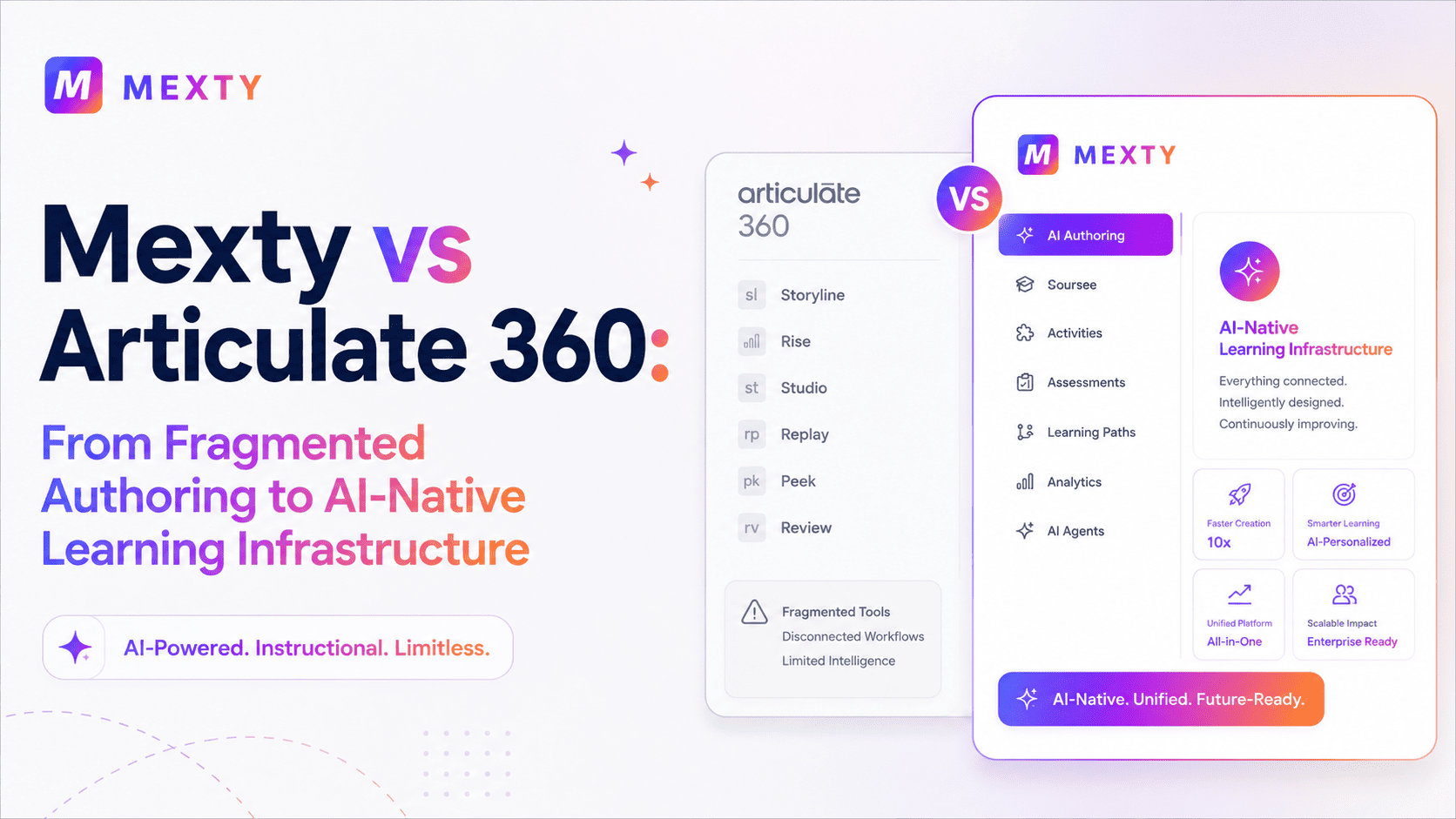
Mexty vs Articulate 360: From Fragmented Authoring to AI-Native Learning Infrastructure
For many years, Articulate 360 has been one of the most recognized suites in eLearning authoring. Storyline 360, Rise 360, Review 360, Reach 360, and the wider Articulate ecosystem have helped thousands of teams create workplace training, publish SCORM-compatible courses, and deploy learning into LMS environments.
But the learning market is changing.
AI is not only accelerating content generation. It is changing the entire workflow between a learning idea and a working interactive course. The new challenge for L&D teams is no longer just “How do we build a course?” It is:
How do we create from trusted sources?
How do we use AI safely?
How do we build interactivity without technical complexity?
How do we publish to the LMS?
How do we support learners after publication?
How do we monitor progress and improve continuously?
This is where the difference between a traditional authoring suite and an AI-Native Learning Infrastructure becomes clear.
Mexty is built for this new reality: one platform, one workflow, everything connected.
The Traditional Articulate 360 Workflow: Powerful, but Fragmented
Articulate 360 remains a powerful solution for eLearning production. Storyline 360 is especially strong for custom slide-based courses, branching logic, triggers, variables, and interactive objects. Rise 360 is useful for responsive courses. Review 360 supports stakeholder feedback. Reach 360 can support delivery. Articulate AI Assistant adds AI support for creating and refining content.
But in many real production environments, the workflow still remains fragmented.
As illustrated in the first benchmark visual, interactive course creation with Storyline 360 often involves many separate steps and tools:
AI drafting may happen in ChatGPT, Claude, Gemini, or Articulate AI Assistant.
Storyboard and planning may happen in Word, PowerPoint, Miro, or Notion.
Visual assets may be created in Canva, Figma, Photoshop, Illustrator, Midjourney, or DALL-E.
Course building happens in Storyline 360.
Advanced interactions may require Storyline advanced features, JavaScript, H5P, widgets, or external tools.
AI tutor or chatbot support may require Custom GPTs, Botpress, Intercom AI, APIs, or iframe integrations.
Publishing happens through Storyline 360 export.
Deployment and tracking may happen in Reach 360, Moodle, Docebo, Cornerstone, or another LMS.
Reporting may happen in LMS reports, Excel, Power BI, or Tableau.
Each tool may be excellent on its own. The issue is not the quality of the tools. The issue is the handoffs.
Information is copied, pasted, reformatted, and rebuilt multiple times. Assets are stored in different places. Designers switch constantly between tools. Interactions may need to be rebuilt across systems. Technical complexity increases with JavaScript, APIs, SCORM settings, and compatibility testing. Data becomes siloed across authoring tools, LMS platforms, spreadsheets, and dashboards.
The result is a fragmented learning creation experience.
More tools.
More integrations.
More context switching.
More cost.
More time spent on production instead of pedagogy.
This is the gap Mexty V3 is designed to close.
Mexty : One AI-Native Workflow
Mexty approaches the problem differently.
Instead of adding AI to a traditional authoring workflow, Mexty is designed as an AI-native platform for creating interactive learning experiences from the start.
The workflow shown in the Mexty benchmark visual is unified:
Define goals and source of truth.
Generate the AI-native course structure.
Vibe-code interactive activities.
Integrate assessments.
Add AI Agent or tutor support.
Publish and deploy.
Support learners.
Analyze performance.
All of this happens inside Mexty.
This makes Mexty more than an Interactive Course Creator. It is an AI-Native Learning Infrastructure that connects source knowledge, AI generation, interactive activities, assessment, AI Agents, learner management, publishing, and analytics.
For L&D teams, this means fewer manual handoffs and less context switching. Instead of building pieces across disconnected tools, teams can work from one secure interactive learning platform.
Source of Truth First
One of the biggest limitations of generic AI authoring is that AI can generate content without knowing whether it is accurate, approved, or aligned with company knowledge.
Mexty starts from the opposite principle: source of truth first.
Teams can connect documents, policies, SOPs, onboarding materials, product documentation, internal knowledge bases, and other trusted content sources. This allows Mexty to generate learning experiences grounded in approved knowledge, not generic assumptions.
This is especially important when teams need to convert PDF to interactive course experiences. In a traditional workflow, a PDF may be manually summarized, copied into slides, transformed into quizzes, and rebuilt as a SCORM package. With Mexty, the goal is to turn static knowledge directly into structured learning: activities, lessons, assessments, and learning paths.
This is what makes Mexty a trusted AI authoring platform rather than a simple AI prompt box.
Vibe Coding for Interactive Learning
One of the strongest differences between Mexty and traditional authoring workflows is the concept of vibe coding for interactive learning.
In traditional Storyline development, advanced interactivity often requires significant authoring expertise: triggers, layers, variables, states, branching logic, and sometimes JavaScript. This gives expert designers control, but it also creates complexity.
Mexty reduces that barrier.
With interactive course creation with vibe coding, the user describes the experience they want:
“Create a drag-and-drop activity from this policy.”
“Build a branching scenario for sales objection handling.”
“Create a cybersecurity mini-game with feedback.”
“Turn this onboarding PDF into an interactive course.”
“Generate a scored assessment based on this knowledge base.”
Mexty then helps create the activity, structure, interaction, and learning logic. The designer can still review and edit, but the technical production burden is reduced.
This is especially important for teams looking to create interactive courses without coding and deliver interactive learning without technical complexity.
For organizations that still need LMS compatibility, vibe coding for SCORM interactive courses becomes a powerful concept: describe the learning experience, generate the interactive content, review it, and publish in an LMS-ready format.
This is vibe-coding for elearning applied to real L&D workflows.
SCORM and LMS Compatibility
Articulate 360 is widely used as a SCORM authoring tool, and SCORM compatibility remains important for many organizations. Enterprises still rely on LMS systems for completion tracking, compliance, certification, and reporting.
Mexty does not ignore that reality.
Mexty V3 is positioned as an LMS-ready authoring platform and LMS-compatible AI course creator. The objective is to help teams create modern interactive learning experiences while still supporting existing LMS ecosystems where needed.
This makes Mexty an AI-native SCORM authoring platform for interactive learning creation: not just a tool to package slides, but a platform to create, structure, assess, deploy, and track learning from trusted knowledge.
For organizations with existing LMS investments, this matters. They do not necessarily want to rip and replace their entire infrastructure. They need an LMS-compatible interactive learning platform that modernizes the creation and learner experience layer while remaining compatible with deployment requirements.
AI Agents for Learning
A traditional course often ends once it is published.
Mexty extends the learning experience with AI Agents for Learning.
AI Agents can support learners with contextual help, answer questions based on trusted course content, guide learners through difficult concepts, and provide personalized support. Trainers and L&D teams can also use AI Agents to update learning materials, suggest new activities, or support learners who are falling behind.
This is a major difference from a standard SCORM package.
The future of learning is not only a course file uploaded to an LMS. It is a living learning experience where learners can receive support throughout their journey.
In the Mexty workflow, the AI Agent is native to the platform. It is not an external chatbot bolted on through an iframe or separate API project. This reduces fragmentation and keeps the learner experience connected to the source of truth.
Security, Privacy, and Governance
Enterprise AI adoption requires trust.
Learning platforms may contain employee data, assessment results, internal policies, confidential product knowledge, customer training content, and regulated procedures.
This is why Mexty is designed as a secure AI authoring platform and privacy-first AI authoring tool. For enterprise buyers, AI in learning cannot be reduced to productivity. It must also address privacy, access control, governance, source control, and compliance.
Mexty’s positioning as a GDPR-compliant AI learning platform, privacy-focused AI course creator, and AI learning platform with privacy controls is central to its value proposition. The platform is built for the requirements of enterprise learning teams that need secure, controlled, trusted AI workflows.
This is also why ISO 27001 and SOC 2 readiness matters. When learning platforms handle internal knowledge and learner data, security cannot be an afterthought. A secure educational AI platform must be designed around governance from the start.
Replacing Complexity, Not Expertise
Mexty is not designed to say that instructional designers are no longer needed.
Quite the opposite.
AI should simplify instructional design workflow, not remove instructional design judgment.
The value of Mexty is that it reduces repetitive production work: copying content, rebuilding interactions, switching tools, formatting slides, recreating assessments, exporting multiple versions, and manually aligning learning components.
This allows instructional designers to focus on higher-value work: learning objectives, learner needs, scenario quality, assessment validity, feedback, engagement, and performance outcomes.
For teams searching for Articulate Storyline Alternatives, Genially Alternatives, or iSpring Alternatives, the real question is not only “Which tool has more features?” The better question is:
Which platform helps us move faster with less complexity?
Which platform supports AI-native creation?
Which platform keeps content grounded in trusted knowledge?
Which platform supports learners after publication?
Which platform reduces tool fragmentation?
Which platform is ready for modern enterprise learning?
In that context, Mexty becomes an easier alternative to Storyline, a modern alternative to Storyline workflows, and an AI alternative to Storyline for teams that want Storyline without complexity.
It can help simplify Storyline development, reduce Storyline dependency, and replace PowerPoint-based training workflows with interactive, AI-assisted learning creation.
Benchmark Summary
Dimension | Articulate 360 Suite | Mexty V3 |
Core model | Traditional authoring suite enhanced with AI | AI-native LMS and authoring platform |
Workflow | Powerful but often fragmented across multiple tools | Unified workflow inside one platform |
AI role | AI assistant for content acceleration | AI-native workflow across creation, assessment, agents, analytics |
Source grounding | Depends on how content is managed by the team | Built around source of truth and knowledge bases |
Interactivity | Strong, especially in Storyline, but can be complex | Vibe coding for interactive learning |
Technical complexity | Advanced interactions may require expert skills | Create interactive courses without coding |
SCORM/LMS | Strong SCORM authoring heritage | SCORM-compatible, LMS-ready authoring platform |
Learner support | Often separate from the authored course | Native AI Agent for Learning |
Analytics | Often distributed across LMS and reporting tools | Integrated analytics and learner monitoring |
Enterprise AI governance | Depends on suite configuration and workflow | Built as secure AI-native learning infrastructure |
Why Mexty Matters for 2026
The best authoring tools in 2026 will not simply be judged by how many templates or triggers they offer.
The Best Elearning Authoring Tool 2026 will be the one that helps learning teams move from complex workflows to interactive learning in minutes, while keeping security, privacy, source grounding, human editing, LMS compatibility, analytics, and learner support under control.
Mexty is built for this new category.
It is an AI authoring tool for L&D, an AI lesson creator for teachers, an easy interactive course builder, an Interactive Learning Platform, and an AI-native LMS authoring platform.
Its objective is not only to generate content faster. Its objective is to replace complex authoring workflows with a secure, AI-native learning infrastructure that supports the full learning lifecycle.
Conclusion
Articulate 360 remains a mature and respected eLearning suite, especially for teams deeply invested in Storyline-based development.
But the market is moving toward something different.
Modern learning teams need more than a powerful desktop authoring tool. They need an enterprise-ready AI authoring tool that connects sources of truth, AI generation, interactive activities, assessments, AI Agents, LMS deployment, learner management, and analytics.
They need to simplify eLearning workflow and simplify instructional design workflow.
They need to move from fragmented production to unified learning infrastructure.
That is the Mexty advantage.
Mexty is built to help teams create interactive learning without technical complexity, reduce tool fragmentation, support SCORM-compatible publishing, and deliver secure AI-native learning experiences from trusted knowledge.
Not just another authoring tool.
A secure, AI-native learning infrastructure built for the future of learning.
If you enjoyed this, you’ll love our next articlesBest eLearning Authoring Tools in 2026: Why AI-Native Learning Infrastructure Is Becoming the New Standard |