

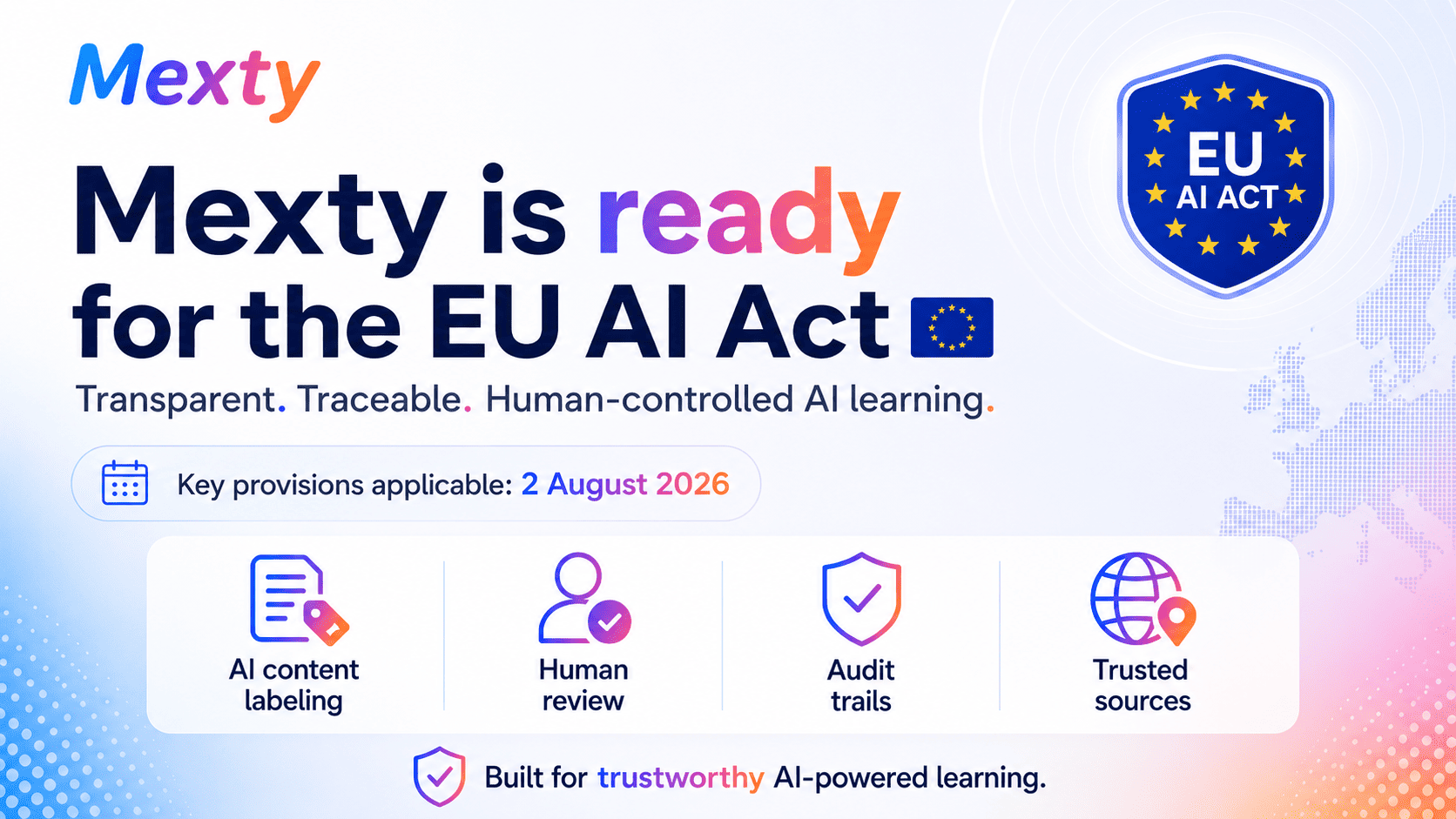
Mexty and the EU AI Act: Building Trustworthy AI-Powered Learning by Design
On 2 August 2026, important
provisions of the European Union’s AI Act become applicable, including Article
50 transparency requirements for certain AI systems and particular categories
of AI-generated or AI-modified content. These rules are intended to help people
recognise when they are interacting with an AI system or encountering synthetic
or manipulated content.
AI literacy requirements are not
new. Article 4 of the AI Act has applied since 2 February 2025 and requires
providers and deployers of AI systems to take appropriate measures to support
the AI literacy of employees and other people using AI systems on their behalf.
The measures should reflect their knowledge, experience, training and the
context in which the technology is used.
For learning and development teams,
this creates an important moment.
AI is rapidly changing how
organizations create courses, support learners, assess knowledge and distribute
information. But responsible adoption cannot be reduced to adding an
“AI-generated” label to a document or publishing a general AI policy.
It requires a complete and
controlled workflow.
At Mexty,
we have prepared our AI-Native secure Learning Infrastructure around that
principle: innovation and governance should not be treated as competing
objectives. They must be designed together.
Why the EU AI Act matters for learning platforms
Learning platforms are becoming deeply connected to AI.
An AI authoring tool for L&D
can help create course structures, scenarios, questions, explanations and
feedback. An AI assistant may guide an author during course development or
support learners while they complete an activity. AI can also help transform
policies, product documentation and training materials into more accessible
learning experiences.
These capabilities offer
significant value. They can help teams:
- accelerate course development;
- reuse existing
knowledge;
- generate
differentiated learning activities;
- provide
more contextual support;
- improve
accessibility and localization;
- simplify
updates;
- create
richer opportunities for practice.
However, they also introduce new
questions.
Was the content created or
significantly modified using AI? Which model was used? What information was
provided to the model? Was the output grounded in an approved source? Did a
qualified person review it? Can the organization identify what changed between
versions? Could the output mislead a learner? Is an AI interaction clearly
identified as such?
These are not merely legal
questions. They are questions of instructional quality, organizational
accountability and learner trust.
The EU AI Act makes some of these
concerns more explicit, but responsible learning design should address them
even where a specific transparency obligation does not apply.
Transparency requires more than a visible label
Article 50 does not impose
identical labelling requirements on every piece of AI-assisted content. Its
obligations depend on the AI system, the role of the provider or deployer and
the type and context of the content involved.
For example, the rules address
informing individuals when they interact directly with certain AI systems,
machine-readable marking of AI-generated or manipulated outputs by relevant
providers, and disclosure requirements covering deepfakes and certain AI-generated
or manipulated text published to inform the public on matters of public
interest.
For learning platforms, the broader
lesson is clear: organizations need to know where AI is being used and be able
to communicate that use appropriately.
Mexty
supports this approach through the clear identification of AI-assisted content
and interactions.
This can include distinguishing
between:
- content written entirely by a human;
- content
initially generated by AI and reviewed by a human;
- existing
content modified with AI assistance;
- learner
interactions with an AI agent;
- AI-generated
images, audio, video or other media;
- AI-supported
assessments or feedback.
Transparency should help users
understand the nature of the experience. It should not become a superficial
badge that replaces meaningful governance.
Human review must remain part of the publishing
process
AI can create convincing material
very quickly. It can also produce errors, omit essential context, misunderstand
source documents or generate statements that sound more certain than the
underlying evidence justifies.
This is particularly important in
workplace learning.
Incorrect content may affect safety
procedures, regulatory compliance, customer interactions, employment practices,
product use or important business decisions.
That is why Mexty is designed as a Trusted AI authoring
platform, not an autonomous publishing engine.
AI-generated material should be
treated as a draft until it has been reviewed and approved by an accountable
person. Authors and reviewers should remain able to:
- inspect the generated output;
- compare
it with the approved sources;
- correct
inaccuracies;
- rewrite
unclear sections;
- remove
inappropriate content;
- change
activities and assessments;
- approve
the final experience before publication.
Full manual editing is essential.
Human oversight is meaningful only when people can genuinely control the result
rather than merely accept or reject an entire generated course.
A responsible Secure AI
authoring platform must therefore combine automation with practical editorial
control.
Grounding AI in approved Sources of Truth
Generic AI models are trained on
broad collections of information. That can be useful for general knowledge,
brainstorming and language support, but enterprise learning often requires
something more controlled.
Organizations need training content
to reflect their own:
- policies;
- procedures;
- technical
documentation;
- approved
terminology;
- products
and services;
- compliance
rules;
- operational
practices;
- brand and
communication standards.
Mexty
uses approved Sources of Truth to help ground AI-generated learning content in
the materials selected by the organization.
This creates an important
distinction between asking a general-purpose model to create a course from its
general knowledge and using an AI-native platform for creating interactive
learning experiences based on controlled organizational sources.
Grounding does not eliminate the
need for human review. Source documents may themselves be outdated, incomplete
or contradictory. However, it gives authors and reviewers a clearer foundation
for validating outputs and maintaining content integrity.
It also makes updates more
manageable. When a policy or procedure changes, organizations need to
understand which learning content depends on it and whether that content should
be reviewed.
Traceability of AI actions, models and changes
Responsible AI adoption requires
more than knowing that AI was used at some point.
Organizations may need to
understand:
- which AI function was used;
- which
model or provider supported the action;
- what
source materials were involved;
- when the
action occurred;
- what
output was produced;
- what
edits were subsequently made;
- who
reviewed and approved the content.
This is why traceability, version history and audit trails
are central to Mexty’s
approach.
Traceability supports several
objectives simultaneously.
It helps authors understand how
content evolved. It gives reviewers better context during validation. It allows
administrators to investigate an issue. It supports continuous improvement and
provides evidence that the organization has implemented meaningful governance
rather than relying on informal practices.
An Enterprise-ready AI authoring
tool should not treat AI generation as an invisible event. It should make
AI-supported creation part of an accountable content lifecycle.
AI literacy must become an operational capability
The AI Act’s literacy requirement
is particularly relevant to learning and development teams.
AI literacy is not satisfied by
sending employees a short definition of artificial intelligence. People need
guidance appropriate to their roles and the systems they use.
An author creating compliance
training needs different knowledge from a learner using an AI tutor. An
administrator configuring a workspace has different responsibilities from a
reviewer approving AI-generated media.
Effective AI literacy may include
understanding:
- what an AI system can and cannot do;
- how
hallucinations and other errors can occur;
- why
outputs need verification;
- how
approved sources should be used;
- when
personal or confidential data should not be entered;
- how to
identify inappropriate or misleading content;
- how to
report a problem;
- when
human judgment must override an AI suggestion.
The European Commission has
published practical AI literacy resources and examples to help providers and
deployers develop proportionate initiatives.
Mexty’s
approach includes guidance for authors, administrators and internal teams so
that responsible AI use becomes part of daily working practices not simply a
policy stored in a shared folder.
Protecting learners in assessments and analytics
AI introduces particular risks when
it influences assessments, learner analytics or decisions affecting
individuals.
AI can help authors draft
questions, propose feedback and generate scenario variations. It can also help
identify patterns in learning activity. But these outputs should not
automatically determine whether a learner is competent, eligible for an
opportunity or subject to a significant decision.
Assessment questions generated by
AI should be reviewed for:
- factual accuracy;
- relevance
to the learning objective;
- ambiguity;
- unintended
bias;
- appropriate
difficulty;
- the
quality of feedback;
- whether
the assessment measures meaningful capability.
Learner analytics also need
context. Completion rates, scores and activity data may inform decisions, but
they rarely provide a complete picture of someone’s knowledge or performance.
Mexty
therefore places safeguards around assessments, analytics and significant
decisions. Human accountability must remain central, particularly where an
outcome could materially affect a learner or employee.
The purpose of an AI Agent for
Learning should be to support learning and reflection not to make
unsupported judgments about individuals.
Reviewing AI-generated media
The transparency debate often focuses
on written content, but AI-generated or AI-modified media can also include:
- images;
- illustrations;
- diagrams;
- voice-overs;
- audio;
- video;
- avatars;
- animations;
- captions;
- transcripts;
- thumbnails.
These assets should be reviewed for
accuracy, appropriateness, accessibility, licensing, potential bias and the
risk that they could mislead learners.
Realistic media deserves particular
attention. A synthetic voice, realistic avatar or generated workplace scene may
be perceived as authentic even when it represents a fictional person or
situation.
The EU has published optional icons
and guidance connected to the disclosure of certain AI-generated content. The
Commission notes that using an icon does not, by itself, establish legal
compliance; the relevant disclosure still needs to meet Article 50 requirements.
For Mexty,
media review is part of the broader publishing workflow rather than an isolated
compliance step.
Reporting and correcting learner-facing issues
Even with strong controls, issues
can occur.
A learner may encounter an
inaccurate explanation, inappropriate image, misleading AI response, broken
interaction or assessment question that does not reflect the approved source.
A trustworthy Secure interactive
learning platform should provide a process for:
- reporting the issue;
- recording
the relevant context;
- investigating
the content or AI interaction;
- identifying
the source of the problem;
- correcting
or withdrawing the affected material;
- reviewing
whether related content is also affected;
- documenting
the resolution.
This creates a practical feedback
loop between learners, authors, reviewers and administrators.
It also turns governance into an
ongoing process. Responsible AI is not something completed when a course is
published. It continues throughout the life of the learning experience.
Combining governance with interactive learning
Compliance should not force
organizations back into static, document-heavy training.
A governed learning environment can
still be creative, adaptive and engaging.
Mexty
enables teams to create interactive courses without coding, build scenarios and
assessments, and deliver learning through a SCORM-compatible environment while
maintaining human review, traceability and source grounding.
As an AI-native LMS and authoring platform, Mexty connects
creation, review, delivery, learner support, analytics and continuous
improvement.
This matters because AI governance
should follow the content across its lifecycle. Controls should not disappear
once material has been exported or assigned to learners.
The objective is not to slow
learning teams down. It is to simplify the instructional design workflow
while making the resulting process more transparent and controllable.
From compliance to confidence
The immediate deadline of 2 August
2026 will understandably lead many organizations to review their AI systems,
transparency practices and documentation.
But the opportunity is bigger than
regulatory compliance.
A controlled AI workflow can help
organizations:
- improve the reliability of learning content;
- protect
personal and organizational information;
- strengthen
accountability;
- respond
more effectively to learner concerns;
- update
training more consistently;
- increase
confidence among authors, administrators and learners;
- scale AI
adoption without losing human oversight.
At Mexty,
our objective is not simply to help organizations claim that they comply with
the EU AI Act.
It is to help them build
trustworthy, transparent and human-controlled AI-powered learning.
Innovation and governance should
not compete. When both are designed into the same infrastructure, organizations
can use AI more confidently while protecting learners, personal data, content
integrity and human accountability.
That is the next phase of AI in learning and Mexty is ready to
support it.
This article provides general
information and does not constitute legal advice. Organizations should assess
the AI Act requirements applicable to their specific systems, roles and use
cases.
If you enjoyed this, you’ll love our next articlesMexty V3 Is Live: An AI-Native Secure Learning Infrastructure for the Future of Enterprise Learning |