

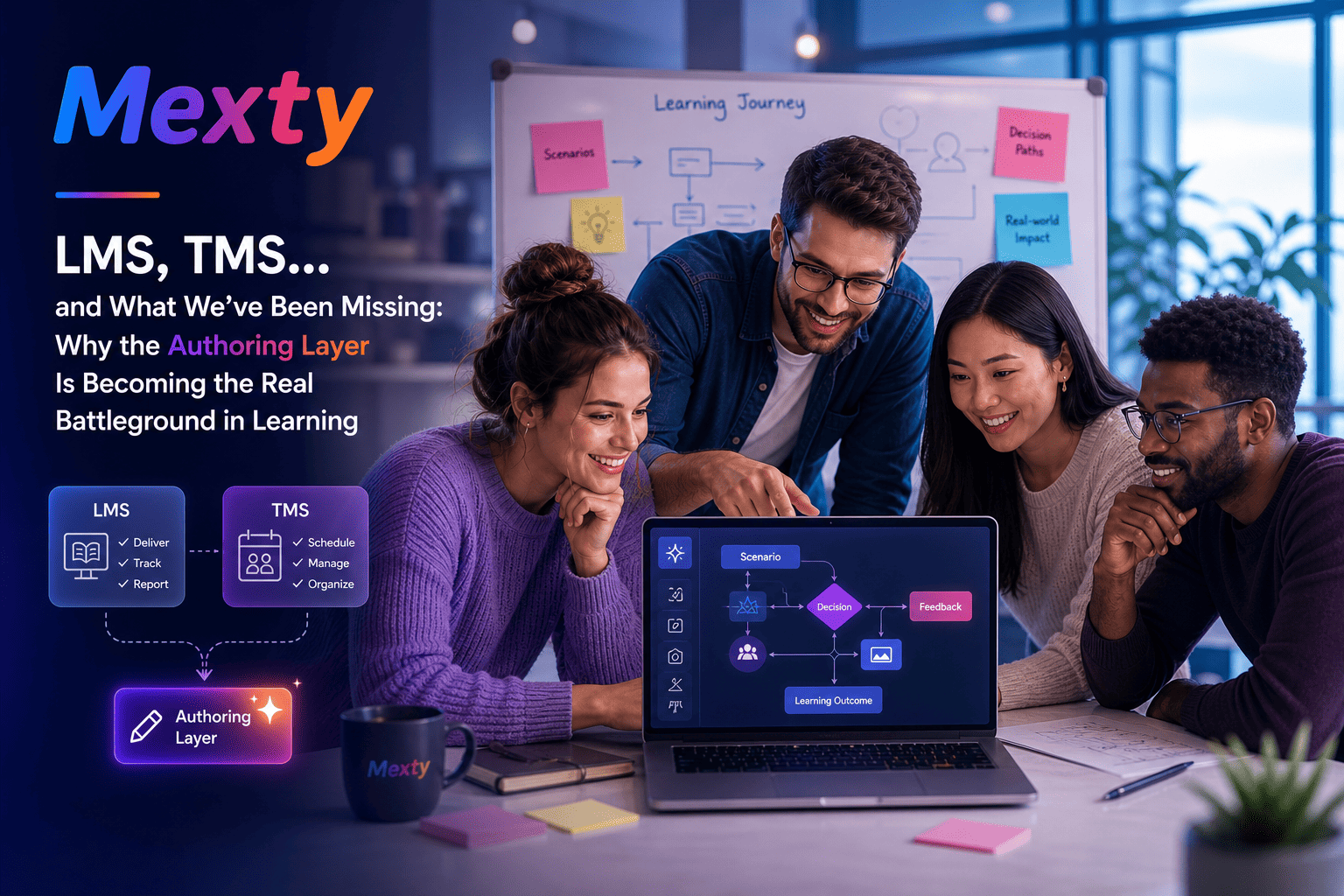
LMS, TMS… and What We’ve Been Missing: Why the Authoring Layer Is Becoming the Real Battleground in Learning
A recent discussion on Reddit caught my attention.
Someone made a simple but powerful observation: many L&D teams are trying to make their LMS do work it was never designed to do.
At first glance, this sounds obvious. Of course, an LMS has limits.
But if you look closer, this reveals a deeper structural issue in how organizations think about learning systems.
The problem is not just about tools.
It is about how we frame the entire learning ecosystem.
Because “training” is still too often treated as one single system problem.
In reality, it is not.
The illusion of a single learning system
In many organizations, the LMS has become the center of gravity.
Everything flows into it:
- courses
- reporting
- compliance tracking
- certifications
- sometimes even scheduling and logistics
And because of that, expectations keep growing.
Can the LMS handle blended learning?
Can it manage sessions?
Can it create engaging experiences?
Can it track everything?
At some point, the LMS becomes a “do everything” platform.
And that’s where the confusion begins.
Because fundamentally, the LMS was never designed to do all of that.
The three layers of learning
What we are seeing now is a clearer separation between three distinct layers:
1. Learning delivery (LMS)
The LMS is built to:
- distribute content
- track completion
- manage access
- report activity
It answers questions like:
Who completed the course? When? What score?
👉 It is a delivery system — not a design tool.
2. Training operations (TMS)
The TMS handles:
- scheduling sessions
- managing instructors
- logistics
- registrations
It runs the operational side of training.
👉 But it does not design learning either.
3. The missing layer: authoring / learning design
Even with a strong LMS and TMS, one key question remains:
👉 What are you actually delivering?
Distributing low-quality or generic content at scale does not create impact.
This is where the authoring layer becomes critical.
Why the authoring layer is now the bottleneck
For years, authoring tools were seen as production tools:
- create slides
- add interactions
- export SCORM
But today, the question has changed:
👉 Can we create learning that actually works?
And this is where traditional tools reach their limits.
The problem with traditional authoring tools
Most legacy tools are built around linear course creation:
- slides
- “next” navigation
- end-of-course quizzes
This leads to:
- passive learning
- limited decision-making
- weak real-world application
👉 Content is produced — but learning is not truly designed.
The rise of interactive learning
A new model is emerging:
- branching scenarios
- decision-based learning
- contextual feedback
- simulations
- adaptive paths
We move from:
👉 “What should we show?”
to
👉 “What should learners do?”
The rise of AI-native authoring platforms
This is where platforms like Mexty are redefining the space.
👉 Discover the platform: https://mexty.ai/
👉 Try interactive generation: https://workspace.mexty.ai/lms/chat
👉 Get started: https://mexty.ai/ressources/getting-started
Unlike traditional tools:
AI-enhanced tools:
- generate content faster
AI-native platforms:
- design learning experiences
- generate structured scenarios
- build interactive flows
- support iterative design
👉 This is not just acceleration.
👉 It is a fundamental shift in how learning is created.
Vibe coding for learning
One of the most interesting emerging concepts is:
👉 Vibe coding for learning
Instead of manually building every interaction, designers describe:
- the intent
- the scenario
- the objective
And the system generates a structured, interactive experience.
👉 The focus shifts from building to designing.
Why SCORM still matters
Despite innovation, SCORM compatibility remains essential.
Modern platforms must:
- support advanced interactions
- remain LMS-compatible
👉 Innovation without breaking existing systems.
The fragmentation problem
Today’s workflows are often fragmented:
- strategy → one tool
- content → another
- feedback → email / Slack
- delivery → LMS
This creates:
- inefficiency
- misalignment
- slower iteration
Toward a learning stack
Forward-thinking teams are evolving toward a new model:
- LMS → delivery
- TMS → operations
- Authoring → creation
👉 And most importantly: connecting these layers.
The shift for L&D teams
L&D teams are moving from:
👉 content producers
to
👉 experience designers
With a focus on:
- decision-making
- practice
- feedback
- real-world application
The risk of AI: more content, less learning
AI makes content creation easier.
But more content ≠ more learning.
The real challenge is:
👉 designing meaningful learning experiences.
What defines the best authoring tools in 2026
The best tools won’t be defined by:
- speed
- templates
But by their ability to:
- support interactive learning
- generate scenarios
- enable real design workflows
- integrate with LMS ecosystems
Conclusion
For years, organizations tried to push everything into the LMS.
Today, we understand its limits.
👉 Learning is not one system.
👉 It is a stack of specialized layers.
And most importantly:
👉 Without a strong authoring layer…
👉 there is no real learning impact.
If you enjoyed this, you’ll love our next articles