

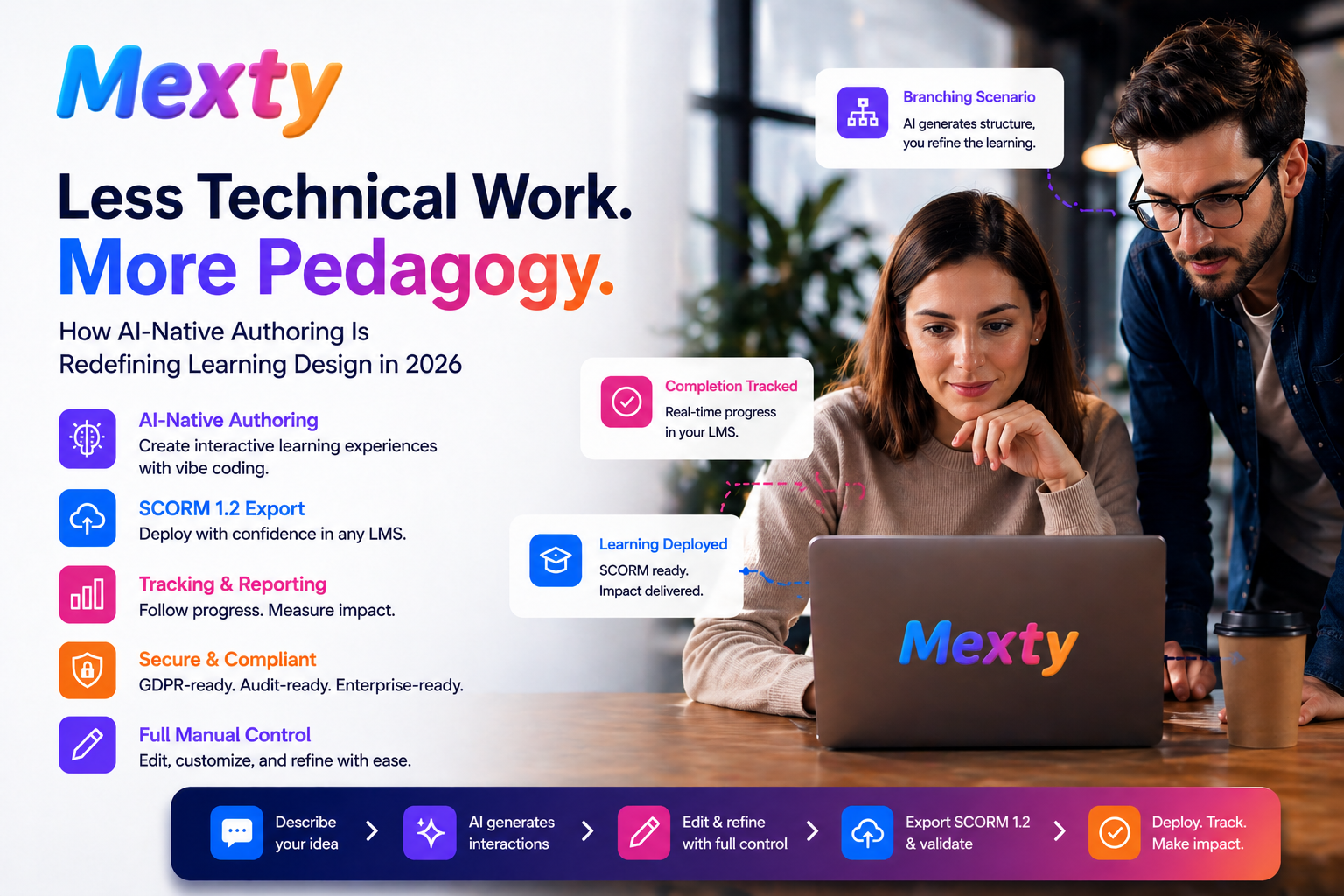
Less Technical Work. More Pedagogy.
How AI-Native Authoring Is Redefining Learning Design in 2026
How AI-Native Authoring Is Redefining Learning Design in 2026
For years, Learning Designers have been asked to do far more than design learning.
They are expected to think like educators, build like developers, manage like project leaders, and coordinate like consultants. In theory, their mission is simple: create learning experiences that help people understand, practice, apply, and improve performance.
In reality, much of their time is spent somewhere else.
Instead of focusing on pedagogy, many instructional designers spend the majority of their energy managing production complexity, building modules, fixing interactions, packaging SCORM files, testing LMS compatibility, and solving technical issues that have little to do with actual learning.
This has created one of the biggest inefficiencies in modern L&D.
The problem is not a lack of pedagogical expertise.
The problem is that technical production takes too much space.
This is exactly where AI-native authoring is changing the profession.
The future of learning creation is not simply faster content generation. It is about giving Learning Designers more time for pedagogy by reducing the technical burden of execution.
That is the real promise behind platforms like Mexty.
The Hidden Cost of Traditional Learning Production
Creating digital learning today usually means juggling three different roles at once:
- Pedagogy (≈35%)
- Technical production (≈40%)
- Communication & coordination (≈25%)
The imbalance is obvious.
Learning Designers are spending too much time being production teams and not enough time being learning architects.
Why Traditional Authoring Tools Are Reaching Their Limits
Traditional tools like Storyline, Captivate, or iSpring were built for manual authoring:
- slide by slide
- interaction by interaction
Even with AI features, the workflow remains heavy.
That’s why teams are actively searching for:
- Articulate Storyline Alternatives
- Genially Alternatives
- iSpring Alternatives
They are not just looking for tools.
They are looking for a better workflow.
From AI Assistance to AI-Native Authoring
There is a major difference between AI-assisted tools and AI-native platforms.
Traditional workflow:
idea → build → export → test → fix → deploy
AI-native workflow:
describe → generate → edit → validate → export → deploy
This is what defines an AI-native interactive learning platform.
And this is where Mexty stands out.
What Vibe Coding Means for Learning Design
Vibe coding for elearning changes everything.
Instead of building manually, designers describe what they want:
- a leadership simulation
- a compliance scenario
- a product onboarding journey
The platform generates the structure instantly.
With Mexty, designers focus on:
- improving pedagogy
- refining feedback
- strengthening learning impact
Not on technical production.
Why SCORM-Compatible Learning Still Matters
SCORM is still essential for:
- LMS tracking
- certification
- compliance
- reporting
Many AI tools fail at deployment.
They create demos, not real learning solutions.
Mexty solves this by making SCORM export native to the workflow.
From idea to LMS-ready learning.
Controlled AI: Speed Without Losing Control
AI should not replace control.
Designers still need to:
- edit content
- adjust flows
- refine interactions
That’s why controlled AI matters.
With Mexty:
- AI accelerates creation
- humans keep ownership
Source of Truth and Learning Reliability
In many industries, accuracy is critical.
AI must rely on validated content:
- internal documents
- policies
- expert sources
This is where “Source of Truth” becomes essential.
Mexty ensures reliable, controlled learning generation.
How Mexty Changes the Balance
Before:
- 35% pedagogy
- 40% technical work
- 25% coordination
With Mexty:
- 50% pedagogy
- 20% technical work
- 30% coordination
This is the real transformation.
The New Role of the Learning Designer
Learning Designers are becoming Learning Architects.
They focus on:
- behavior change
- learner experience
- performance impact
Not on building slides.
Conclusion: Less Technical Work. More Pedagogy.
The future of learning is not about more content.
It’s about better learning.
And the best tools will be those that:
- reduce complexity
- support real pedagogy
- enable deployment at scale
That is exactly what Mexty delivers.
Less technical work.
More pedagogy.
And learning that actually works.
If you enjoyed this, you’ll love our next articles