

Learning Science Best Practices Only Work When the
System Understands the Context
Learning science has given us a
strong set of principles.
Retrieval practice.
Spacing.
Interleaving.
Feedback.
Active practice.
Progressive difficulty.
Reactivation of prior knowledge.
But knowing these best practices
does not guarantee that they will actually work.
Why?
Because a good learning principle
only becomes effective when it is applied at the right time, for the right
learner, in the right context.
Asking a learner to retrieve
something from memory can be extremely effective but first, we need to know
whether that knowledge was actually acquired, how long ago it was last used,
what mistakes were made previously, and whether the learner is ready to move
forward.
The real challenge is therefore no
longer just to design a good curriculum. It is to create an environment capable
of measuring, contextualizing, and adjusting learning over time.
This is where an AI-Native
secure Learning Infrastructure can fundamentally change how we think about
learning.
Best practices need context
Take spacing as an example. In
theory, spacing learning over time improves retention. But spacing what? For
whom? At what interval?
Two learners who completed the same
course may have very different levels of mastery.
One may have understood the concept
perfectly and simply need to reactivate it three weeks later.
Another may have struggled with
several foundational concepts and need a different activity the next day.
Applying the same schedule to
everyone risks turning a strong learning principle into a mechanical
rule.
The same is true for interleaving.
Mixing different problem types can help learners recognize which strategy to
apply but if the learner has not yet mastered the fundamentals, interleaving
may simply create confusion.
Learning science gives us principles,
not universal recipes, however their effectiveness depends on context and
today, much of that context can come from the continuous evaluation of the
learner.
Assessment should not only happen at the end
In many learning systems,
assessment is still treated as an event:
- Learn.
- Take a
test.
- Receive a
score.
But a final score arrives too late
to influence most of the learning journey.
A more intelligent learning
infrastructure should treat assessment as a continuous process. Every activity
can generate a signal: A repeated error, a concept mastered quickly, a
hesitation, a skill becoming more stable, a type of problem that remains difficult
or an improvement after feedback.
Individually, these signals may not
tell us much. However, connected over time, they begin to describe the
learner’s actual progression and that progression provides context for better
learning decisions:
- Should a concept be reactivated?
- Should
the learner receive more practice?
- Should
the difficulty increase?
- Should an
alternative explanation be introduced?
- Should
previous knowledge be revisited?
- Is the
learner ready to move forward?
The teacher or trainer remains
responsible for the learning objective and the pedagogical decisions. But
technology can help surface patterns that would otherwise be difficult to
observe at scale.
From curriculum to learning infrastructure
For many years, digital learning
focused primarily on content production: a course, a SCORM module, a video, a
quiz, a presentation...
Naturally, authoring tools were
designed around the production of these assets, however AI is now dramatically
accelerating this process.
In fact, an AI lesson creator
for teachers can generate a first lesson structure in minutes. An Interactive
Course Creator can turn static content into an activity. An AI-native
platform for creating interactive learning experiences can help build
scenarios, simulations, and exercises without weeks of development. Also Vibe
coding for interactive learning reduces the technical barrier even further,
making it possible to create richer interactive experiences much faster.
This is a major improvement but
producing more content is not necessarily the biggest problem we need to solve.
The more important question is: How do we connect content, activities,
assessments, learner data, and pedagogical decisions into one coherent system?
That is the point where we move
from an authoring tool to a learning infrastructure.
What an AI-Native Learning Infrastructure should do
An AI-native learning environment
should not simply be an LMS with a chatbot added to it.
It should connect elements that
have historically been fragmented:
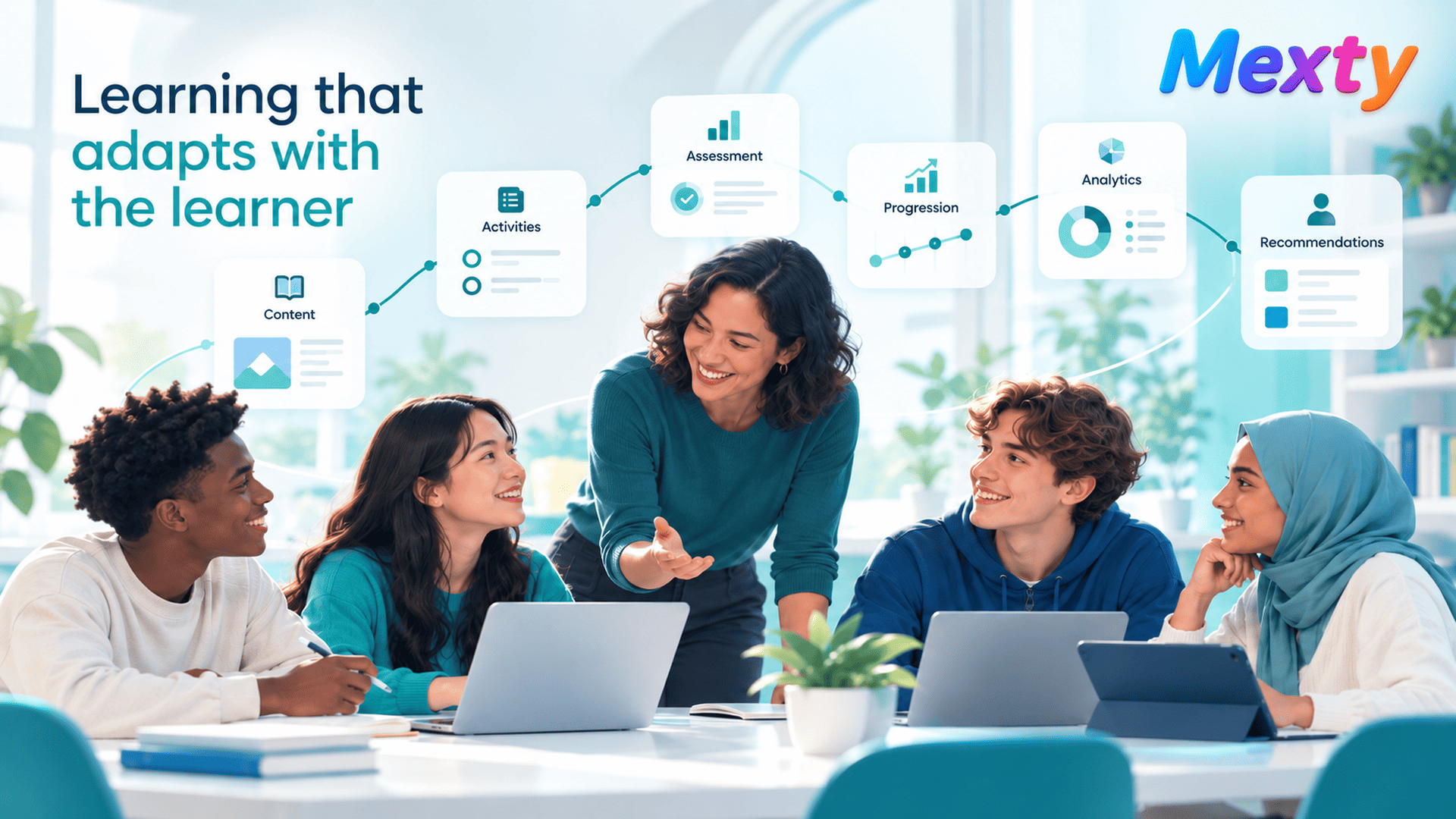
Content → Activities → Assessments
→ Progression → Analytics → Recommendations
When these elements exist in the
same environment, they can begin to inform one another:
- An assessment can influence what comes next.
- An
interactive activity can reveal a misunderstanding.
- A
sequence can be adapted.
- Prior
knowledge can be reactivated.
Teachers can see trends across a
class or follow an individual learner’s progression. AI can help interpret
these signals and suggest next steps without automatically taking control of
every decision.
That distinction matters because
the goal is not to automate pedagogy, the goal is to give teachers and L&D
teams better context for better decisions.
AI should support pedagogical judgment, not replace it
It is tempting to imagine a system
where an algorithm automatically decides what every learner should do next.
That should not be the objective because learning is too complex to be reduced
to a sequence of automated recommendations.
Teachers understand factors that
data may not fully capture:
- Motivation.
- Fatigue.
- Confidence.
- Classroom
dynamics.
- A
temporary difficulty.
- Personal
interest.
A truly intelligent system should
therefore help educators see, understand, and decide rather than take control
away from them. This becomes even more important when AI is used in education.
Technical capability must be
supported by governance, transparency, and security. A GDPR-compliant AI
learning platform should help organizations control data, permissions, AI
usage, and access.
The infrastructure should augment
human judgment, not replace it.
Toward more intelligent progression
Imagine a learner working on a
science concept:
- They read an explanation.
- They
complete an interactive activity.
- They
answer the first questions correctly but repeatedly fail when the same
principle appears in a slightly different context.
In a traditional system, the
learner may simply complete the module with a score of 75%. In a connected
learning environment, that pattern becomes meaningful.
The issue may not be knowledge
recall. It may be a transfer issue. The learner may understand the concept in
one familiar context but struggle to recognize when and how to apply it
elsewhere.
The system could then suggest:
- a new interactive activity;
- a
simulation;
- a
slightly different problem;
- an
alternative explanation;
- or a
reactivation activity several days later.
The teacher can accept, adapt, or
reject the suggestion. We are no longer simply distributing content. We are
supporting observed and adjusted progression.
How Mexty
can help connect creation, learning, and progression
This is the direction we are
building toward at Mexty. Mexty is not only an AI authoring
tool for L&D or a way to create learning content faster. Our objective
is to connect, in one environment:
- templates and learning content;
- interactive
activities;
- AI
experiments;
- Assessments;
- learning
paths;
- trusted
knowledge sources;
- analytics;
- and
progressively, recommendations that help teachers, trainers, and learners
make better decisions.
Mexty is also SCORM-compatible, allowing
organizations to continue using their existing LMS when needed.
But the ambition goes beyond SCORM export or being another SCORM authoring tool. The bigger goal is to
reduce fragmentation.
Today, a learning journey may be
designed in one platform, activities created in another, assessments managed
somewhere else, and analytics reviewed in a fourth system.
Every break in the workflow creates
another place where context can be lost.
An Interactive Learning Platform
that keeps these elements connected can instead help organizations see learning
as a continuous process.
The real potential of AI in learning
Generative AI first captured the
attention of L&D because of its ability to create: a course, a quiz, an
image, an activity or a video.
That production revolution is real
but it may only be the first stage.
The greater value of AI may come
from making learning systems more context-aware.
- Understanding what has already been learned.
- Identifying
what is still difficult.
- Detecting
recurring errors.
- Suggesting
when a concept should be revisited.
- Connecting
assessment with progression.
- Offering
different forms of practice.
- Helping
the teacher identify where intervention may be most useful.
In other words, the future of AI in
learning may not be about generating more content. It may be about
understanding what the learner needs next.
From a well-designed curriculum to a system that
evolves with the learner
A strong curriculum remains
essential. It defines progression, knowledge, skills, and objectives but a
curriculum alone cannot know how every learner is actually progressing.
Learning science gives us the
principles.
Teachers give those principles
meaning.
Continuous assessment provides
context.
And an AI-native infrastructure can
help connect all three.
That may be one of the most
important next steps in digital learning. Not replacing the teacher or
generating endless content. But building environments capable of measuring,
contextualizing, and adjusting learning over time, while keeping people in
control of what matters.
At Mexty, this is the transition we want to support: from
platforms that simply distribute learning content to infrastructures that help
make learning progression more intelligent, continuous, and connected.