

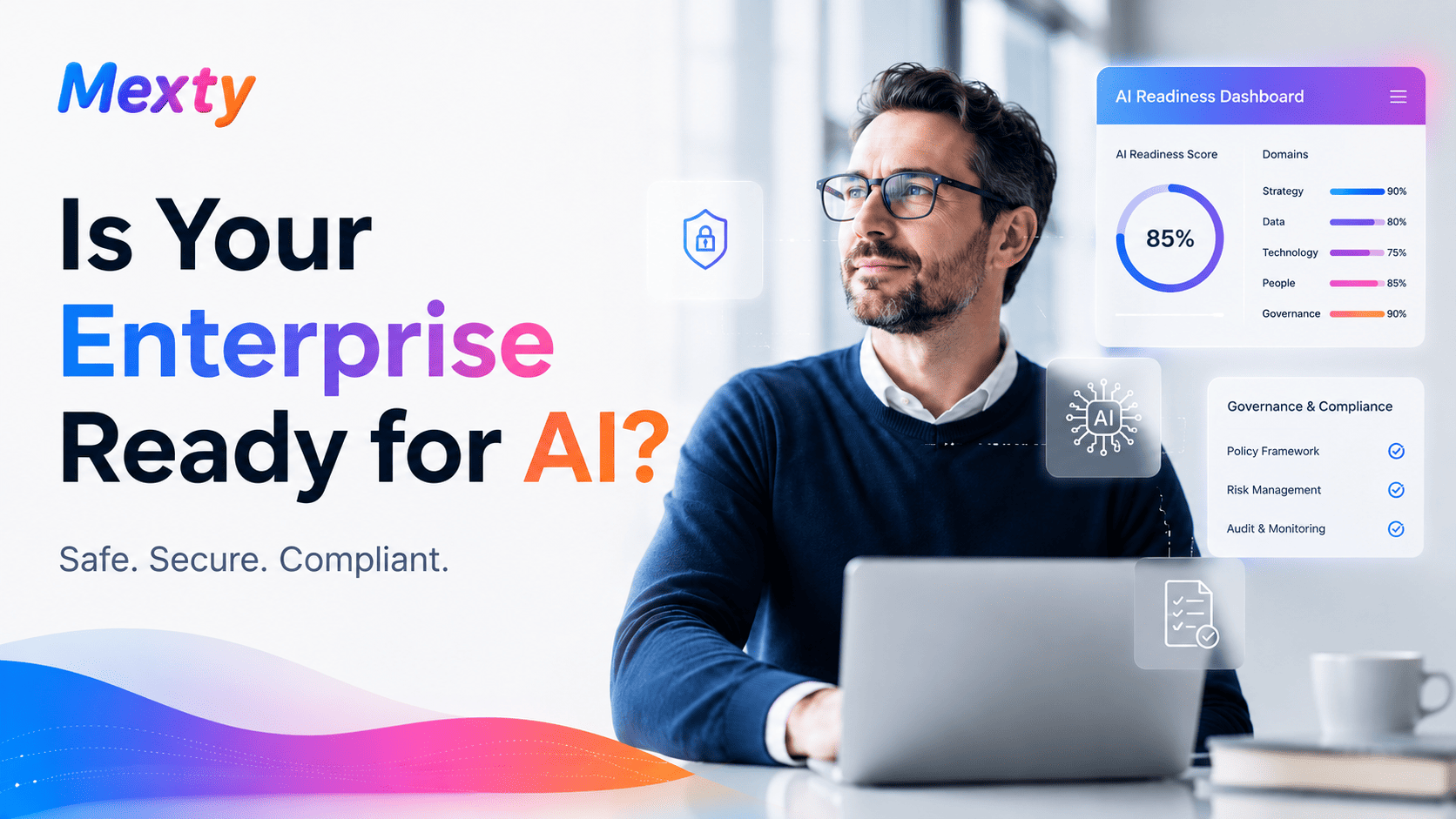
Is Your Enterprise Actually Ready to Use AI ?
AI adoption is no longer a future topic. It is already happening inside every organization.
Employees are using AI to draft emails, summarize documents, prepare presentations, analyze information, translate text, write training content, build scenarios, support customer communication, and improve daily productivity.
The real question is no longer: “Are our teams using AI?”
They are.
The better question is: “Are they using AI safely, effectively, and in a way the organization can actually govern?”
This is where many enterprises are not as ready as they think.
AI readiness is not only a technology question
For many organizations, AI readiness is still treated as a software decision.
Which AI tool should we buy?
Which model should we use?
Which chatbot should we allow?
Which productivity suite should we activate?
These questions matter, but they are only part of the problem.
AI readiness is also a learning, governance, compliance, and operational challenge. Employees need to understand what AI can do, what it cannot do, where the risks are, when human review is required, and how AI should be used in their specific role.
A marketing team does not use AI the same way as a legal team.
A trainer does not use AI the same way as an HR manager.
A customer support agent does not use AI the same way as a product expert.
A learner does not use AI the same way as a course author.
This is why a generic AI training module is not enough.
What Article 4 of the EU AI Act really means ?
Article 4 of the EU AI Act does not ask every company to deliver the same training program or impose a universal number of hours. It requires providers and deployers of AI systems to take measures, to their best extent, to ensure a sufficient level of AI literacy for staff and others dealing with AI systems on their behalf. This must take into account people’s technical knowledge, experience, education, training, and the context in which the AI systems are used. (AI Act Service Desk)
That distinction is important.
AI literacy is not a box-ticking exercise. It is not simply “everyone watched a one-hour video about AI.” It is about whether people understand AI well enough for the way they actually use it.
For an enterprise, that means AI literacy should be role-based, contextual, and connected to real work.
Employees need to know:
when AI output may be wrong;
when source verification is needed;
which data should not be entered into an AI system;
when human review is required;
how to recognize bias or hallucination;
how to use AI without creating compliance, privacy, or business risk.
This is not just training. It is organizational enablement.
Where most platforms fall short ?
Many platforms assume that the people building, managing, and deploying AI-supported learning are already AI experts.
But in most enterprises, that is not the reality.
Learning teams are often under pressure to move fast. They need to create onboarding programs, compliance modules, product training, internal academies, leadership programs, and role-based learning paths. Now they are also expected to integrate AI safely, understand AI governance, support AI literacy, and prove business impact.
That is a lot to ask from teams that may not have technical AI expertise.
This is where traditional tools reach their limits.
A classic SCORM authoring tool can help produce a course.
An LMS can help assign and track completion.
A chatbot can answer questions.
A presentation tool can create slides.
A generic AI tool can draft content.
But none of these, alone, gives enterprises a complete, secure, AI-native learning workflow.
They do not necessarily connect trusted sources, human review, interactive practice, AI support, learner tracking, compliance controls, and analytics in one system.
And without that connection, AI adoption can become fragmented.
AI literacy needs infrastructure, not just content
Enterprises often respond to AI literacy requirements by creating a course.
That is a good start, but it is not enough.
AI literacy is not something employees learn once and then forget. It needs to be reinforced through practice, updated as tools evolve, adapted to each role, and connected to real use cases.
For example, an AI literacy learning path for L&D teams should not look the same as one for sales teams.
An L&D team may need to understand how to use AI to create learning objectives, generate scenarios, review assessments, protect source accuracy, and validate content before publishing.
A sales team may need to understand how to use AI for account preparation, prospect research, follow-up emails, and objection handling while avoiding confidential data leaks or unverified claims.
A manager may need to understand how AI can support coaching, team communication, performance conversations, and decision preparation without delegating judgment to the system.
This is why enterprises need more than training content. They need an AI-Native secure Learning Infrastructure that makes AI use safer and simpler across the learning lifecycle.
Mexty’s approach: AI-native, secure, and designed for learning teams
Mexty is an AI-native, secure, interactive learning platform designed to help enterprises create, deliver, and track training and learning paths with AI.
It is not a training service company. It is not just a content generator. It is an AI-native platform for creating interactive learning experiences and managing them with security, governance, and compliance in mind.
The point is simple: enterprises should not need every employee, trainer, or instructional designer to already be an AI expert before they can benefit from AI-powered learning.
The platform should handle much of the complexity.
With Mexty, L&D teams can focus on the learning objective, the source material, the learner experience, and the business need. The platform supports the AI workflow, content creation, interactivity, delivery, tracking, and compliance structure around it.
That is what makes Mexty different from isolated AI tools.
From AI content generation to AI-native learning workflows
AI content generation is useful, but it is not enough.
Generating a course outline is not the same as designing a learning experience.
Generating a quiz is not the same as assessing meaningful understanding.
Summarizing a PDF is not the same as helping learners apply a process.
Creating slides is not the same as changing behavior.
The real value of AI in enterprise learning is the ability to Simplify instructional design workflow while keeping human judgment in control.
With Mexty, teams can start from trusted sources such as policies, procedures, product documents, handbooks, onboarding materials, compliance documents, and knowledge bases.
They can then use AI to create interactive courses, simulations, activities, assessments, and learning paths. They can review and manually edit the output before publishing. They can deliver learning directly or use SCORM where needed.
This makes Mexty an AI authoring tool for L&D, but also more than that. It is a Secure interactive learning platform designed for enterprise use.
Why “secure by design” matters
AI introduces new risks into learning workflows.
What data is uploaded?
Which sources does AI use?
Can learners rely on the answer?
Who reviewed the content?
Can the organization trace what was created?
Is personal data protected?
Can the training be updated when the source changes?
These questions matter because AI-generated or AI-assisted learning content can influence employee behavior, compliance decisions, customer interactions, and workplace performance.
That is why enterprise AI learning platforms must be built around privacy, security, and governance.
Mexty is designed with GDPR compliance, EU AI Act compliance, ISO 27001 certification, and SOC 2 Type 2 currently in progress. For enterprise teams, this matters because AI learning infrastructure must not become another uncontrolled layer of risk.
A Privacy-first AI authoring tool is not just a nice-to-have. It is becoming essential for organizations that want to scale AI responsibly.
Making AI usable for non-technical teams
One of the biggest barriers to AI adoption is not fear. It is complexity.
Many L&D teams do not have developers. They do not want to manage complex authoring pipelines, disconnected tools, prompt libraries, compliance spreadsheets, manual exports, and separate analytics systems.
They need to Create interactive courses without coding.
They need Interactive learning without technical complexity.
They need a platform that can help them move from source documents to learning paths, from static content to practice, and from course publishing to learner tracking.
This is where Mexty supports a new kind of workflow: Vibe coding for interactive learning.
Not “vibe coding” as uncontrolled creation.
Not speed without structure.
Not AI replacing instructional design.
But the ability to describe what you want to build, work from trusted content, generate a first version, review it, edit it, adapt it, and publish it without requiring complex technical production.
That is the difference between simply using AI and building an AI-native learning process.
AI literacy should be embedded into the learning ecosystem
The best way to support AI literacy is not only to create one AI literacy course.
It is to embed AI literacy into the way people learn and work.
That means employees should learn how to use AI through role-based examples, realistic scenarios, interactive practice, and ongoing support.
A learner should be able to ask questions.
A manager should be able to reinforce the right behavior.
An L&D team should be able to update content when policies change.
The organization should be able to track progress over time.
This is where an AI Agent for Learning becomes valuable. AI agents can support learners after the formal course ends, answer questions in context, and help reinforce knowledge provided they are grounded in approved sources and governed properly.
For enterprises, this matters because AI literacy is not only about awareness. It is about safe application.
Scaling AI readiness across the enterprise
An enterprise may have thousands of employees, multiple roles, different business units, different countries, and different levels of AI maturity.
A single generic training session cannot cover all of that.
Organizations need the ability to create and deploy multiple learning paths:
AI literacy for all employees;
AI governance for managers;
AI-assisted authoring for L&D teams;
AI risk awareness for HR and legal;
AI productivity workflows for sales and operations;
AI usage guidance for customer-facing teams.
This is why a LMS-compatible interactive learning platform matters. Enterprises need flexibility: create learning experiences centrally, assign them to the right groups, deliver them at scale, and track learner progress.
Mexty helps organizations move from one-off training content to structured, scalable learning paths.
The real question for enterprise AI readiness
The question is not whether your people are using AI.
They already are.
The real question is whether your organization has created the conditions for safe, effective, and compliant AI use.
Do employees know what they are allowed to do with AI?
Do they understand the limitations?
Can they identify when AI output needs review?
Are learning teams equipped to create AI-related training?
Can managers reinforce responsible AI behaviors?
Can the organization track who has been trained and where gaps remain?
Is the learning platform helping reduce risk, or adding another layer of complexity?
This is where AI readiness becomes a platform question.
From AI risk to AI capability
The organizations that will benefit most from AI will not simply be the ones that adopt the most tools.
They will be the ones that build the right learning infrastructure around those tools.
AI literacy gives people the understanding.
Governance gives the organization control.
Secure platforms reduce risk.
Interactive learning builds confidence.
Analytics show progress.
Human judgment keeps the system responsible.
That is why Mexty is built as an enterprise-ready, AI-native learning platform.
Not just to generate content faster.
Not just to replace complex authoring workflows.
Not just to publish another course.
But to help enterprises create, deliver, and track learning paths at scale, while staying compliant by design.
Because AI readiness is not a single training session.
It is a continuous capability.
And the organizations that close that gap first will be the ones that turn AI from a risk into a real business advantage.
Don’t miss the latest news. Follow Mexty and visit www. Mexty.ai to discover what’s next!
If you enjoyed this, you’ll love our next articles
Closing the Loop on Learning Impact: Why L&D Needs More Than Completion Metrics |