

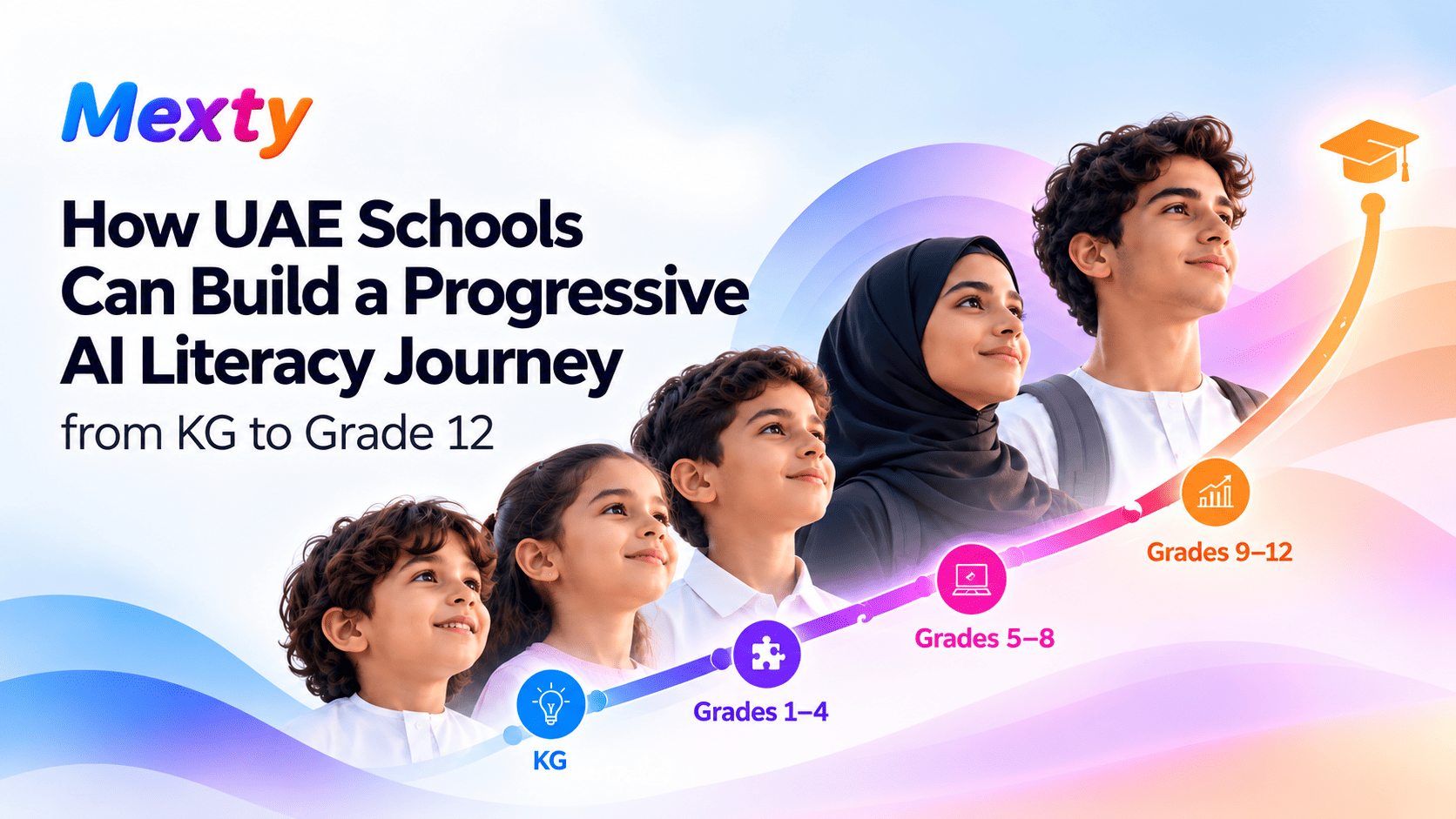
How
UAE Schools Can Build a Progressive AI Literacy Journey from KG to Grade 12
Artificial intelligence is entering
classrooms faster than most education systems can redesign their curricula
around it.
Students already use AI to search,
write, translate, summarize information, generate images and solve problems.
But access to AI tools is not the same thing as AI literacy. The more important
question for schools is what a child should understand about AI at age five,
ten, fifteen and by the time they leave school.
A meaningful AI Literacy program
therefore cannot be a one-off lesson on ChatGPT or a short module on prompting.
It needs to develop progressively, just like mathematics, science or language,
moving from simple awareness in the early years toward critical evaluation,
responsible use, system design and governance in secondary school.
This is closely aligned with the
direction being taken in the UAE, where AI is increasingly treated as a
long-term student capability rather than an isolated technology skill. The
challenge for schools is now to turn that progression into something teachers
can actually deliver, adapt and assess.
That is where Mexty can support implementation.
Mexty provides UAE schools with a ready-made, editable
AI Literacy learning journey from KG to Grade 12, including learning paths,
courses, related interactive activities, AI Literacy Lab exercises and
assessments. Schools are not starting from an empty template. They start with a
structured foundation and then adapt it to their own curriculum, policies,
timetable and students.
AI Literacy should change as
students grow
A five-year-old and a
seventeen-year-old should not be learning AI in the same way.
Young children do not need to begin
with algorithms or large language models. They first need to understand simple
ideas: machines follow instructions, technology is created by people, patterns
matter, and computers do not think or feel in the same way humans do.
As students mature, the questions
can become progressively more sophisticated.
The learning journey can be
understood as:
Discover → Understand → Use →
Question → Evaluate → Design → Govern
The attached curriculum model
follows this progression from early awareness and pattern recognition through
machine learning, evaluation of AI outputs, responsible LLM use, model
comparison and eventually governance and societal impact.
Mexty translates that progression into actual grade-level
learning paths rather than leaving it as a conceptual framework.
KG:
Discovering intelligent machines
At Kindergarten level, AI Literacy
should remain concrete and intuitive.
Children can begin with questions
such as:
- What is a
machine?
- What
makes something appear “smart”?
- Who tells
machines what to do?
- Can
machines have feelings?
- How can
technology help people?
Stories, sequencing games, sorting
activities, role-play and everyday examples are more appropriate than technical
terminology.
The objective is to establish a few
basic concepts:
Humans create technology.
Machines
follow instructions.
Machines can recognize patterns.
AI can help people.
Machines are not people.
This is also an appropriate stage
for early digital-safety habits.
How Mexty
supports KG learning
The Mexty KG learning path can already
contain age-appropriate courses and activities. Teachers can then adapt them
by:
- changing
stories or characters;
- adding
school-specific images or examples;
- simplifying
or extending explanations;
- replacing
an activity with another interactive format;
- adding
songs, videos or classroom instructions;
- including
teacher-led offline activities alongside the digital learning sequence.
The objective is not to put young
children in front of an AI chatbot. It is to use structured activities to help
them build the conceptual foundations they will need later.
Grades
1–2: Patterns, examples and mistakes
The next step is helping students
understand that AI systems can identify patterns and learn from examples.
Students might classify objects,
group images, observe simple pattern-recognition tasks or explore how a machine
can make mistakes when the examples it receives are poor.
By Grade 2, students can begin
learning one of the most important AI Literacy principles:
AI can be wrong.
That creates the first foundation
for critical thinking.
Instead of teaching children that
technology is always correct, the learning experience introduces the idea that
humans need to check what machines do.
Using Mexty
Teachers can open the relevant UAE
learning path and use the existing courses and activities as a starting point.
For example, an activity might ask
students to:
- sort
examples into categories;
- identify
which instruction caused a mistake;
- compare
correct and incorrect classifications;
- decide
when a human should check the machine.
The teacher can edit the examples,
instructions, visuals and difficulty without rebuilding the lesson from
scratch.
Grades
3–4: Data, rules and decisions
By Grades 3 and 4, students can
begin moving from recognizing AI toward understanding why it behaves the way it
does.
Concepts can include:
- data and
examples;
- simple
algorithms;
- if-then
rules;
- predictions;
- good and
poor-quality data;
- privacy
and personal information.
A useful Grade 4 question is: How
does AI use rules, data and patterns to make decisions and predictions?
At this stage, students begin to
understand that AI outcomes depend on the information and rules behind them.
Making Mexty
Grade 4 template relevant to your school
A UAE school could open the Mexty Grade 4 learning path and:
- keep the
existing learning objectives;
- edit
course text and explanations;
- add its
own digital citizenship policy;
- include
local examples;
- add
teacher notes;
- adjust
activities to match the school timetable;
- customize
the end-of-unit assessment.
Because the learning path already
connects courses and related activities, the teacher is adapting an existing
journey rather than assembling disconnected resources.
Grades
5–6: Understanding how AI learns
Upper-primary students can begin
exploring machine learning more directly.
They can investigate:
- training
data;
- classification;
- supervised
and unsupervised learning;
- simple
neural-network concepts;
- accuracy;
- incomplete
data;
- bias.
By Grade 6, the central question
becomes:
How does AI learn from data?
Students can also begin working on
small projects that apply AI thinking to a real-world or community problem.
From course content to
experimentation
This is where the Mexty
AI Literacy Lab becomes increasingly useful.
Instead of simply explaining that
different data can lead to different results, students can work through
controlled experiments.
For example:
Experiment 1: Change the examples
Students
observe how different training examples affect classification.
Experiment 2: Good data vs poor
data
Students
compare results based on complete and incomplete information.
Experiment 3: Accuracy and human
review
Students decide
whether a result is reliable enough to use.
The Lab helps move students from
learning about AI toward observing AI behavior directly.
Grades
7–8: Questioning and evaluating AI
By lower secondary school, students
are ready for a major shift.
The objective is no longer only to understand AI.
It is to evaluate it.
Topics can now include:
- generative
AI;
- misinformation;
- deepfakes;
- bias;
- fairness;
- privacy;
- data
quality;
- trustworthy
information.
Students can begin asking:
Is this result reliable?
What
evidence supports it?
Could it be biased?
Who might be affected?
Should this output be trusted?
This is where AI Literacy
intersects strongly with media literacy, digital citizenship and critical
thinking.
A practical Grade 8 workflow in Mexty
A school can open the ready-made
Grade 8 UAE AI Literacy learning path.
The learning path already contains
relevant courses, activities and assessment components.
The teacher can then:
1. Review the existing course
content
Edit
explanations, images, videos and examples.
2. Add school-specific material
Include the
school AI policy, digital citizenship guidelines or trusted reference material.
3. Adapt interactive activities
Change
scenarios, difficulty or examples to fit the class.
4. Use an AI Literacy Lab
experiment
Have students
compare outputs from two models or investigate an apparent hallucination.
5. Adapt the final assessment
Add or modify
decision scenarios, comparison tasks or confidence checks.
The school starts with a complete
learning journey, while teachers remain free to customize it.
Grade
9: LLMs, prompting and trust
By Grade 9, many students are
likely to have direct experience with large language models.
The educational objective should
therefore not simply be to teach students how to write better prompts.
It should be to teach them how to challenge
an AI response.
Students can investigate:
- prompt
design;
- context;
- role and
perspective;
- hallucinations;
- source
verification;
- bias;
- academic
integrity;
- responsible
AI use.
A central question becomes:
How do we use and challenge LLMs
responsibly?
Students should understand that a
fluent answer is not necessarily a correct answer, and that confidence is not
evidence.
A Mexty
AI Literacy Lab example
Students could ask several models:
Is social media beneficial for
teenagers?
Then compare the answers.
Next, they change the context:
Answer as a psychologist.
and:
Answer as a social media company.
The learning task is not to decide
which answer is “best.”
Students examine:
- perspective;
- evidence;
- assumptions;
- certainty;
- missing
information;
- potential
bias.
This makes prompting part of
critical thinking rather than a technical trick.
Grades
10–11: Comparing, designing and governing AI
Older students can work with more
sophisticated questions.
Topics can include:
- deep
learning;
- neural
networks;
- model
performance;
- explainability;
- accessibility;
- cybersecurity;
- human-AI
collaboration;
- high-stakes
decisions;
- accountability.
Students can compare systems and
ask:
Which model is appropriate for this
task?
What are the
trade-offs?
Is the system fair?
Can the result be explained?
Who remains accountable?
By Grade 11, the key question
becomes:
How do we make AI trustworthy,
inclusive and accountable?
Using interactive scenarios
Mexty can help teachers move away from purely theoretical
discussion.
For example, learners could work
through a branching scenario:
An AI system recommends rejecting
an applicant for a school programme.
Students must decide:
- accept
the recommendation;
- request
human review;
- examine
the data for bias;
- request
further evidence.
This can then become part of a
scored Evaluation.
Grade
12: AI as a societal system
By Grade 12, AI Literacy should
extend beyond tools and models.
Students can explore AI through:
- ethics;
- economics;
- regulation;
- data
governance;
- auditing;
- environmental
impact;
- public
policy;
- future
careers;
- AI in
healthcare, transport and government;
- humanitarian
challenges.
A strong final project might ask
students to design an AI-enabled solution and evaluate both its technical
performance and its societal implications.
The final question becomes:
How do we design, govern and deploy
AI responsibly in society?
Building a Grade 12 capstone in Mexty
A teacher could use the existing
Grade 12 learning path and adapt the capstone project.
Students might be asked to:
- identify
a real-world problem;
- propose
an AI-enabled solution;
- identify
required data;
- analyze
possible bias;
- consider
privacy and security;
- explain
the role of human oversight;
- assess
societal impact;
- present
and defend the solution.
The assessment can combine project
evidence, structured evaluation and teacher judgment.
Teachers
remain in control of every grade
One of the most important
principles behind Mexty's
UAE AI Literacy approach is that the curriculum is editable.
The ready-made learning paths
provide a complete foundation, but they are not locked.
A school can open any grade-level
template and:
- edit
existing content or add its own text, images, videos and resources;
- adapt
sequencing to fit the school timetable;
- enrich
examples with cases relevant to the school community;
- adjust
course or activity difficulty;
- add the
school's AI-use or digital citizenship policies;
- modify
interactive activities and AI Literacy Lab exercises;
- customize
assessments.
The source curriculum already
emphasizes that schools need flexibility in how they adapt learning paths,
lessons, policies, activities and assessments while retaining pedagogical
control.
This is particularly important in
the UAE, where schools operate across different curricula and educational
models.
Ground
AI Literacy in trusted knowledge
AI Literacy should also teach
students an important distinction:
What does the model know?
versus:
What does an approved source
actually say?
With Mexty Knowledge Bases and Source of
Truth, teachers can add approved resources and use them to ground learning
experiences.
A teacher might upload:
- school
policies;
- validated
curriculum documents;
- teacher-approved
articles;
- UAE
guidance;
- digital
safety resources.
Students can then compare:
general AI response
with
trusted-source-grounded response
and investigate why they differ.
This transforms source verification
from an abstract concept into something students can experience.
Assessment
should progress with the learner
The assessment model should evolve
alongside the curriculum.
A younger learner might:
- classify;
- recognize;
- sequence;
- identify
a safe or unsafe example.
An older learner might:
- compare AI outputs;
- evaluate
evidence;
- recognize
bias;
- make a
decision;
- justify
human intervention;
- design
and defend a solution.
Mexty's Evaluation module can combine:
- quizzes;
- hotspots;
- visual
recognition;
- categorization;
- branching
decision scenarios;
- question
banks;
- confidence
checks.
This means schools can assess more
than whether a student remembers terminology.
They can assess whether the learner
can actually apply AI Literacy in context.
Teacher
training is part of implementation
A progressive student curriculum
will only work if teachers feel confident delivering it.
Teachers do not need to become
machine-learning engineers.
They do need enough understanding
to guide students through questions such as:
- Why does AI hallucinate?
- What
makes a source reliable?
- How does
context change an answer?
- How can
bias appear?
- What
information should students not share?
- When
should AI assistance be allowed?
- When must
human judgment remain in control?
Mexty can provide teacher AI Literacy learning paths
alongside the student curriculum.
Teachers can also experience the
same activities and Labs before using them with learners.
That makes professional development
part of the implementation rather than an afterthought.
A
complete AI Literacy journey, not a collection of AI lessons
The biggest risk for schools is
fragmentation.
One year students do robotics.
The next year they learn ChatGPT.
Later they attend a
prompt-engineering workshop.
Each experience may be useful, but
together they do not necessarily form a curriculum.
The objective is continuity.
Mexty helps schools connect:
Grade-level objectives → Learning
Paths → Courses → Interactive Activities → AI Literacy Labs → Assessments →
Learner Evidence
within one environment.
The original article summarizes the
same principle: schools need a coherent progression from discovery and
understanding through questioning, evaluation, design and governance, rather
than restarting AI education every year.
From
framework to classroom reality
The UAE direction is increasingly
clear.
AILiteracy should be progressive,
practical, critical and responsible.
The next challenge for schools is
implementation.
Mexty supports that transition by providing a complete
UAE-oriented KG–12 learning foundation, while giving schools the
flexibility to adapt it.
The infrastructure brings together:
- Editable
learning paths
- Ready-made
courses
- Interactive
activities
- AI
Literacy Labs
- Trusted
knowledge
- Assessments
- Teacher
training
- Learner evidence and
analytics
The role of Mexty is not to replace teachers or
determine pedagogy.
It is to give schools a structured
environment in which teachers can adapt, deliver and assess AI Literacy while
retaining control over the learning experience.
The real objective is not to
produce students who know how to use today's AI tools.
Those tools will change.
The long-term capability is much
more important:
- Can
students understand AI?
- Can they
question it?
- Can they
verify what it produces?
- Can they
recognize its limitations?
- Can they
use it responsibly?
- And can they make
sound human decisions when AI is involved?
That
is what a progressive KG–12 AI Literacy journey should ultimately achieve.
If you enjoyed this, you’ll love our next articlesFrom ChatGPT to Critical Thinking: How UAE Schools Can Build Real AI Literacy with Mexty |