

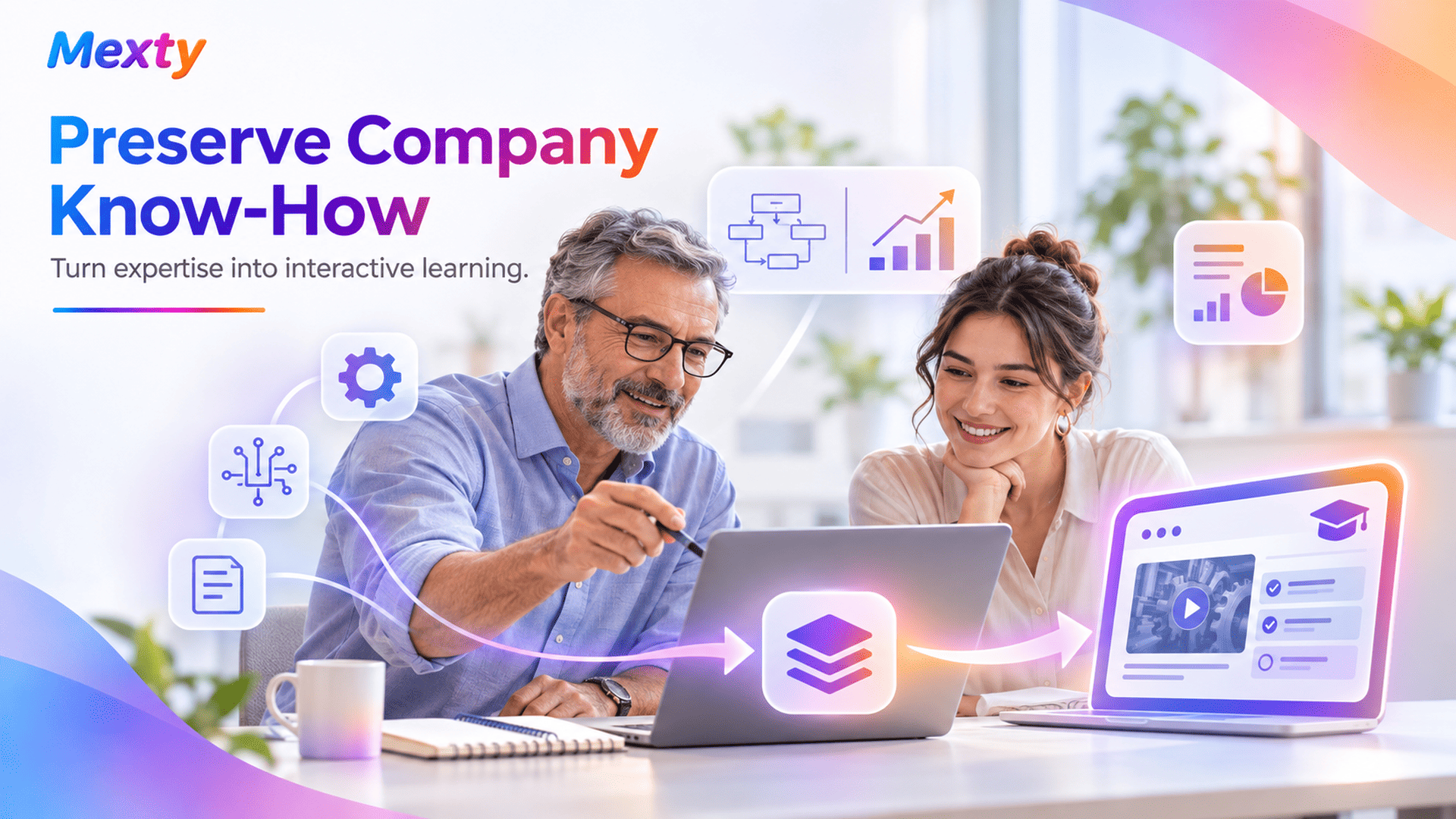
How
to Preserve and Transfer Critical Know-How Before It Leaves the Company
In many companies, the
most valuable knowledge is not stored in a database, a procedure, or a
PowerPoint. It lives in people :
- It is the technician who knows the exact adjustment that solves a
recurring issue.
- The engineer
who can diagnose a failure from a subtle signal.
- The salesperson
who knows how to handle a difficult customer.
- The manager who
understands why a process works one way in theory and another way in
practice.
- The operator
who knows the shortcuts, exceptions, warning signs, and small details that
never made it into the manual.
This is company know-how.
The big challenge is when
experienced employees retire, resign, change roles, or simply become less
available, part of that knowledge can disappear with them.
You cannot challenge this
by only documenting the information. You need to turn experience into
transferable learning.
Documentation
Is Not the Same as Knowledge Transfer
Many organizations already
have procedures, PDFs, presentations, technical manuals, and internal
documentation.
That is useful but
information alone does not guarantee capability:
- A 60-page technical procedure may explain how a process should work,
but it may not teach a new employee how to recognize the moment when
something is going wrong.
- A PowerPoint
may describe how to manage a customer escalation, but it does not give the
learner the opportunity to practise the conversation.
- A manual may
list the steps of a maintenance procedure, but it does not reproduce the
judgement of an expert who has handled the same problem hundreds of times.
That is why knowledge
transfer needs to go beyond content storage.
The objective should be to
capture :
- what experts know,
- how they make
decisions,
- what they look
for,
- what mistakes
they avoid,
- how they react
when the standard process no longer applies,
- and how they
know whether an outcome is good enough.
This is where interactive
learning becomes much more valuable than static documentation.
From
Expert Knowledge to Interactive Learning
A modern Interactive
Course Creator can help organizations transform expert knowledge into
practical learning experiences.
Instead of simply
recording a long interview with an expert or uploading a PDF, companies can
create with the expert support :
- technical demonstrations,
- branching
scenarios,
- decision-making
activities,
- role-plays,
- troubleshooting
exercises,
- simulations,
- knowledge
checks,
- and practice
environments with feedback.
This is especially
important for technical know-how.
Imagine an experienced
maintenance engineer explaining how to diagnose a machine fault.
The knowledge transfer
could include :
- A short explanation of the system.
- Images or
diagrams showing typical warning signs.
- A scenario
where the learner must choose what to inspect first.
- Feedback
explaining why one choice is safer or more efficient.
- A second
scenario with slightly different conditions.
- An assessment
that tests whether the learner can apply the reasoning independently.
This turns expertise into
capability.
An Interactive Learning
Platform can help make that knowledge reusable across teams, sites,
countries, and generations of employees.
AI Can
Accelerate Knowledge Capture
One of the biggest
barriers to knowledge transfer has always been time.
Experts are usually busy
precisely because they are experts.
They do not have days to
write courses, build quizzes, format slides, or create eLearning modules.
This is where an AI authoring tool for L&D can create real value.
Instead of asking an
expert to become an instructional designer, the company can start from the
material that already exists :
- PDFs,
- PowerPoint
presentations,
- manuals,
- procedures,
- internal
documents,
- transcripts,
- or structured
interviews.
An AI-enabled authoring
environment can help organize this material into a first learning structure,
suggest learning objectives, generate questions, and propose interactive
activities.
For example, a team can convert
PDF to interactive course and then enrich it with expert input,
simulations, examples, assessments, and practice activities.
AI can accelerate the
production work.
But the expert still
validates the content.
That distinction matters.
The objective is not to
automate expertise.
It is to make expertise
easier to capture and transmit.
Move
Beyond PowerPoint-Based Training
Many companies still rely
heavily on presentations to transfer knowledge.
The typical workflow looks
like this :
- An expert creates a PowerPoint.
- Someone
presents it in a meeting.
- The slides are
uploaded to a shared folder.
- New employees
receive the file months later.
That is not really a
learning system. It is content distribution.
Modern companies need to replace
PowerPoint-based training workflows with something more interactive and
measurable.
A secure learning
environment can transform the same source material into :
- guided learning paths,
- practical
exercises,
- assessments,
- simulations,
- role-plays,
- and adaptive
activities.
This makes knowledge
easier to retain, easier to practise, and easier to update.
Vibe
Coding Can Make Technical Learning More Practical
One of the most
interesting developments in digital learning is Vibe coding for interactive
learning.
Traditionally, building a
custom simulation or interactive technical exercise required developers.
That made sophisticated
learning expensive.
Now, AI can help create
interactive components from natural-language instructions.
A technical expert could
describe an activity such as : “ Create a troubleshooting simulation where the
learner sees four warning indicators and must choose which diagnostic test to
run first. ”
The system can help
generate the interactive experience without requiring the expert to code it
manually.
This makes it much easier
to create interactive courses without coding.
For technical training,
this is especially powerful because it allows organizations to build practice
environments around their own equipment, procedures, customer cases, or
operational scenarios.
The result is interactive
learning without technical complexity.
Capture
Not Just What Experts Know, but How They Think
The real value of an
experienced employee is rarely just factual knowledge. It is judgement because
experts recognize patterns. They know when a situation is normal and when
something feels wrong. They know which rule matters most when two rules
conflict and they understand context.
That kind of knowledge is
difficult to capture in a standard document but scenarios can help. Suppose an
experienced sales manager is training a new account executive. Instead of only
explaining the company’s negotiation principles, the training can present
realistic customer situations.
The learner chooses how to
respond. The expert explains what they would have done and why. Over time, this
creates a library of judgement, not just information.
That is one of the most
important uses of an AI-native platform for creating interactive learning
experiences.
Make
Knowledge Transfer Continuous
Knowledge transfer should
not happen only when someone announces their retirement.
By then, it is often too
late.
A better approach is to
make knowledge capture part of normal operations.
Whenever an expert :
- solves an unusual technical problem,
- improves a
process,
- handles a
difficult customer case,
- identifies a
recurring error,
- develops a
better method,
- or learns
something important from a project,
that knowledge can be
converted into a reusable learning asset.
An AI-Native secure
Learning Infrastructure can help organizations keep these assets in one controlled
environment and continuously improve them over time:
- New employees learn from them.
- Existing
employees refresh their knowledge.
- Experts update
the content when processes change.
- Managers can
see who has completed the learning and how people perform in assessments.
The knowledge becomes part
of the organization, rather than remaining attached to one individual.
Keep
Knowledge Secure and Governed
Capturing internal
know-how also raises an important question:
Where is that knowledge
being stored ?
Technical procedures,
internal methods, customer scenarios, and operational expertise may be highly
sensitive.
This is why knowledge
transfer should happen within a secure AI authoring platform, not
through uncontrolled combinations of public AI tools, shared documents, and
disconnected applications.
For organizations
operating in Europe, using a GDPR-compliant AI learning platform can
also help create a more controlled approach to employee learning and internal
knowledge.
Security, access control,
versioning, and governance become especially important when training contains
proprietary information.
The objective is not only
to capture more knowledge.
It is to protect it.
Make
Learning Portable
Some companies already
have an LMS and do not want to replace it.
That should not prevent
them from modernizing knowledge transfer.
A SCORM-compatible
environment allows organizations to create interactive learning and export it
into an existing LMS.
An LMS-ready authoring
platform can therefore support both models:
- create and deliver learning directly in the same environment,
- or create
learning and export it to another system.
This flexibility is
important for larger organizations and training providers with established
learning ecosystems.
Measure
Whether Knowledge Was Actually Transferred
There is one final
question that matters: Did the learner actually become more capable?
- Completion is not enough.
- Watching a
video does not prove competence.
- Opening a PDF
does not prove understanding.
- Even passing a
simple quiz may not prove that someone can perform the task in a real
situation.
Knowledge transfer should
therefore include practice and assessment.
An AI-native LMS and
authoring platform can connect :
content → practice →
assessment → learner progression → analytics.
This makes it possible to
move from : “ Did the employee complete the training ? ” to : “Can the employee
now apply the knowledge ? ”
That is the real measure
of successful knowledge transfer.
Your
Company’s Know-How Is an Asset
Company know-how has
economic value :
- Technical expertise.
- Operational
methods.
- Customer
knowledge.
- Sales
practices.
- Manufacturing
experience.
- Quality
processes.
- Lessons learned
from years of mistakes and improvements.
Organizations invest
enormous amounts of time and money building that knowledge. Yet too often, they
allow it to remain undocumented, unstructured, and dependent on a handful of
individuals.
Modern learning technology
gives companies a different option to :
- Capture the expertise.
- Turn it into
interactive practice.
- Validate it
with experts.
- Deliver it at
scale.
- Measure whether
people can apply it.
- And
continuously improve it.
The goal is not to replace
your experts. It is to make sure their expertise can continue creating value
long after the original conversation, project, or even employee is gone.
Because a company’s
know-how should belong to the company. Not only to the people who currently
carry it.
If you enjoyed this, you’ll love our next articlesCorporate Learning Is No Longer a Big-Company Privilege: How AI Is Making Training Affordable for SMEs |