
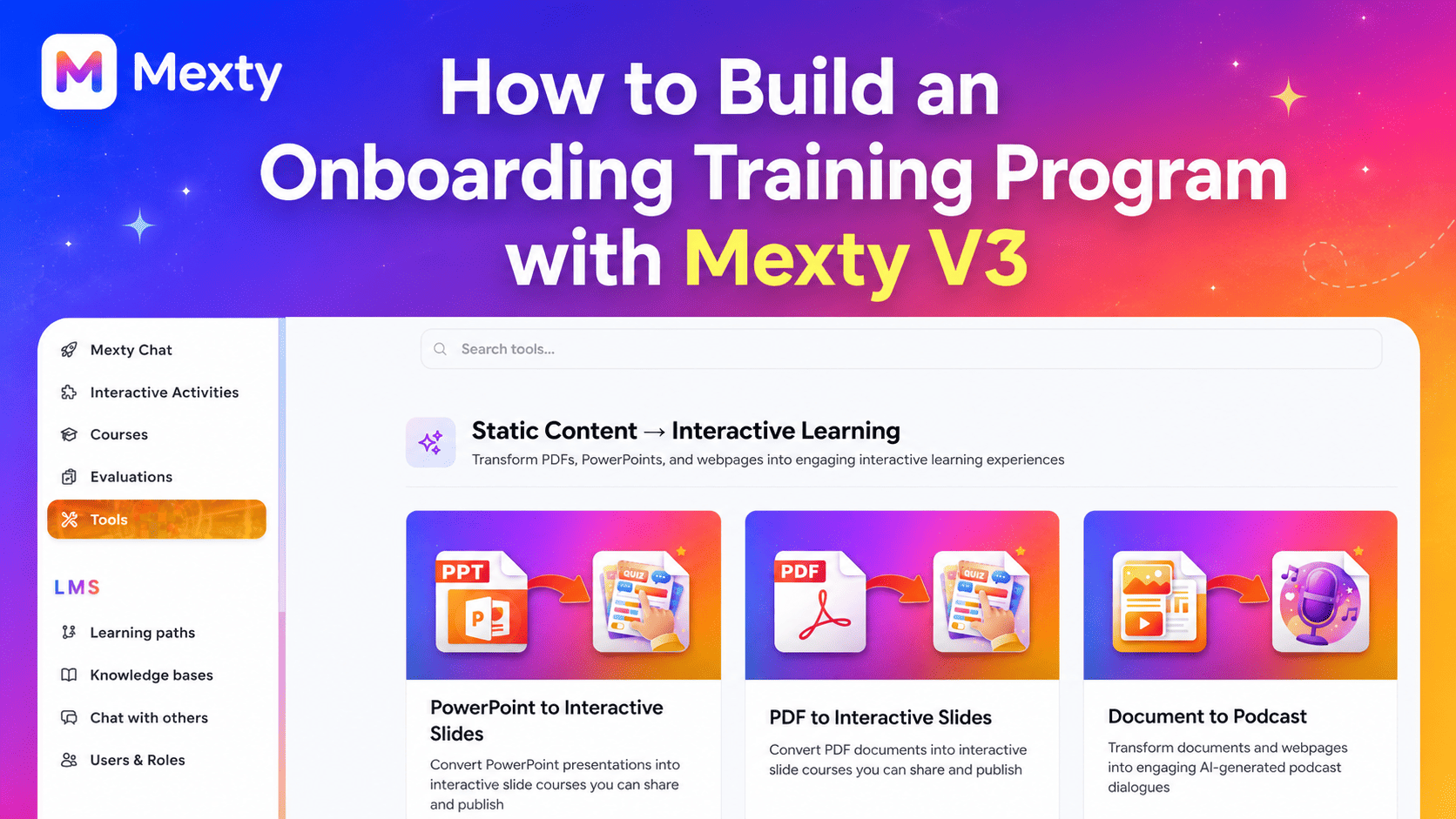
How to Build an Onboarding Training Program with Mexty
V3
New hire onboarding should not be a
folder full of PDFs.
Yet in many companies, this is
still exactly how onboarding works. A new employee receives a set of documents,
links, policies, presentations, internal tools instructions, product materials,
security guidelines, and role-specific notes. The information may be useful,
but the experience is often fragmented.
The learner has to figure out what
to read first, what matters most, what to remember, what to apply, and how to
know whether they are ready. Managers have limited visibility. L&D teams
spend time manually converting static documents into courses, quizzes,
checklists, and LMS modules. And when a policy or process changes, the onboarding
content quickly becomes outdated.
Onboarding should be different.
It should be structured,
interactive, measurable, and role-based. It should guide new employees
progressively from company understanding to practical readiness. It should help
managers track progress. It should help learners ask questions. And it should
be built from trusted company knowledge, not generic AI-generated content.
This is where Mexty V3 changes the
workflow.
Mexty V3 is an AI-Native
Learning Infrastructure for creating, delivering, and tracking interactive
learning experiences. It helps learning teams transform onboarding documents
into complete onboarding journeys, including modules, activities, assessments,
assignments, learning paths, analytics, and contextual AI support.
With Mexty, companies can move from
static onboarding documents to interactive, measurable onboarding training.
Why onboarding training needs a new approach
Traditional onboarding often starts
with good intentions.
The HR team prepares an employee
handbook. The company shares a values guide. The IT team provides a tools and
systems guide. The security team adds security essentials. The product team
shares product documentation. The sales or engineering team may add
role-specific onboarding material.
Each document has value. But the
new hire experience is often overwhelming.
A new employee may ask:
What should I learn first?
Which documents are mandatory?
How do I apply this information in real work?
What does my manager expect by the end of week one?
How do I know if I am ready?
Where do I ask questions?
Which version of the document is the latest?
For L&D and HR teams, the
challenge is also significant. Turning these documents into onboarding training
usually means manually creating courses, slides, quizzes, activities, and
checklists. This can require multiple tools: PowerPoint, a SCORM authoring
tool, an LMS, spreadsheets, survey tools, and sometimes external AI assistants.
This is why many teams want to simplify
eLearning workflow and simplify instructional design workflow. They
want to replace complex authoring workflows and move toward an easier,
more integrated way to create learning experiences.
Mexty V3 was designed for this
shift.
Start with trusted onboarding source documents
The first step in building
onboarding training with Mexty is simple: start from the documents your company
already has.
For example, an onboarding program
may use:
- Employee handbook
- Company
values and culture guide
- Product
overview
- Security
essentials
- Internal
tools and systems guide
- Role-specific
onboarding addendum
- Compliance
policies
- Customer-facing
positioning documents
- Knowledge
base articles
- Internal
procedures
Instead of asking an instructional
designer to manually convert each document into slides and quizzes, Mexty
allows the team to use these materials as trusted sources of truth.
This is a critical difference.
Generic AI tools can produce
onboarding content, but the result may not reflect the company’s real policies,
processes, tone, values, products, or security rules. Enterprise onboarding
cannot rely only on generic prompting. It needs source-of-truth grounding.
Mexty is designed as a Trusted
AI authoring platform where learning experiences can be created from
approved company knowledge. This helps teams build onboarding programs that are
more accurate, more relevant, and easier to maintain.
For example, an HR team can upload
the employee handbook, the values guide, and the tools guide. A security team
can add security essentials. A product team can add the product overview. A
sales enablement team can add a Sales Engineer onboarding addendum.
Mexty can then help transform these
sources into a structured learning journey.
Convert PDFs and documents into onboarding courses
One of the most practical use cases
for Mexty is the ability to convert PDF to interactive course.
Many onboarding materials already
exist as PDFs, Word documents, PowerPoint decks, or internal pages. The problem
is not that companies lack content. The problem is that the content is static.
A 30-page handbook is not a
learning experience.
A security policy is not a behavior change program.
A product document is not a readiness journey.
A values guide is not automatically culture onboarding.
Mexty helps bridge this gap.
As an Interactive Learning
Creator, Mexty can analyze source documents, propose learning objectives,
structure modules, create activities, generate assessments, and suggest
assignments. It becomes an AI authoring tool for L&D that helps
teams turn raw company knowledge into learning experiences.
For example, from a security
essentials PDF, Mexty can help create:
- A short security onboarding module
- Data
classification scenarios
- Phishing
awareness activities
- Secure
tool usage reminders
- Knowledge
checks
- Final assessment
questions
- Learner
feedback
From a company values guide, Mexty
can help create:
- Culture onboarding slides
- Values-in-action
scenarios
- Decision-making
exercises
- Reflection
prompts
- Manager
discussion questions
From a product overview, Mexty can
help create:
- Product introduction modules
- Customer
use case activities
- Matching
exercises
- Role-based
product explanation assignments
- Final
product knowledge check
This is how onboarding moves from
“read this document” to “practice applying this knowledge.”
Build a 4-week onboarding learning path
Onboarding should not be a single
course. It should be a journey.
With Mexty V3, learning teams can
create complete onboarding learning paths. These paths can be structured by
week, role, department, location, seniority level, or business objective.
For example, a Sales Engineer
onboarding path could include:
Week 1: Company culture, tools, and
security essentials
The learner understands the company mission, values,
working norms, internal tools, communication expectations, and basic security
rules.
Week 2: Product and customer
understanding
The learner studies the product portfolio, platform
architecture, customer use cases, key terminology, and customer pain points.
Week 3: Role-specific practice
The learner practices discovery conversations,
technical qualification, demo preparation, objection handling, and
collaboration with sales, product, security, and customer success teams.
Week 4: Final validation and
readiness assessment
The learner completes a final product story, security
scenario, role-specific assessment, manager check-in, and readiness review.
This is where Mexty becomes more
than a course builder. It becomes an Interactive Learning Platform and
an AI-native LMS and authoring platform.
The platform can help create
modules, activities, assignments, assessments, and learning paths. It can also
support delivery and tracking through embedded LMS capabilities.
This is why Mexty is not simply an
authoring tool. It is an AI-native secure learning infrastructure for
the full onboarding workflow.
Use vibe coding for interactive learning
One of the most exciting changes in
learning design is the emergence of AI-assisted creation that feels closer to
“vibe coding.”
In software, vibe coding means
describing what you want and letting AI help generate the structure, logic,
interface, or prototype. Mexty brings this idea into learning.
Mexty enables vibe coding for
interactive learning.
Learning designers can describe the
type of activity they want to build:
“Create a branching scenario where
a new employee must decide how to handle a suspicious email.”
“Create an activity where the
learner matches customer pain points with product capabilities.”
“Create a values-in-action scenario
for a new manager.”
“Create a knowledge check based on
the security essentials document.”
“Create a product discovery
simulation for a Sales Engineer.”
This enables interactive course
creation with vibe coding and helps teams create richer learning
experiences without starting from blank slides.
But Mexty is not just about vibe
coding. It is vibe coding for learning, grounded in trusted sources of truth
and connected to learning delivery, tracking, versioning, and compliance.
This is important because
enterprise learning requires more than creativity. It requires structure,
accuracy, governance, accessibility, and measurable outcomes.
Create interactive courses without coding
Many learning teams want to create
more engaging onboarding experiences, but they do not want to become
developers.
Traditional authoring tools can be
powerful, but complex. Advanced interactions, branching scenarios, animations,
and simulations can take time. Custom development may require technical skills.
Even simple updates can become difficult when content is spread across multiple
files, exports, and LMS packages.
Mexty helps teams create
interactive courses without coding.
It acts as an easy interactive
course builder and a secure interactive learning platform where
teams can combine AI-assisted creation with manual editing.
For onboarding, this means L&D
teams can create:
- Interactive welcome modules
- Scenario-based
activities
- Product
knowledge checks
- Compliance
quizzes
- Role-play
simulations
- Decision
trees
- Final
readiness assessments
- Assignments
and manager check-ins
This makes onboarding more engaging
and practical.
Instead of asking new hires to
passively consume information, Mexty helps them interact with realistic
situations, make decisions, receive feedback, and demonstrate readiness.
This is interactive learning
without technical complexity.
Replace PowerPoint-based training workflows
Many onboarding programs still
depend heavily on PowerPoint.
PowerPoint is familiar, but it was
not designed to manage interactive onboarding journeys. It does not easily
support learning paths, learner analytics, AI Agents, source-of-truth
grounding, versioning, LMS delivery, or ongoing updates.
This is why many teams are looking
to replace PowerPoint-based training workflows.
Mexty provides a more integrated
approach.
Instead of building slides
manually, exporting them, importing them into another tool, adding quizzes,
exporting SCORM, uploading to an LMS, and tracking separately, teams can work
inside a connected AI learning workflow.
This helps organizations simplify
instructional design workflow and simplify eLearning workflow.
It also reduces the need to
constantly move between disconnected tools.
For teams evaluating Articulate
Storyline alternatives, Genially alternatives, or iSpring
alternatives, Mexty offers a different category: not only a tool for
content creation, but an AI-Native Learning Infrastructure for
interactive learning creation, LMS delivery, analytics, and AI learner support.
A modern alternative to traditional authoring
workflows
Traditional tools like Storyline,
Genially, and iSpring have played an important role in eLearning. They helped
organizations create digital courses, interactive content, and SCORM packages.
But many teams now need faster,
more connected workflows.
They are looking for a modern
alternative to Storyline workflows, an easier alternative to Storyline,
or an AI alternative to Storyline. They want to simplify Storyline
development, reduce Storyline dependency, and create Storyline
without complexity.
Mexty does not position itself only
as another slide-based tool. It is built around AI-native creation, trusted
sources of truth, learning paths, LMS delivery, analytics, and secure
governance.
For teams searching for the Best
Elearning Authoring Tool 2026 or the best authoring tools in 2026,
the question is changing.
The future is not only about who
has the best slide editor.
The future is about who can support
the full learning lifecycle:
- Source content
- AI-assisted
creation
- Human
editing
- Interactive
activities
- Assessments
- Learning
paths
- LMS
delivery
- Analytics
- AI Agents
- Versioning
- Security
- Compliance
This is where Mexty V3 introduces a
new model.
SCORM-compatible onboarding training
SCORM is still important for many
organizations.
Even when learning teams want
modern AI-assisted creation, they often still need content that works within
existing LMS environments. They need onboarding modules that can be assigned,
launched, completed, and tracked.
Mexty supports this reality.
It is designed as an LMS-ready
authoring platform, an LMS-compatible interactive learning platform,
and an LMS-compatible AI course creator. It can also support SCORM-compatible
learning outputs for teams that need to integrate with established LMS
workflows.
This makes Mexty relevant for
organizations looking for a modern SCORM authoring tool or an AI-native
SCORM authoring platform for interactive learning creation.
For onboarding, this matters
because companies may want to create modern interactive experiences while still
meeting existing LMS and compliance requirements.
In other words, teams can use vibe
coding for SCORM interactive courses without losing the operational
structure they need.
Add assignments and manager check-ins
Good onboarding is not only
self-paced learning.
It also includes practice,
reflection, and manager involvement.
With Mexty, onboarding learning
paths can include assignments and manager check-ins. For example:
- Shadow a customer call and summarize three
learnings
- Prepare a
3-minute product explanation
- Complete
a security decision scenario
- Map
customer pain points to product capabilities
- Review
company values with a manager
- Complete
a readiness self-assessment
- Submit a
final onboarding reflection
This makes onboarding more
practical and connected to real work.
Instead of measuring only whether a
course was completed, teams can evaluate whether the learner is becoming ready
for the role.
Track progress with analytics
One of the weaknesses of
traditional onboarding is limited visibility.
Managers may not know whether the
learner completed the required content. L&D teams may not know which
modules are difficult. HR may not know whether onboarding is consistent across
departments. New hires may not know what is expected next.
Mexty V3 helps by connecting
onboarding creation with embedded LMS capabilities and analytics.
Teams can track:
- Completion progress
- Assessment
scores
- Assignment
status
- Learner
engagement
- Overdue
modules
- Readiness
indicators
- Learning
path progression
- Final
certification results
This transforms onboarding from an
informal process into a measurable learning journey.
Mexty can function as an Interactive
LMS platform and LMS-integrated authoring tool, allowing teams to
create, deliver, and track learning in one workflow.
Support new hires with AI Agents
New hires often have questions
between formal onboarding sessions.
They may not want to ask their
manager every small question. They may not know which document contains the
answer. They may need support in the moment.
Mexty can support learners with
contextual AI Agents.
An AI Agent for Learning can
be grounded in onboarding documents, policies, product information, internal
tools guides, and role-specific instructions.
A new hire might ask:
“Which tool do I use to request access?”
“What does this company value mean in practice?”
“How should I explain the product to a customer?”
“What should I do if I receive a suspicious email?”
“What do I need to complete before the end of week two?”
Because the AI Agent is connected
to trusted onboarding content, it can provide more relevant and controlled
support than a generic chatbot.
This helps transform onboarding
into an ongoing support experience.
Security, privacy, and compliance matter
Onboarding content often includes
sensitive company information.
It may include internal processes,
product documentation, security rules, customer examples, organizational
structure, tools access, and compliance requirements. This information should
not be handled casually.
That is why Mexty is designed as a Secure
AI authoring platform, a Privacy-first AI authoring tool, and an Enterprise-ready
AI authoring tool.
Mexty is also positioned as a GDPR-compliant
AI learning platform, an AI learning platform with privacy controls,
and a Privacy-focused AI course creator.
For organizations operating in
regulated or security-conscious environments, this matters. Learning technology
must not only be creative and fast. It must also be trustworthy.
Mexty is designed with security,
privacy, governance, and compliance in mind, including GDPR readiness, AI
Act-aware governance, and ISO 27001 and SOC 2 certification in progress.
This makes it a secure
educational AI platform for organizations that need more than generic AI
generation.
A practical onboarding workflow with Mexty
A simple onboarding workflow with
Mexty could look like this:
Step 1: Upload trusted source
documents
Add the employee handbook, company values guide,
product overview, security essentials, tools guide, and role-specific
onboarding material.
Step 2: Ask Mexty to create a
learning path
For example: “Create a 4-week onboarding path for a
new Sales Engineer, with weekly objectives, modules, interactive activities,
assignments, assessments, and manager check-ins.”
Step 3: Review the proposed
structure
The learning team reviews the weekly plan and adjusts
objectives, modules, or sequence as needed.
Step 4: Generate modules and
activities
Mexty helps create interactive content, activities,
scenarios, quizzes, and assignments.
Step 5: Edit manually or with AI
assistance
Instructional designers remain in control. They can
refine tone, structure, questions, feedback, and content.
Step 6: Assign the path to learners
The onboarding path can be assigned to new hires or
specific roles.
Step 7: Track progress and
readiness
Managers and L&D teams monitor completion, scores,
assignments, and readiness indicators.
Step 8: Support learners with AI
Agents
New hires can ask questions based on approved
onboarding knowledge.
This is the value of an AI
workflow for instructional design: faster creation, better structure,
stronger governance, and measurable learning outcomes.
From complex workflows to interactive learning in
minutes
The promise of Mexty is not that
learning design becomes automatic.
The promise is that learning teams
can move faster and work smarter.
They can move from complex
workflows to interactive learning in minutes. They can create first drafts
faster, generate activities faster, build assessments faster, and structure
onboarding journeys faster.
But they can still review, edit,
approve, version, deliver, and track the content.
This is the balance enterprise
learning needs: speed and control.
Conclusion: onboarding should be a journey, not a
document dump
New hire onboarding is too
important to be treated as a folder of PDFs.
It shapes how employees understand
the company, apply policies, use tools, serve customers, protect data, and
become productive in their roles.
Mexty V3 helps companies build
onboarding training that is structured, interactive, measurable, role-based,
and grounded in trusted sources of truth.
It is an AI-native platform for
creating interactive learning experiences, an AI-native LMS authoring
platform, and a secure AI-native learning infrastructure for modern
enterprise learning.
With Mexty, teams can move:
From handbook to learning path.
From static content to interactive onboarding.
From generic AI prompting to source-of-truth learning creation.
From completion tracking to readiness measurement.
From disconnected tools to an AI-native LMS and authoring platform.
Onboarding should not be a passive
reading exercise.
It should be an interactive journey
that helps every new hire become ready, confident, and productive.
That is how onboarding training should
work.
If you enjoyed this, you’ll love our next articlesMexty V3 Is Live: An AI-Native Secure Learning Infrastructure for the Future of Enterprise Learning |