

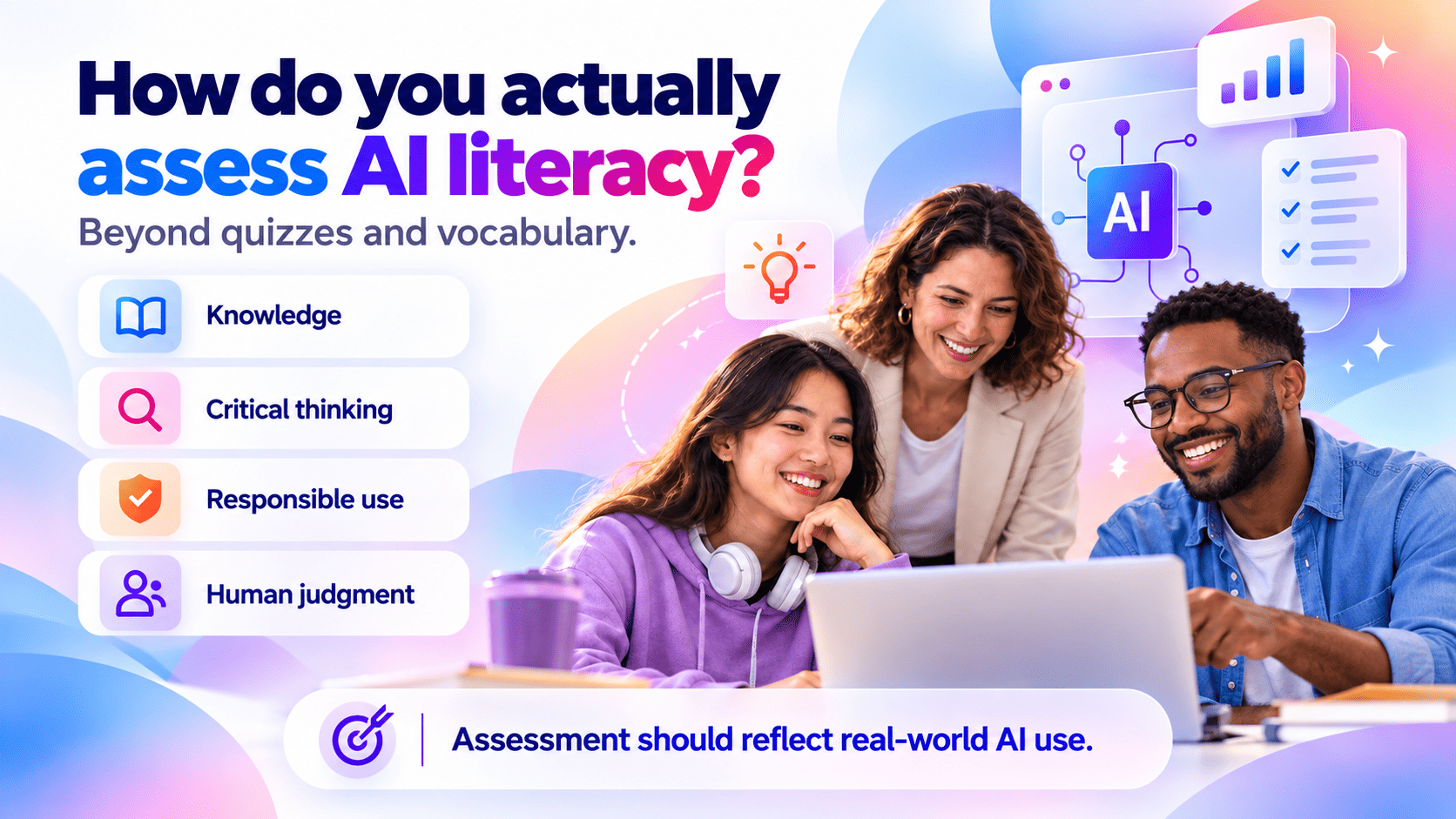
How Do You Assess AI Literacy ? From students to employees
As artificial intelligence becomes part of everyday learning and work, organizations face a new question : how do you actually assess AI literacy ?
It is relatively easy to test whether someone can define machine learning, explain what an AI hallucination is, or identify a chatbot. It is much harder to determine whether a student or employee can recognize an unreliable AI answer, identify bias, verify evidence, challenge an automated recommendation, or understand when a decision must remain with a human.
That is why AI-literacy assessment cannot rely on traditional quizzes alone. AI literacy combines knowledge, practical use, critical evaluation, responsible use, human judgment, and problem solving. The assessment model needs to reflect that complexity. How Do You Assess AI Literacy_A…
For schools, this means moving beyond testing AI vocabulary.
For enterprises, it means moving beyond asking whether employees have completed an AI-awareness course.
In both cases, the real question is whether people can use AI critically and responsibly in realistic situations.
From knowing about AI to making decisions with AI
A traditional assessment might ask :
What is generative AI ?
What is bias ?
What is an AI hallucination ?
What is machine learning ?
These questions still matter because foundational knowledge matters. But knowing a definition does not demonstrate capability.
Knowing what hallucination means does not prove that someone can recognize one in an AI - generated report.
Knowing that AI can contain bias does not mean an employee can detect bias in a recruitment recommendation or that a student can identify it in an AI - generated historical explanation.
Knowing how to write a prompt does not necessarily mean someone understands how context, the quality of the information provided to the AI, or the choice of model can influence its response or whether that response should be trusted.
A stronger progression is :
I know what AI is → I can use it → I can question it → I can evaluate it → I can create with it → I can make responsible decisions about it.
This progression applies equally to education and the workplace.
AI literacy is a multi-dimensional competency
A meaningful assessment should examine several dimensions.
1. Knowledge
Does the learner understand concepts such as data, algorithms, generative AI, machine learning, bias, hallucinations and privacy ?
2. Practical use
Can they use AI effectively for an appropriate task ?
3. Critical evaluation
Can they question an answer, compare outputs, verify claims, recognize uncertainty and identify missing evidence ?
4. Responsible use
Do they understand confidentiality, privacy, intellectual property, academic or professional integrity, fairness and safe use ?
5. Human judgment
Can they recognize when AI can assist a decision and when a human must retain responsibility ?
6. Creation and problem solving
Can they use AI to solve a meaningful problem while understanding its limitations ?
AI literacy is therefore closer to a competency model than to a conventional subject examination.
This also makes AI literacy relevant well beyond schools.
The same capabilities increasingly matter for HR teams, managers, customer - service employees, engineers, marketers, healthcare workers and anyone using AI - generated information in their work.
Different contexts require different assessments
The principle is the same, but the situations should reflect the learner.
A student might be asked to compare two AI - generated explanations and identify which claims require verification.
A manager might receive an AI - generated recommendation about employee performance and need to decide what evidence should be reviewed before taking action.
A recruiter might examine an AI-generated shortlist and assess whether the recommendation could contain bias.
A marketing employee might evaluate an AI - generated market analysis and identify statements that require source verification.
A customer-service agent might decide whether an AI - generated response is appropriate to send to a customer or requires human intervention.
This is where an Interactive Learning Platform becomes particularly useful. The assessment can move from abstract questions to realistic decisions, rather than simply checking whether the learner remembers terminology.
AI literacy needs more than multiple choice
Multiple-choice questions remain useful for foundational knowledge, but they should form only one part of the assessment.
A richer assessment can combine several formats.
Recognition tasks
Show learners an AI-generated output and ask them to identify :
an unsupported claim ;
confidential information ;
possible bias ;
misleading certainty ;
manipulated visual content ;
a statement requiring verification.
Hotspots and visual-recognition activities are particularly useful because they test whether someone can notice a problem, not simply define one.
Decision scenarios
AI literacy often involves decisions rather than right-or-wrong factual answers.
Imagine an AI system recommends rejecting a job applicant based on historical data.
The learner could be asked :
What should happen next ?
Accept the recommendation ?
Ask for human review ?
Investigate the underlying data ?
Look for potential bias ?
Request additional evidence ?
A branching scenario evaluates how the learner applies a principle in context. This type of experience is especially useful for an AI authoring tool for L&D, because organizations can reproduce situations employees actually face.
Comparing AI outputs
Learners can compare :
two models ;
two prompts ;
AI-generated answers from different perspectives ;
a general model response and one grounded in trusted sources.
They can then identify differences in evidence, assumptions, uncertainty, completeness and bias.
Confidence checks
Confidence adds another dimension.
Someone who gives the correct answer with low confidence may need reinforcement. Someone who gives an incorrect answer with very high confidence may represent a greater risk.
This is particularly relevant to AI literacy because generative AI itself can present incorrect information with apparent confidence.
Categorization
Learners can classify examples as : Reliable / Needs verification / Unsafe
Or : Human decision / AI-assisted decision / AI should not decide
This tests practical distinctions that matter in both education and enterprise AI use.
Human control before and after AI - supported assessment
When AI is involved in assessment, human oversight needs to be designed into the process not added as an afterthought.
This is especially important in contexts covered by the EU AI Act. The Regulation classifies certain AI systems used in education and vocational training as high risk when they evaluate learning outcomes, determine access or materially influence a person's educational or professional pathway.
For an assessment workflow, a sensible human-control model therefore has two checkpoints :
Before the assessment
A teacher, trainer, instructional designer or authorized subject - matter expert should validate :
the learning objectives ;
the competencies being measured ;
the assessment questions and scenarios ;
the scoring logic ;
the appropriateness of any AI-generated content ;
the sources used ;
the role AI is permitted to play.
AI may help accelerate creation, but a human approves what is being assessed and how.
After the assessment
Where AI assists with interpretation, scoring or recommendations, a qualified human should review the result before it is used for a consequential decision.
That means checking :
whether the output is reasonable ;
whether evidence supports it ;
whether bias or unexpected behavior may have occurred ;
whether exceptional cases need investigation ;
whether the learner should have an opportunity for review or appeal where appropriate.
The principle is simple :
Human validation before → AI-supported assessment → Human review after.
Importantly, not every training quiz or AI - assisted evaluation automatically becomes a high-risk system under the EU AI Act ; classification depends on its purpose and use but human control is a sound design principle even where the specific high - risk provisions do not apply.
How Mexty supports richer AI-literacy assessment
Mexty's Evaluation module is designed to combine different assessment formats into one scored experience.
An evaluation can include :
traditional quizzes ;
hotspots and visual recognition ;
branching decision paths ;
randomized question banks ;
confidence checks ;
categorization ;
comparison activities ;
practical scenarios.
The existing module also allows evaluations to be organized around explicit objectives rather than creating a generic “ AI test .
For example, an objective might be :
Assess whether the learner can recognize an unreliable AI output, verify the relevant evidence and decide when human intervention is required.
The appropriate activities can then be assembled around that competency.
This is where Mexty's broader positioning as an AI-native platform for creating interactive learning experiences becomes relevant. Assessment is connected to the learning experience rather than existing as a separate end-of-course quiz.
For L&D teams, the same environment can help simplify the instructional design workflow by connecting creation, interactive activities and evaluation. For education, it can support progressive AI-literacy assessment across courses and learning paths.
As an AI-Native secure Learning Infrastructure, Mexty is intended to support both creators and learners while keeping human validation central to the process.
The platform can also support SCORM - compatible learning experiences for organizations that need to deliver content through existing LMS environments, while Mexty's Interactive Course Creator and evaluation capabilities allow assessment to extend beyond passive content consumption.
Assessment should reflect real - world AI use
AI literacy will increasingly matter in both classrooms and workplaces. Students need to know whether an AI - generated answer can be trusted when employees need to know whether an AI - generated recommendation should influence a customer, recruitment, financial or operational decision. Also, managers need to understand what AI can support and what they remain accountable for.
The objective of assessment therefore cannot simply be : “ Does this person know AI vocabulary ? ”
It should become:
Can this person understand AI ?
Can they use it appropriately ?
Can they challenge it ?
Can they recognize uncertainty and bias ?
Can they verify evidence ?
Can they make a responsible decision ?
And do they know when a human must remain in control ?
That is the shift from testing AI knowledge to assessing AI capability.
And as AI becomes embedded across education and work, that capability may become one of the most important outcomes an AI - native secure learning infrastructure can help organizations develop and measure.
About Mexty ….
Mexty turns learning into personalized experiences designed to drive real - world performance.
Discover how AI - native learning can turn knowledge into action with Mexty.
Meet Mexty : the AI-powered learning platform that turns knowledge into engaging experiences, real skills, lasting behavior change, and measurable results.
That’s where Mexty changes the way learning works.
Go beyond traditional e-learning with Mexty, where AI transforms your expertise into personalized learning journeys that engage, inspire, and drive real impact.
Once you’ve discovered and tried Mexty, we’d love to hear your thoughts !
Share your experience and impressions with us about this new, interactive way to learn and create. Your feedback is very valuable to us.
Don’t miss the latest news. Follow Mexty and visit www. Mexty.ai to discover what’s next !
If you enjoyed this, you’ll love our next articlesAI Literacy Should Become a Core School Capability, Not an Optional Digital Skill |