

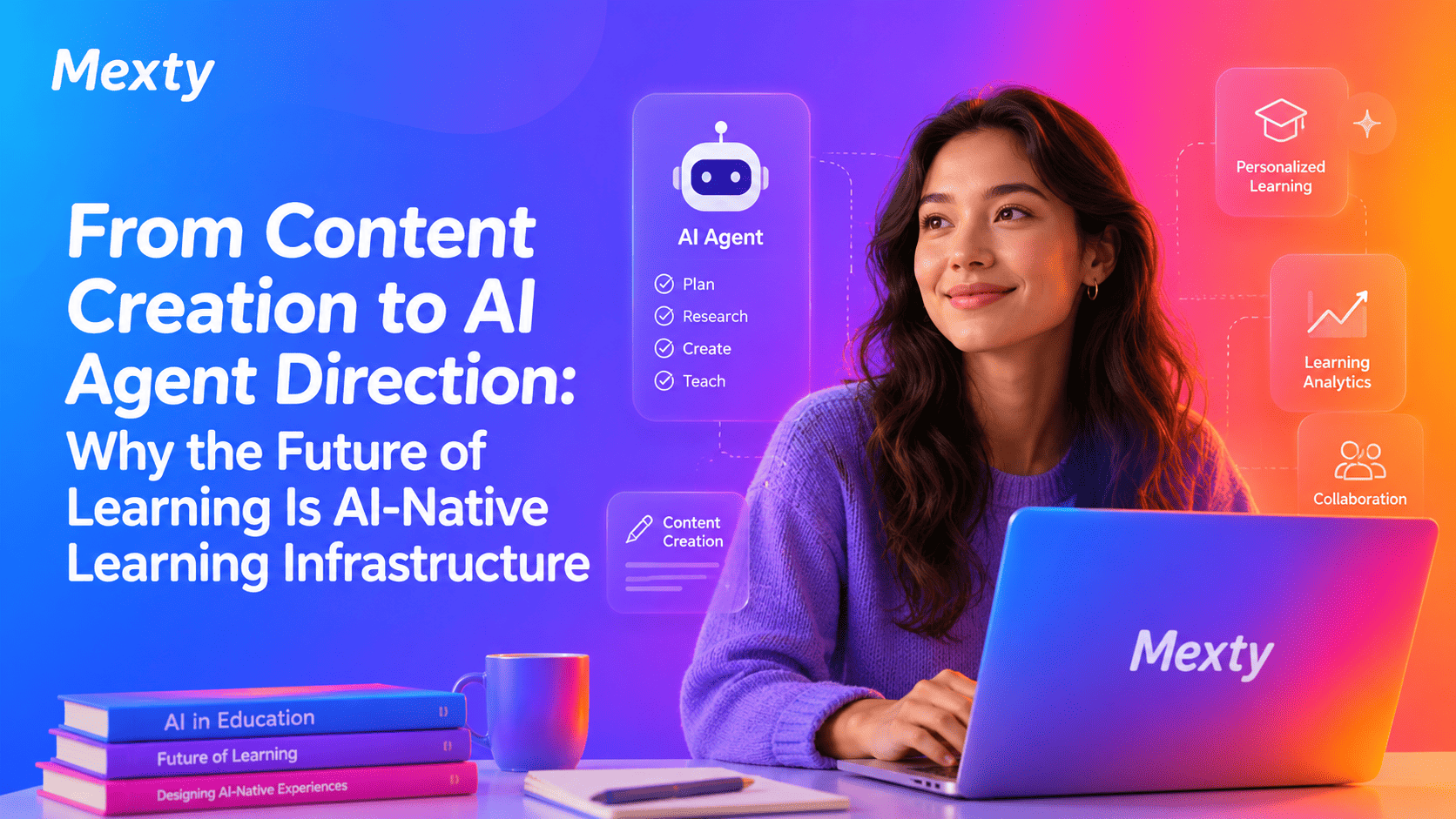
From Content Creation to AI Agent Direction: Why the Future of Learning Is AI-Native Learning Infrastructure
For more than two decades, digital learning has been largely defined by content creation.
Instructional designers built courses.
Subject Matter Experts provided knowledge.
Authoring tools transformed content into SCORM packages.
Learning Management Systems distributed training.
The process evolved, but the underlying model remained largely the same: create content, publish content, track completion.
Artificial Intelligence is changing that model.
Most discussions about AI in learning focus on speed.
AI can generate learning objectives, quizzes, assessments, images, videos, branching scenarios, and even complete courses in minutes.
While impressive, this is only the beginning.
The real transformation is much deeper.
We are moving from only content creation to content creation and AI agent direction.
And this shift will redefine instructional design, eLearning development, and enterprise learning over the next decade.
The First Generation of AI Learning Tools
The first generation of AI-powered learning tools focused primarily on content generation.
Need a quiz? Generate it.
Need a storyboard? Generate it.
Need a course outline? Generate it.
Need to convert PowerPoint slides into eLearning? Generate it.
This dramatically accelerated development and introduced a new generation of tools competing with traditional authoring software.
Many organizations began exploring AI alternatives to Storyline, searching for easier alternatives to Storyline and alternative solutions to complex authoring tools.
The appeal was obvious.
Why spend days building content when AI could create a first draft in minutes?
But organizations quickly discovered a limitation.
Generating content is not the same as creating learning.
And creating learning is not the same as creating learning experiences.
The Rise of AI Agents in Learning
The next generation of learning technology is not focused on generating static content.
It is focused on creating intelligent interactions.
Imagine an onboarding experience.
Instead of reading a policy document, a new employee interacts with an AI colleague.
The learner asks questions. The AI responds. The conversation evolves.
The learner practices decision-making.
The AI adapts its responses based on the learner's behavior.
Now imagine the same concept applied to:
- Leadership development
- Sales training
- Customer service
- Healthcare education
- Compliance training
- Soft skills development
- Technical certifications
Suddenly, learning becomes conversational.
Learning becomes experiential.
Learning becomes interactive.
This is where AI Agents for Learning become transformative.
Instructional designers are no longer simply building courses.
They are directing digital actors.
Instructional Designers Are Becoming Experience Directors
Think about how AI agents are designed.
An instructional designer may tell the AI:
"Act like a frustrated customer."
"Challenge the learner's assumptions."
"Respond with uncertainty."
"Coach the learner through a difficult conversation."
"Behave like a new manager experiencing resistance from their team."
This process resembles directing actors more than creating slides.
The designer is no longer focused exclusively on screens, buttons, and navigation.
The focus shifts toward:
- Human interaction
- Emotional realism
- Contextual decision-making
- Practice opportunities
- Behavioral outcomes
This evolution fundamentally changes the role of instructional design.
The future instructional designer will increasingly function as:
- Experience architect
- Conversation designer
- Agent director
- Learning strategist
- AI workflow designer
Why Prompt-to-Course Is Not Enough
Many emerging platforms promise "prompt-to-course" creation.
Simply describe a topic.
Receive a course.
While attractive, this approach creates a dangerous misconception.
Production-ready learning requires much more than generated content.
Enterprise organizations need:
Source of Truth
Learning content must be based on validated information.
Without a source of truth, organizations risk distributing inaccurate information.
Human Validation
AI-generated content must be reviewed by experts.
Particularly in regulated industries.
Content Traceability
Organizations need to know where information originated.
Who approved it?
When was it updated?
Which version is currently deployed?
Version Control
Learning assets evolve continuously.
Organizations require structured management of revisions.
Governance
Content creation must follow organizational standards.
Compliance
Learning programs often support legal and regulatory requirements.
Security
Sensitive information must remain protected.
These requirements reveal a critical insight:
The future is not prompt-to-course.
The future is AI-Native Learning Infrastructure.
What Is AI-Native Learning Infrastructure?
Traditional authoring platforms were built before AI existed.
AI capabilities have often been added later.
An AI-native platform takes a fundamentally different approach.
AI is integrated into every stage of the learning lifecycle:
- Content creation
- Content validation
- Agent creation
- Interactive experiences
- Analytics
- Continuous improvement
- Deployment
- Governance
An AI-native platform for creating interactive learning experiences treats AI as part of the workflow, not merely as an optional feature.
This enables organizations to simplify instructional design workflows while maintaining quality and control.
The End of Complex Authoring Workflows
Traditional eLearning development often requires:
- Storyboarding
- PowerPoint creation
- Graphic design
- Authoring tool development
- SCORM packaging
- LMS testing
- Stakeholder reviews
- Multiple revision cycles
This process can take weeks or months.
Many organizations are now looking for ways to replace complex authoring workflows.
They seek:
- Easier alternatives to Storyline
- Modern alternatives to Storyline workflows
- Alternatives to complex authoring tools
- Ways to reduce Storyline dependency
- Solutions that simplify Storyline development
The goal is not necessarily to eliminate instructional design expertise.
The goal is to remove unnecessary technical complexity.
Vibe Coding for Interactive Learning
Instead of manually building every interaction, designers describe experiences conversationally.
The platform generates functionality.
The designer refines and guides.
This approach enables:
- Interactive course creation with vibe coding
- Vibe coding for SCORM interactive courses
- Faster prototyping
- Easier iteration
- Reduced technical barriers
Most importantly, it allows instructional designers to focus on learning outcomes rather than technical implementation.
From PDFs to Interactive Learning Experiences
One of the most common enterprise challenges involves static documentation.
Organizations possess:
- PDFs
- Policies
- Procedures
- Manuals
- Guides
- Knowledge bases
Yet learners struggle to engage with them.
Modern AI lesson creators for teachers and enterprise learning teams can convert PDF to interactive course experiences automatically.
However, the real opportunity is not conversion.
It is transformation.
Static information becomes:
- Scenarios
- Conversations
- Simulations
- Coaching interactions
- AI-driven practice
This represents a major leap beyond traditional eLearning.
Why SCORM Still Matters
Despite advances in AI, organizations still rely heavily on SCORM-compatible content.
This reality creates demand for:
- SCORM authoring tools
- LMS-ready authoring platforms
- LMS-compatible AI course creators
- LMS-integrated authoring tools
The future is not abandoning SCORM.
The future is combining AI innovation with SCORM compatibility.
Organizations need solutions that support existing infrastructure while enabling next-generation learning experiences.
This is why AI-native SCORM authoring platforms for interactive learning creation are becoming increasingly important.
Security and Trust Will Become Competitive Advantages
As AI adoption grows, security becomes a critical differentiator.
Organizations increasingly seek:
- Secure AI authoring platforms
- Privacy-first AI authoring tools
- GDPR-compliant AI learning platforms
- Secure educational AI platforms
- Trusted AI authoring platforms
- AI learning platforms with privacy controls
The challenge is no longer whether AI can generate content.
The challenge is whether organizations can trust AI-generated content.
Trust requires:
- Human oversight
- Governance
- Compliance
- Auditability
- Data protection
The winners in the AI learning market will not simply be the fastest.
They will be the most trustworthy.
The Future of Learning Platforms
Learning technology categories are beginning to converge.
Historically, organizations used separate solutions for:
- Authoring
- LMS
- Analytics
- Collaboration
AI is changing these boundaries.
The future is likely to be:
- AI-native LMS and authoring platforms
- Interactive LMS platforms
- LMS-compatible interactive learning platforms
- AI-native LMS authoring platforms
Rather than moving content between disconnected systems, organizations will work inside unified learning ecosystems.
Beyond the Best Authoring Tool
Many buyers search for:
- Best authoring tools in 2026
- Best eLearning authoring tool 2026
- Articulate Storyline alternatives
- Genially alternatives
- iSpring alternatives
These are valid questions.
But they may become increasingly irrelevant.
The more important question is:
"What learning infrastructure will support AI-driven learning experiences over the next decade?"
The answer will not be determined by the best slide editor.
It will be determined by the platform's ability to orchestrate AI agents, human expertise, governance, analytics, and learning workflows.
Humans Remain at the Center
One fear surrounding AI is that it will replace instructional designers.
The opposite may be true.
As content generation becomes automated, the value of human expertise increases.
Humans remain responsible for:
- Strategy
- Judgment
- Empathy
- Governance
- Validation
- Ethics
- Experience design
AI can generate.
Humans direct.
AI can simulate.
Humans evaluate.
AI can accelerate.
Humans decide.
This partnership defines the future of learning.
The Next Era of Learning
The learning industry is entering a new phase.
We are moving beyond:
- PowerPoint-based training workflows
- Static eLearning
- Complex authoring workflows
- Content-centric design
And toward:
- Interactive learning without technical complexity
- AI workflow for instructional design
- Interactive course creation without coding
- AI agents for learning
- AI-native learning infrastructure
The future belongs to organizations that can combine speed with trust.
Because speed creates attention.
But trust creates adoption.
The most successful platforms will not simply generate content.
They will help organizations create, validate, govern, deploy, and continuously improve learning experiences powered by AI agents and guided by human expertise.
That future is already beginning.
And instructional designers are not being replaced by AI.
They are becoming directors of intelligent learning experiences.
Learn more about AI-native learning infrastructure at Mexty.
| If you enjoyed this, you’ll love our next articles The Biggest Mistake in AI Learning: Treating AI as a Feature Instead of Building a Learning Infrastructure |