

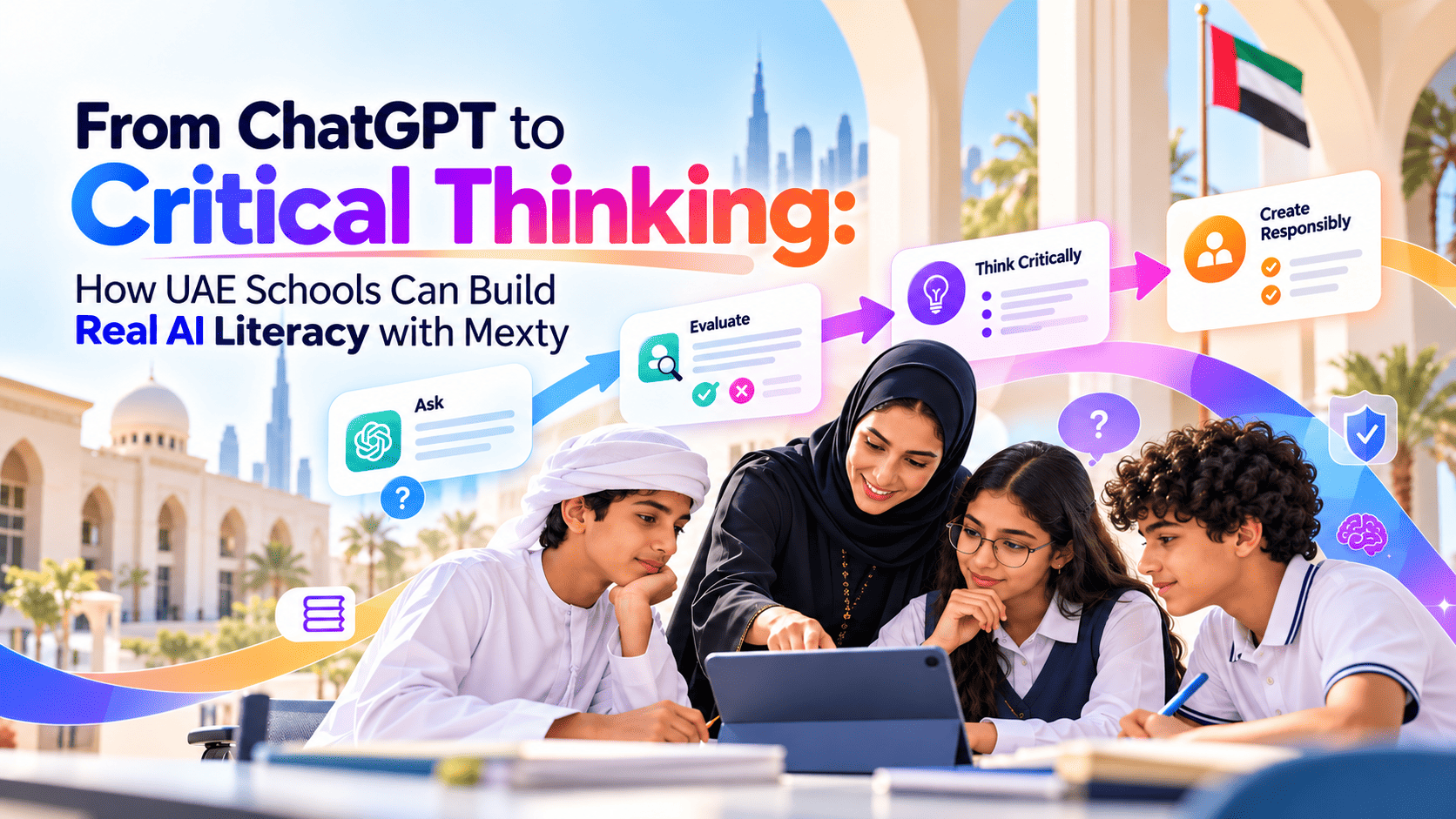
From ChatGPT to Critical Thinking: How UAE Schools Can Build Real AI Literacy with Mexty
AI is already part of school life.
Students use it to search, write,
translate, summarise, generate images and solve problems. It is tempting to
call that AI Literacy but It is not.
Knowing how to ask ChatGPT a
question is useful, but real AI Literacy begins when a student can ask a
different set of questions:
Why did the model give me this
answer?
What evidence supports it?
Could it be biased?
What might be missing?
Should I trust it?
That shift from simply using AI to
questioning, evaluating and governing it is becoming central to the UAE
approach to AI education. The UAE framework is designed as a structured K–12
progression, moving students from foundational awareness toward critical
evaluation, responsible use, design and real-world application, with human
judgment and oversight remaining important throughout.
The challenge for schools is no
longer only to introduce AI.
It is to turn that ambition into a
coherent learning journey that teachers can actually deliver, adapt and assess.
That is where Mexty can support implementation.
AI
Literacy is not the same as AI usage
A school can have coding classes,
robotics clubs and access to generative AI and still not have a coherent AI
Literacy program.
Students may become confident AI users without necessarily understanding how AI works, why outputs can be
unreliable, how bias can appear, when information should be verified or when
human judgment needs to override an AI recommendation.
Clearly isolated activities may be
useful, but they do not automatically create progression. A stronger model
develops AI Literacy progressively, from simple ideas about machines and
patterns in the early years to data, algorithms, bias, misinformation, hallucinations,
privacy, accountability and governance in later grades.
The learning journey becomes:
Discover → Understand → Use →
Question → Evaluate → Create → Govern
Mexty helps turn that progression into an actual learning
structure.
Start
with ready-made UAE AI Literacy learning paths
Schools should not need to build
every AI Literacy lesson from scratch.
Mexty provides editable AI Literacy learning paths from
KG to Grade 12. Each grade can already include the relevant:
Learning Path → Courses →
Interactive Activities → AI Literacy Lab Experiences → Assessments
The school therefore starts with a
structured foundation rather than an empty authoring screen.
A Grade 8 learning path, for
example, may already include courses and activities around:
- generative
AI;
- misinformation;
- bias;
- deepfakes;
- privacy;
- data
quality;
- trusted
information;
- human
oversight.
The role of the teacher is not to
recreate the whole sequence.
It is to review, adapt and enrich
it.
Adapt
the learning path to the school
The UAE learning paths provide the
structure, but schools still need flexibility.
A school could open the Grade 7 UAE
AI Literacy template and:
- edit
existing content or add its own text, images, videos and resources;
- adapt the
sequencing to fit the school timetable or curriculum structure;
- replace
or enrich examples with cases relevant to the school community;
- adjust
the difficulty or depth of courses and activities;
- add the
school’s own digital citizenship or AI-use policies;
- add or
modify interactive activities and AI Literacy Lab exercises;
- customise
the final assessment.
This is important because UAE
schools operate across different curricula, school models and pedagogical
approaches.
Mexty provides the structured foundation.
The school keeps pedagogical
control.
Turn
explanations into interactive experiences
AI Literacy is especially difficult
to teach through passive content alone.
Students can read a definition of
hallucination without being able to recognise one.
They can memorise the meaning of
bias without being able to identify bias in an AI output.
They can learn that sources should
be verified without knowing how to verify them.
Mexty allows teachers to turn these concepts into
interactive learning experiences.
For example, instead of simply
explaining hallucinations, a teacher could use an activity where students
receive an AI-generated answer containing several plausible claims and are
asked:
Which statement needs verification?
A bias lesson could become a
categorisation exercise:
Potentially biased
Needs more evidence
Acceptable with justification
A privacy lesson could become a
branching scenario:
A student wants to paste personal
information into an AI tool. What should they do next?
Interactive activities make
students practise judgment rather than simply memorise terminology.
Use
the AI Literacy Lab to let students investigate AI
One of the strongest ways to teach
AI Literacy is to let students observe AI behaviour directly.
Mexty’s AI Literacy Lab is designed for this purpose.
Students can run controlled
experiments such as:
Compare different AI models
Ask the same question to two
different models.
Then examine:
- what
information each model included;
- what each
model omitted;
- how
confident the answers appear;
- whether
the conclusions differ;
- which
answer is better supported by evidence.
The objective is not to decide that
one model is always better.
It is to understand that different
AI systems can behave differently.
Change the context
Ask: Should schools allow students
to use AI for homework?
Then ask the same question with
different contexts: “Answer as a teacher” and “Answer as a student”. You
could also add: Answer as a school principal.
Students can then compare how the
different perspectives affect:
- the
benefits highlighted;
- the risks
mentioned;
- assumptions
about responsibility;
- concerns
about fairness or cheating;
- the
importance given to learning, efficiency or control.
The learning objective is to show
that context and perspective can shape an AI-generated response, even when the
underlying question stays the same.
Investigate hallucinations
Students can be given a question
where the model may produce an unsupported claim.
The learning task is not simply to
find the error.
It is to ask:
Why does the answer sound
convincing?
What should
be verified?
What evidence would we need?
Compare general AI with trusted-source-grounded AI
Students can ask a general model a
question and then compare the response with one grounded in approved school
materials.
This helps them understand the
difference between:
general model knowledge
and trusted-source-grounded knowledge.
Ground learning in trusted school
knowledge
A central AI Literacy skill is
understanding that a fluent answer is not necessarily a reliable answer.
Mexty Knowledge Bases allow schools to bring approved
content into the learning environment.
Teachers can add:
- school
policies;
- curriculum
documents;
- approved
articles;
- digital-safety
guidance;
- teacher-created
resources;
- reference
documents.
These can then be used as trusted
sources for courses and activities.
A teacher could, for example,
upload the school’s own AI-use policy and create an activity asking students to
evaluate different AI-use scenarios against that policy.
Or a teacher could provide an
authoritative source and ask learners to compare it with a general AI-generated
explanation.
This makes source verification
practical.
Add
teacher-created content without rebuilding the course
The ready-made learning paths are
not intended to lock teachers into fixed content.
Teachers can add their own:
- PowerPoints;
- PDFs;
- videos;
- classroom
instructions;
- examples;
- discussion
prompts;
- worksheets;
- assessment
questions.
Existing school material can
therefore become part of the AI Literacy journey rather than sitting outside
the platform.
A teacher might already have a PDF
called: Responsible Use of AI at Our School
That document could be used to
enrich the relevant course, create an interactive activity or become part of an
assessment.
This helps schools combine their
existing resources with the structured AI Literacy learning path.
Teach
students to question AI, not simply prompt it
Prompting is useful but prompt
engineering alone is not AI Literacy.
A student may know how to produce
an impressive answer while having no idea whether that answer is accurate,
biased or appropriately sourced.
This is why the Mexty approach places greater emphasis on questioning AI.
A student should learn to ask:
- Why did
the model produce this answer?
- What
information influenced it?
- What
evidence supports it?
- What
might be missing?
- Could
another model answer differently?
- Could the
response be biased?
- Does the
answer need human review?
The goal is to move students from
using AI toward understanding when it should be questioned and when human
judgment must come first.
Assess
judgment, not only recall
If AI Literacy is treated as a real
curriculum, schools need evidence that students are progressing.
A multiple-choice quiz may tell you
whether a learner knows what a hallucination is.
It does not necessarily tell you
whether the learner can recognise one.
Mexty Evaluations can combine different assessment formats.
For example:
Knowledge check: What
is an AI hallucination?
Visual recognition: Show
a response and ask students to identify the unsupported claim.
Categorisation: Students
classify responses as:
Students classify each AI-generated
response according to whether it appears trustworthy, requires further
verification, or is unsafe to use without human review.
Decision scenario: A
model recommends an important action.
The student must decide whether to accept
the AI recommendation, verify it further, or escalate it to a human for review,
and then indicate how confident they are in that decision.
This adds an important
metacognitive dimension.
The assessment should move beyond
simple multiple-choice questions toward decision scenarios, visual recognition,
categorisation, confidence checks and comparison activities.
Build
teacher readiness alongside student learning
A successful AI Literacy program
depends on teachers.
Teachers do not need to become AI
engineers but they do need enough confidence to guide students through
questions such as:
- Why can
AI hallucinate?
- How does
context influence a response?
- What
makes a source trustworthy?
- How can
bias enter an AI system?
- What
information should students never share?
- When is
AI assistance appropriate?
- When must
a human remain responsible?
Mexty can support teacher development through dedicated
learning paths.
Teachers can also experience the
same AI Literacy Lab activities before using them with students.
That gives teachers both content
knowledge and practical familiarity with the learning experience.
[Explore AI Literacy Teacher Training →
Keep
governance inside the learning experience
AI governance should not exist only
as an IT policy because students need to understand why rules exist. A school
should define:
- which AI tools students can use;
- which
models are appropriate for different ages;
- what
student information can be shared;
- which
sources are trusted;
- how
AI-generated content is reviewed;
- when
teachers must intervene;
- how
academic integrity is handled.
Mexty helps schools integrate these principles into the
learning environment rather than treating governance as a separate document.
The school can add its own AI-use
policy to a course.
Students can work through scenarios
based on that policy.
Teachers can use trusted sources.
Assessments can test whether
learners understand when human review is required.
This turns governance into part of
AI Literacy itself.
A practical Grade 9 example
Imagine a Grade 9 learning path
focused on:
LLMs, Prompting and Trust
The template already contains the
course and related activities.
A teacher might adapt it as
follows.
1. Review the existing lesson
The teacher checks the explanations
of LLMs, hallucinations and prompting.
2. Add the school AI policy
The school’s rules around
responsible AI use and academic integrity are added as trusted content.
3. Adapt one example
A generic prompt is replaced with a
classroom-relevant example.
4. Run an AI Literacy Lab
Students ask:
Is social media beneficial for
teenagers?
They compare two models.
They then change the context.
5. Add a verification task
Students must identify which claims
require external evidence.
6. Run the assessment
The evaluation combines a short
quiz, a comparison task and a decision scenario.
7. Review student evidence
The teacher can see whether
students understand the concepts and whether they can apply judgment in
practice.
That is a complete AI Literacy
learning experience. Not just an AI demonstration.
From
AI usage to AI capability
The UAE direction is not simply
about giving students access to more AI tools. It is about building a
progressive capability.
Young learners begin with
awareness.
Older learners start understanding
patterns and data. Then they question outputs, compare models, examine
evidence, evaluate bias and understand governance.
Discover → Understand → Use →
Question → Evaluate → Create → Govern
Mexty helps schools turn that progression into something
operational:
Ready-made KG–12 Learning Paths
Editable
Courses
Interactive Activities
AI Literacy Labs
Trusted Knowledge
Assessments
Teacher Training
Learner Evidence
The objective is not to replace the
UAE framework, teachers or school leadership. It is to provide the learning
infrastructure that helps schools move from policy and curriculum objectives to
classroom practice.
The most important outcome is not
whether students can use AI faster. It is whether they learn when to use it,
when to question it, when to verify it and when human judgment must come first.
| If you enjoyed this, you’ll love our next articles AI Literacy Around the World: How Education Systems Are Preparing Students for an AI-Native Future |