

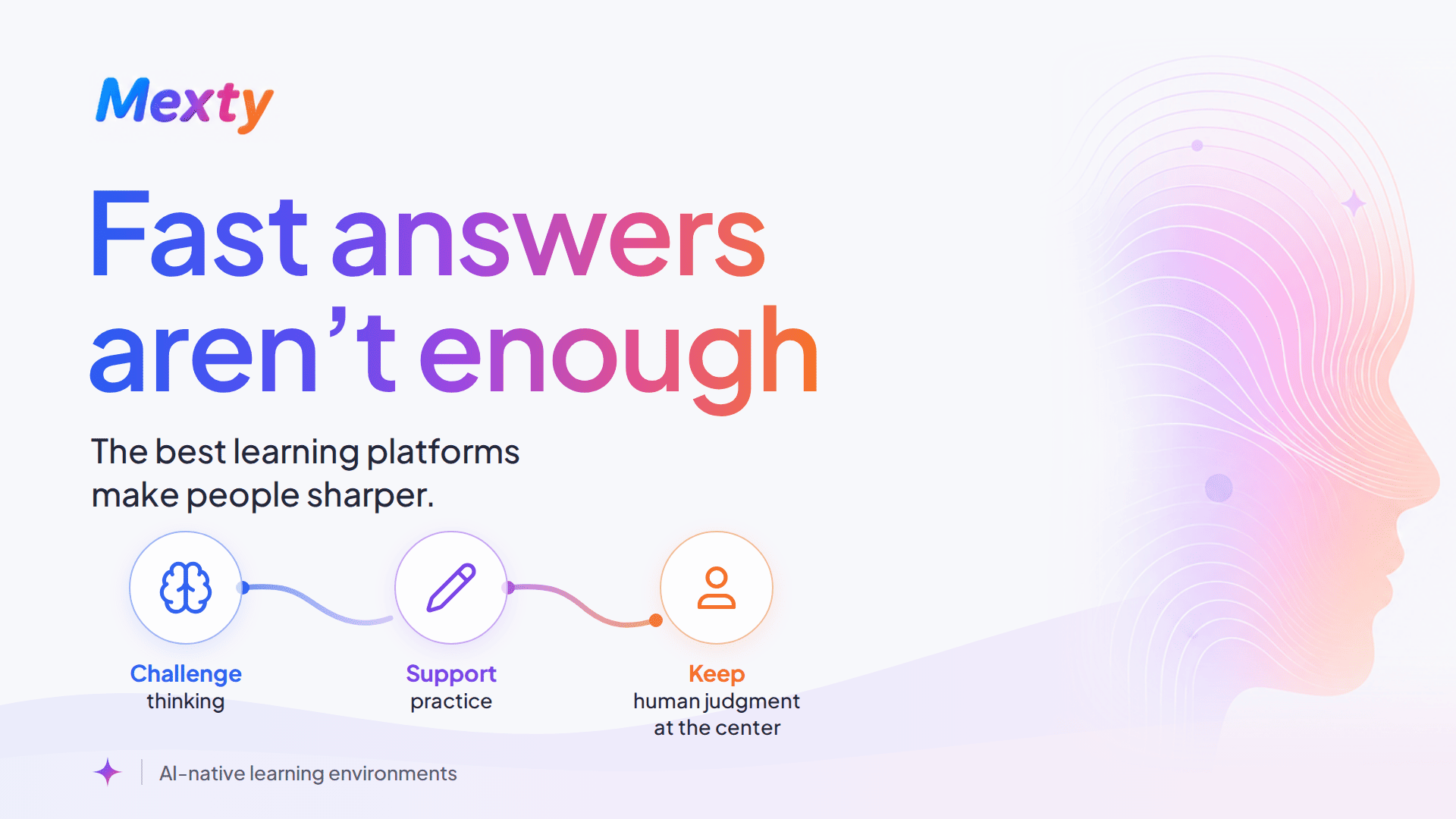
Faster Answers Are Not the Future of Learning
The next generation of learning
platforms should not simply give learners faster answers.
Speed is no longer the difficult
problem. Generative AI can explain a concept, summarize a document, produce a
quiz, draft a course outline, or create a presentation in seconds. What once
required hours of research and content production can now happen almost
instantly.
That is useful. But it is not the
same as learning.
The harder question is what happens
to someone’s thinking when the answer arrives before the struggle does.
When learners immediately delegate
a task to AI, they may complete it faster without necessarily understanding it
better. They may receive a polished answer without developing the judgment
required to evaluate it. They may appear productive while becoming increasingly
dependent on the tool.
The future of learning technology
therefore cannot be defined only by faster content generation. It must be
defined by its ability to improve reasoning, judgment, practice, and
performance.
The platforms that matter will not
simply answer questions. They will help people ask better ones.
Speed solves a production problem, not a learning problem
Many current AI tools are optimized
around output:
- Generate a lesson.
- Summarize
a PDF.
- Create a
quiz.
- Produce a
presentation.
- Rewrite a
policy.
- Build an
activity.
These capabilities can
significantly simplify the instructional design workflow and reduce
repetitive work. An AI authoring tool for L&D can help learning
teams move more quickly from source material to a first version of a training
experience.
But rapid production does not
guarantee effective learning.
A 70-slide presentation generated
in 20 seconds is still a 70-slide presentation. A quiz created automatically
may still measure only superficial recall. A summarized policy may be accurate
but fail to help employees apply it in a difficult workplace situation.
The key distinction is between
content efficiency and learning effectiveness.
An organization does not ultimately
need more content. It needs people who can perform, decide, adapt, and solve
problems.
That requires more than an Interactive
Course Creator. It requires a learning environment designed around how
people build and demonstrate capability.
Productive friction should not disappear
Traditional learning experiences
often contain the wrong kinds of friction.
Learners may struggle with:
- confusing navigation;
- long,
passive modules;
- poorly
structured information;
- inaccessible
interfaces;
- irrelevant
content;
- repetitive
administrative steps;
- technical
barriers that prevent them from practising.
This friction adds no educational
value. It should be removed.
A modern Interactive Learning
Platform should make learning easier to access, easier to navigate, and
easier to personalize. It should help authors create interactive courses
without coding, reduce unnecessary complexity, and make it possible to move
from source material to active learning more efficiently.
But some friction is essential.
Thinking takes effort. Practice
requires repetition. Good judgment develops through exposure to uncertainty,
feedback, and consequences. Learners often need to make an initial attempt,
recognize a gap, reconsider their assumptions, and try again.
When AI removes all of that
struggle, it can also remove the conditions that make learning durable.
The objective should therefore not
be frictionless learning. It should be intelligent friction.
AI should remove the friction that
distracts from learning while preserving the effort that builds understanding.
AI should question learners, not only answer them
Most people currently experience AI as an answer engine. They ask a question, and the system produces a response.
In a learning environment, that
interaction should often be reversed.
Instead of immediately giving the
solution, an AI system could ask:
- What information are you using to reach that
conclusion?
- What
assumptions might be wrong?
- Which
option would you choose and why?
- What
could happen if your decision fails?
- How would
you explain this to a customer or colleague?
- Which
part of the AI-generated answer should be verified?
- What
evidence would change your position?
This changes AI from a shortcut
into a thinking partner.
An effective AI Agent for
Learning should know when to explain, when to question, when to provide a
hint, and when to let the learner continue struggling productively. It should
encourage reflection rather than replace it.
It can also adapt the level of
support.
A beginner may need guidance,
examples, and structured feedback. A more experienced learner may benefit from
ambiguity, incomplete information, and scenarios with competing priorities. The
learning experience should evolve as capability develops.
This is one of the most important
differences between basic AI content generation and an AI-native platform
for creating interactive learning experiences.
The first generates material.
The second orchestrates learning.
Active learning must replace passive consumption
Many digital learning experiences
still reproduce the logic of presentations: content is placed on screens,
learners click “Next,” and a quiz appears at the end.
Adding AI to that model does not
fundamentally transform it.
An AI-generated passive course is
still passive.
The next generation of platforms
must make practice central. Learners should be asked to make decisions, solve
realistic problems, analyse evidence, respond to changing situations, and
receive meaningful feedback.
This can include:
- branching scenarios;
- role-based
simulations;
- case
analysis;
- guided
reflection;
- decision
exercises;
- interactive
problem-solving;
- coached
practice;
- workplace
challenges;
- iterative
assignments.
An easy interactive course
builder can make these formats more accessible to learning teams.
Capabilities such as vibe coding for interactive learning can further
reduce the technical effort required to design simulations or branching
experiences.
However, the goal is not
interaction for its own sake. Clicking, dragging, or selecting an option is not
automatically meaningful.
Interaction becomes valuable when
it requires learners to retrieve knowledge, apply a principle, evaluate
alternatives, or make a decision.
The design question should always
be: what is the learner thinking during this activity?
Assessment must evolve in the age of AI
AIcan now perform many of the
tasks traditionally used in assessment.
It can answer multiple-choice
questions, write essays, summarize readings, generate code, produce
presentations, and construct plausible business recommendations.
This does not mean assessment is no
longer possible. It means we need to assess something more meaningful.
Recall still matters in some
contexts. People need foundational knowledge to reason fluently and recognize
when something is wrong. But recall alone is no longer sufficient evidence of
capability.
Assessment should increasingly
focus on:
- reasoning;
- decision-making;
- application;
- problem
diagnosis;
- prioritization;
- adaptation;
- explanation;
- observable
performance;
- the
ability to challenge an AI-generated response.
Instead of asking learners only for
the final answer, we can ask them to show how they reached it.
Why did they choose one option over
another? What evidence did they use? What risks did they consider? Which
assumptions did they reject? How would their decision change under different
conditions?
This approach makes learning
assessment more authentic and more difficult to outsource entirely to AI.
It also reflects how performance
works in the real world. Employees are rarely valued only for producing an
answer. They are valued for making sound decisions in context.
Evaluating AI output is becoming a foundational skill
Learners must not only know how to
use AI. They must know how to evaluate it.
AI systems can produce answers that
are fluent, persuasive, and wrong. They may omit important context, use
outdated information, misinterpret a source, or present uncertainty as
confidence.
The ability to question AI output
is therefore becoming as fundamental as reading comprehension.
Learners should be able to ask:
- Where did this answer come from?
- Is it
grounded in an approved source?
- Is the
information current?
- What
might be missing?
- Does the
conclusion follow from the evidence?
- Could
bias be influencing the result?
- Does this
recommendation comply with organizational policy?
- Should a
human expert review it?
This is particularly important in
corporate training, where an incorrect answer may affect customers, employees,
compliance, safety, or business decisions.
A trusted AI authoring platform
should help organizations design learning around verified knowledge rather than
unstructured model output. A secure interactive learning platform should
also support appropriate governance, privacy, review, and human oversight.
AI literacy should not be treated
as a single awareness course. It should be embedded across learning experiences
so that learners repeatedly practise checking, challenging, and improving
AI-generated work.
From AI authoring to AI-native learning infrastructure
The first wave of generative AI in
learning focused heavily on content production.
That was a natural starting point.
Creating courses has traditionally required significant time, specialist
expertise, and complex tools. AI can now help teams replace complex
authoring workflows, generate initial structures, suggest activities, and
transform existing material.
For example, a platform may help an
author convert PDF to interactive course content and then refine it with
scenarios, questions, assessments, and feedback.
But the next stage goes beyond
authoring.
An AI-Native secure Learning
Infrastructure should connect:
- trusted knowledge sources;
- course
creation;
- interactive
practice;
- assessment;
- learner
support;
- content
review;
- versioning;
- delivery;
- analytics;
- continuous
updates.
This creates a living environment
rather than a static package.
When a policy changes, the
associated learning experience should be easier to identify and update. When
learners repeatedly struggle with a particular concept, the platform should
help teams improve the activity. When an AI assistant supports a learner, its
response should be grounded in the correct sources and aligned with the
intended learning objectives.
This is also why being SCORM-compatible
remains valuable. Organizations still need to deliver and track learning
through existing systems. But the future cannot be limited to producing a SCORM
package and considering the learning process complete.
The course should be one component
of a broader learning ecosystem.
Keeping human judgment at the center
AI can support many parts of
learning:
- drafting;
- explaining;
- questioning;
- adapting;
- translating;
- generating
examples;
- suggesting
feedback;
- analysing
patterns.
But it should not decide what
people need to learn without human oversight. It should not automatically
determine whether someone is competent based on limited data. It should not
replace professional judgment in high-impact decisions.
Learning professionals remain
essential because they understand context.
They identify the real performance
problem. They decide what knowledge must remain in human memory. They determine
which mistakes are acceptable during practice and which could be dangerous.
They design feedback that helps people improve rather than simply marking an
answer as wrong.
They also translate organizational
expectations into understandable behaviours.
The future is therefore not AI instead of instructional design. It is instructional design strengthened by AI.
The most valuable platforms will
make learning professionals more capable, not less relevant.
The Mexty perspective
At Mexty, we see the future as a transition from AI-generated
content to AI-native learning environments.
These environments should be:
Grounded in trusted sources.
AI support
should draw from approved organizational knowledge whenever accuracy and
context matter.
Designed for active learning.
Learners should
practise, decide, reflect, and receive feedback—not simply consume generated
content.
Built for human oversight.
Authors and
reviewers should remain able to inspect, edit, validate, and update learning
experiences.
Connected across the workflow.
Authoring,
delivery, assessment, learner assistance, analytics, and updates should
function as parts of the same environment.
Focused on capability.
The objective
is not to generate the greatest amount of content. It is to help people perform
better.
This is the promise of an AI-native LMS and authoring platform: not just making course creation faster, but
creating a stronger connection between trusted knowledge, purposeful practice,
and workplace performance.
The winning platform will make learners sharper
The next decade will produce
countless tools capable of answering questions instantly.
That capability will become
ordinary.
The more important difference will
be what those tools do to the people using them.
Do they encourage dependency, or
develop independence?
Do they reduce thought, or
stimulate it?
Do they reward confident output, or
teach careful judgment?
Do they provide information, or
create capability?
The best learning platforms will
not be the ones learners cannot work without. They will be the ones that help
learners become more capable when the technology is no longer present.
Faster answers are useful.
Sharper people are the real goal.
If you enjoyed this, you’ll love our next articlesMexty vs Mindsmith vs Coursebox vs Articulate Frontline: Which AI Learning Platform Fits Your Strategy in 2027? |