

Corporate
Learning Is No Longer a Luxury: How AI-Native Learning Solutions Are Empowering
SMEs
For years, professional
training was largely reserved for organizations with significant budgets and
dedicated learning teams. Today, AI is changing that equation. Discover how
small and medium-sized enterprises can turn their existing knowledge into interactive,
trusted, and measurable learning without enterprise-level costs or complexity.
Why has
professional learning been so difficult for SMEs ?
Every business has
knowledge worth sharing.
It exists in company
procedures, employee handbooks, product documentation, customer support guides,
compliance policies, and the experience of employees who have spent years
developing their expertise.
Yet, in many small and
medium-sized enterprises (SMEs), that knowledge remains scattered across PDF
documents, PowerPoint presentations, shared folders, and the minds of a few
experienced employees.
The reason is not that
SMEs don't value training.
For years, the cost and
complexity of building a professional learning environment have made structured
training difficult to justify.
Traditional eLearning
solutions often required several separate investments: expensive authoring
software, a Learning Management System (LMS), instructional design expertise,
and considerable time to develop and maintain content.
For a company with 30, 50,
or even 300 employees, the economics often didn't make sense.
So organizations continued
to rely on informal knowledge transfer, occasional presentations, and documents
that employees were expected to read and understand independently.
This approach creates real
business risks.
New employees take longer
to become productive. Training quality varies depending on who delivers it.
Critical expertise becomes concentrated in a few individuals. Compliance
requirements become difficult to communicate consistently.
And perhaps most
importantly, companies have limited visibility into whether employees actually
understand and apply what they have learned.
The problem was never a
lack of knowledge. It was the difficulty of transforming that knowledge into
effective learning.
That is precisely what AI is changing.
AI is
removing the barriers to professional learning
Generative AI has
dramatically accelerated content production.
An AI authoring tool
for L&D can now help structure information, develop learning
objectives, generate explanations, suggest activities, and prepare assessments
in a fraction of the time previously required.
But faster content
generation is only part of the transformation.
The real breakthrough is
the emergence of connected, affordable AI-native learning solutions that make
professional training accessible to organizations without specialized learning
departments.
Three changes are
particularly important.
1. Companies can create
learning from knowledge they already own
Previously, transforming a
company procedure into a course often involved collecting documents, analyzing
content, preparing slides, designing interactions, creating assessments, and
publishing the result.
Today, organizations can
use their existing documentation as the foundation for AI-assisted course
creation.
With an Interactive
Course Creator like Mexty,
business experts can begin with validated documents and generate structured
learning experiences that can subsequently be reviewed, edited, and approved.
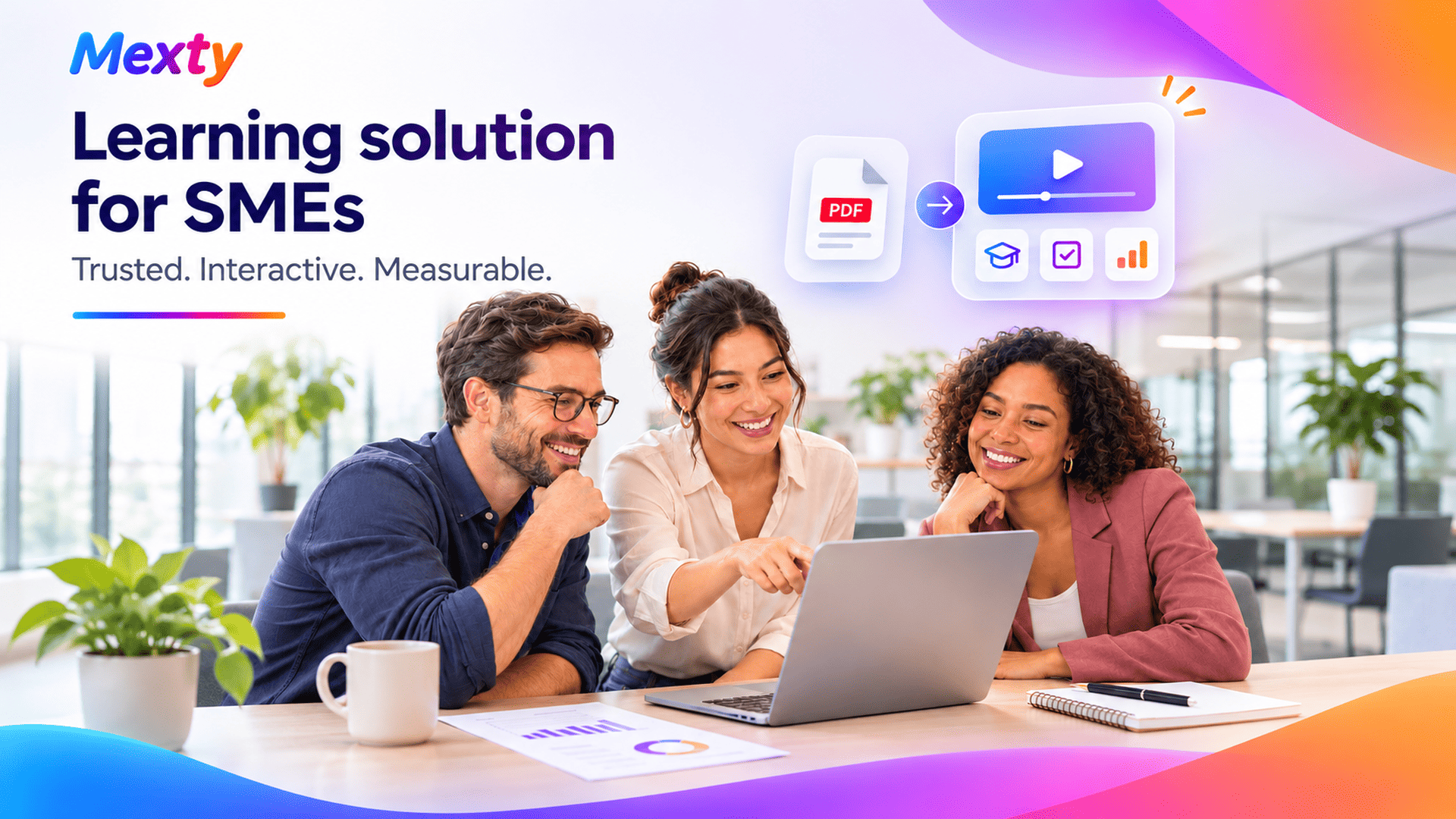
A company looking to Convert
PDF to interactive course content can move beyond simply displaying the
original document online.
It can turn that
information into explanations, practical exercises, decision-making activities,
and knowledge checks.
For example, an HR manager
can transform an onboarding handbook into a structured employee learning
journey.
A quality manager can turn
an internal procedure into an interactive compliance module.
A product manager can
convert technical documentation into training for sales teams or customers.
The knowledge already
exists.
AI helps make it teachable,
accessible, and reusable.
2. Interactive learning no
longer requires advanced technical skills
Traditional eLearning
development could require specialized authoring skills, technical knowledge, or
significant design experience.
This created a dependency
on dedicated teams or external agencies.
AI is reducing that
barrier.
Mexty enables
users to Create interactive courses without coding, using templates and
AI-assisted generation of learning activities.
One particularly promising
approach is Vibe coding for interactive learning.
Instead of manually
programming an activity, a creator can describe the learning experience they
want.
For example :
"Create an
interactive customer service scenario where employees must choose how to
respond to a dissatisfied customer. Show the consequences of their decisions
and explain the best approach."
Or :
" Build a workplace
safety activity where employees identify potential hazards and receive
immediate feedback. "
AI can help turn these
instructions into editable interactive experiences.
This opens new
possibilities for HR managers, trainers, subject-matter experts, and business
owners who understand their training needs but lack specialized development
skills.
The objective is not to
replace instructional designers. It is to make professional learning creation
accessible to more people while preserving instructional quality.
3. Authoring, learning
delivery, and analytics can work together
Creating a course is only
the beginning.
Organizations must also
deliver it to employees, manage assignments, evaluate understanding, and
monitor progress.
Historically, this often
required multiple disconnected tools.
An AI-native LMS and
authoring platform changes this model by combining content creation with
learning management and assessment capabilities.
Mexty brings
these functions together in one connected environment.
Companies can create
interactive learning content, review it, deliver it through the built-in LMS,
and monitor learner activity and assessment results.
This integration helps Simplify
eLearning workflow management and reduces the administrative complexity
associated with operating separate systems.
The result is more than
faster course production.
It is a practical way for
SMEs to establish their own internal learning capability.
What
makes Mexty
different from a conventional AI course generator ?
The market now includes many tools capable of generating course outlines, presentations, quizzes, or learning materials using AI.
These capabilities are
useful.
But producing content is
not the same as managing effective learning.
Mexty's
positioning as an Interactive Learning Platform is based on a broader
approach: connecting trusted knowledge, interactive creation, human validation,
learning delivery, assessment, and continuous improvement.
Trusted
company knowledge, not uncontrolled generation
When organizations create
compliance, technical, or operational training, accuracy matters.
A confident but incorrect
AI-generated explanation can create confusion and potentially serious
consequences.
Mexty's
Source of Truth approach helps users create learning grounded in validated
company documentation rather than relying solely on generic AI knowledge.
As a Trusted AI
authoring platform, its value depends not only on generating useful
content, but also on enabling experts to verify and maintain its accuracy.
Human review remains
essential because grounding AI in approved sources does not guarantee that
every generated explanation or assessment is correct.
AI prepares the first
draft. Company experts retain the final word.
One
connected learning environment
Mexty
combines interactive authoring with LMS delivery, evaluations, and learning
analytics.
Companies can create a
course and deliver it through the built-in LMS, or use Mexty as an LMS-integrated authoring
tool alongside their existing learning environment.
Its SCORM-compatible
export capabilities support organizations that already have an LMS and prefer
to keep their current delivery infrastructure.
This flexibility is
particularly valuable for SMEs that want to begin with authoring and expand
toward a complete learning system when their needs evolve.
Learning
support beyond course completion
Employees do not all learn
at the same pace or require the same support.
Mexty's
broader learning environment includes capabilities such as learning paths,
assessments, analytics, and AI-assisted learner support.
An AI Agent for
Learning can help learners access explanations and guidance within
supported learning experiences.
These capabilities can
make learning more responsive to individual needs while keeping educational
decisions under human control.
Most importantly,
companies can begin moving beyond tracking attendance toward evaluating understanding
and progression.
Five
business opportunities for SMEs
An affordable AI-native
learning solution can address multiple challenges within the same organization.
1. Compliance and
regulatory training
Compliance requirements
are often complex, repetitive, and subject to change.
Employees must understand
company policies, regulatory obligations, security procedures, and appropriate
workplace behavior.
Instead of simply
distributing documents, organizations can create interactive scenarios that require
employees to make decisions.
A data protection module
might ask employees how to respond to a request involving confidential customer
information.
A workplace safety
exercise might require learners to identify hazards and select appropriate
actions.
Assessments and LMS
records can help document training completion and demonstrated understanding.
This provides stronger
training evidence than relying solely on confirmation that employees received a
document, although training records alone do not establish legal compliance.
2. Employee onboarding
Every new employee must
understand the organization, its products, tools, procedures, and expectations.
In smaller companies,
onboarding often depends on the availability of managers or experienced
colleagues.
Structured learning paths
can make the process more consistent.
New employees can follow
interactive modules, practise decisions, complete assessments, and revisit
information when necessary.
Managers can monitor
progress and concentrate their time on coaching and human interaction rather
than repeatedly explaining the same procedures.
3. Knowledge transfer and
business continuity
What happens when one of
your most experienced employees leaves ?
In many SMEs, important
knowledge is concentrated in a few people.
This creates operational
dependency and increases the risk of losing expertise.
AI-assisted learning
creation makes it easier to transform approved procedures and expert knowledge
into structured, reusable resources.
Experienced employees can
contribute their expertise, review the content, and validate practical
scenarios.
New employees can then
benefit from that knowledge without relying exclusively on informal
explanations.
Knowledge becomes an
organizational asset rather than a personal dependency.
4. Product and sales
enablement
Sales and technical teams
must continuously adapt to new products, customer requirements, and changing
markets.
Traditional product
training often relies on presentations or technical manuals.
Interactive learning
offers a more practical alternative.
Sales employees can
practise responding to customer objections, identifying appropriate solutions,
or explaining product advantages.
Technical teams can work
through troubleshooting simulations and decision-based exercises.
As products evolve, the
training can be updated and redistributed.
5. Customer and partner
education
Learning is not limited to
employees.
SMEs can also create
interactive experiences to educate customers, distributors, resellers, and
service partners.
A software company can
provide guided product onboarding.
A manufacturer can create
interactive product tutorials.
A service provider can
help customers understand how to use its solutions effectively.
Well-designed customer
education can contribute to improved product adoption, more consistent user
experiences, and reduced repetitive support requests.
Professional
learning at a price SMEs can afford
Affordability is one of
the most significant opportunities created by AI-native learning platforms.
Mexty's
Authoring subscription starts at €19 per creator per month, with an
annual billing option, and a free plan is available for exploring the platform.
The integrated LMS uses
learner-based pricing that becomes more economical at scale.
For companies that already
have an LMS, Mexty's paid
authoring plans support SCORM export without requiring a separate Mexty learner subscription for every person
using that exported course.
For companies that want to
create and deliver training in one place, the integrated LMS provides learner
management and progress tracking.
This flexible model allows
an SME to begin with a small number of creators and expand gradually.
The important point is not
simply that the software is less expensive.
It is that the total cost
and complexity of building an internal learning capability can become
manageable for much smaller organizations.
Companies no longer necessarily
need a large training department, several independent software subscriptions,
or external developers to begin.
They can start with one
course, one business need, and a small group of learners.
Then expand when the value
becomes clear.
Measuring
results : From course completion to business impact
Creating a professional
training system is valuable only if it helps an organization achieve its
objectives.
This is where the
discussion must go beyond technology.
Before designing a
training program, companies should ask :
What business problem are
we trying to solve, and how will we know whether learning has helped ?
An onboarding program
might aim to reduce the time required for new employees to become productive.
A compliance program might
aim to reduce repeated mistakes or improve the recognition of risky situations.
A product training program
might aim to improve sales knowledge and customer interactions.
The learning objectives
and assessments should be connected to those operational goals.
Mexty's
learning analytics can provide visibility into course participation, progress,
and assessment performance.
But evaluating ROI in
Learning requires going further.
Companies should compare
learning evidence with relevant operational indicators, such as error rates,
onboarding duration, customer satisfaction, or business performance.
A positive change in
business indicators does not automatically prove that training caused it. Other
operational factors may contribute.
Nevertheless, defining the
expected result from the beginning, measuring learning progress, and examining
relevant business data creates a much stronger foundation for improvement.
The objective is not to
produce more courses. It is to develop capabilities that improve business
performance.
Start
small. Learn. Improve. Expand.
One of the biggest
misconceptions about corporate learning is that organizations need to implement
an entire training system before they can begin.
That is no longer
necessary.
An SME can start with a
single practical challenge.
Perhaps onboarding takes
too long.
Perhaps compliance
procedures are distributed but not consistently understood.
Perhaps product expertise
is concentrated in a few employees.
Or perhaps customers
repeatedly contact support because they do not understand how to use a product.
Choose one problem.
Identify the knowledge
already available.
Define the desired
outcome.
Use AI to create a first
interactive learning experience.
Ask the relevant experts
to review it.
Share it with a small
group, evaluate what participants understand, collect feedback, and improve the
experience.
Then expand to other teams
and topics.
This gradual approach
reduces implementation risk and allows the organization to experience value
before increasing its investment.
Conclusion
: The real breakthrough is making learning accessible to everyone
For years, corporate
learning was often treated as a capability companies could develop only after
reaching a certain size.
AI is changing that relationship.
Professional training no
longer needs to begin with expensive software, specialized development teams,
and long production cycles.
It can begin with
knowledge that already exists inside the company.
Mexty helps
organizations turn that knowledge into interactive learning, validate it
through human expertise, deliver it through connected tools, and measure what
learners understand.
The opportunity is not
simply to generate courses faster or reduce software expenses.
It is to make trusted,
governed, interactive, and measurable learning accessible to organizations of
every size.
And that changes how SMEs
can develop their teams, preserve expertise, strengthen compliance, onboard
employees, and educate customers.
The real barrier is
increasingly less about technology and more about deciding where to begin.
So here is a challenge for
SME leaders :
Think of one important
piece of company knowledge that still lives in a PDF, a PowerPoint
presentation, or the head of an experienced employee.
What if you could turn it
into an interactive learning experience that your entire team could benefit
from?
That could be the first
step toward building your own professional learning system.
Start creating with Mexty and
discover what your company's knowledge can become.
If you enjoyed this, you’ll love our next articlesHow SMEs Can Start Using AI Safely: Why Learning Is One of the Best Places to Begin |