
Closing the Loop on Learning Impact: Why L&D Needs More Than Completion Metrics
Learning & Development teams
are constantly asked to prove business impact.
The question is familiar : Did
the training work ?
But in many organizations, L&D
is expected to answer this question with data that was never designed to prove
impact in the first place: completion rates, time spent, quiz scores,
attendance, satisfaction surveys, and course feedback.
These numbers are useful. They show
whether people accessed the training, completed the module, spent time in the
platform, or answered assessment questions correctly.
But they rarely answer the question
that matters most : Did anything actually change in the workflow ?
That is the structural challenge
L&D cannot solve alone.
Because the real evidence of
learning impact does not live only inside the LMS. It lives in the work itself.
Did the salesperson handle
objections differently ?
Did the manager run better one-to-one conversations ?
Did the support team reduce escalation errors ?
Did the compliance behavior improve ?
Did the onboarding journey reduce time to productivity ?
Did the operational KPI move ?
These are not always visible in a
traditional learning platform.
They are observed by managers,
measured by operations, and reflected in business systems.
So L&D ends up reporting on the
part of the process it controls, not necessarily the part that matters most.
Why completion rate became the default KPI ?
Completion rate became the default
KPI not because anyone truly believes it proves learning impact, but because it
is often the only number L&D can reliably access.
Most learning platforms were built
around course delivery. They can tell you who completed a module, who passed a
quiz, and how much time was spent in the system.
That is important for compliance,
tracking, and administration. But it creates a narrow view of learning.
A learner can complete a course
without changing behavior.
A learner can pass a quiz without applying the skill.
A learner can enjoy a session without improving performance.
This is the gap between learning
activity and business impact.
For years, L&D teams have tried
to close this gap manually through surveys, manager interviews, spreadsheets,
and follow-up meetings. But these methods are hard to scale, difficult to
standardize, and often disconnected from the actual learning workflow.
This is why organizations need to
move beyond isolated training delivery and toward a more connected learning
infrastructure.
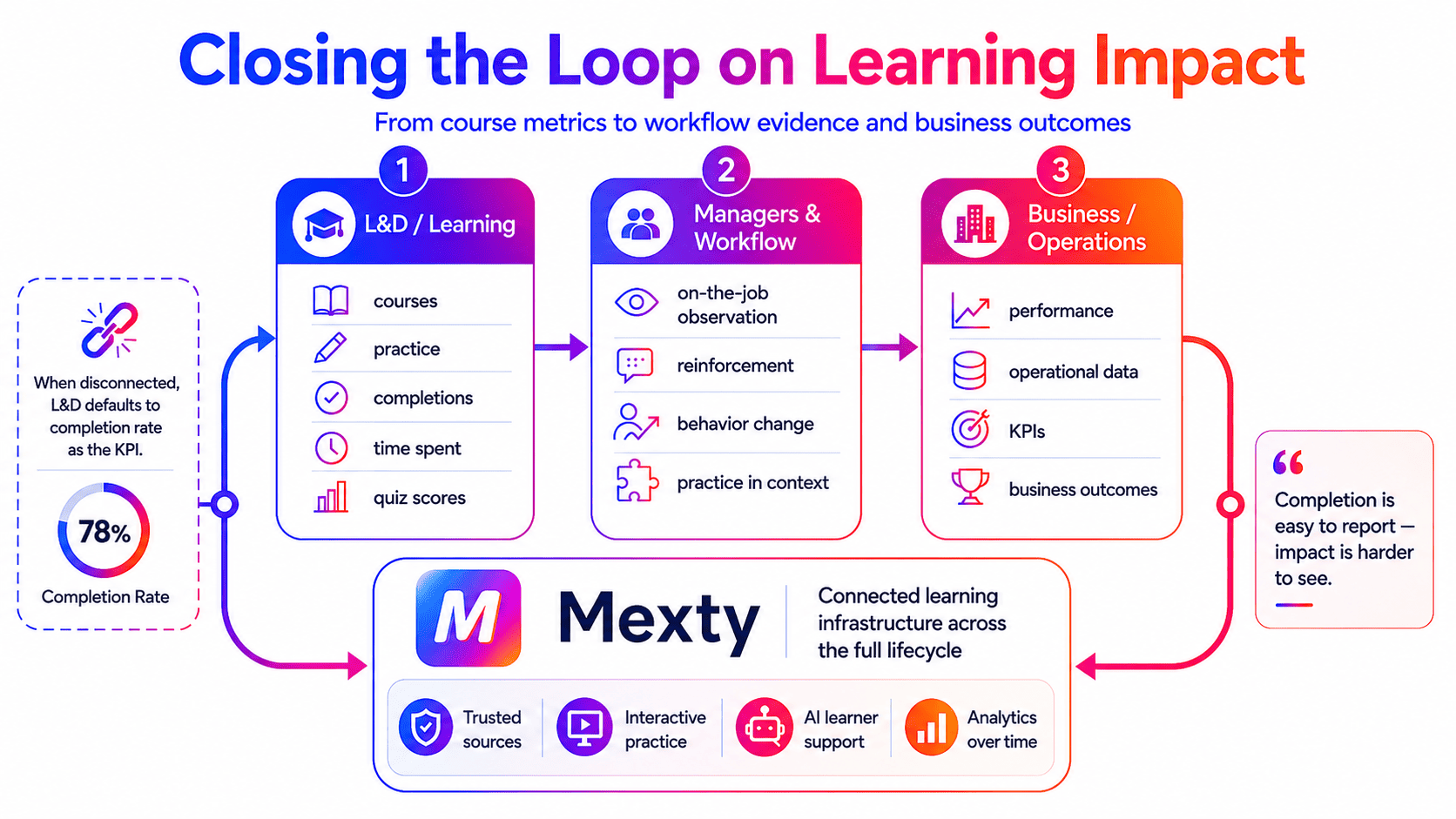
Learning impact requires shared ownership
Real evaluation is not the
responsibility of L&D alone.
It requires shared ownership
between three groups:
L&D designs the intervention.
Learning teams identify the skill gap, design the
experience, create the practice, build the assessment, and define what good
performance should look like.
Managers observe and reinforce
behavior.
Managers see whether people actually apply what they
learned. They can observe behavior in meetings, customer conversations,
operational tasks, field work, or team routines.
The business shares the performance
data.
Operations, sales, HR, compliance, customer success,
and other business teams hold the metrics that show whether the training
mattered.
Without this connection, L&D is
left with incomplete evidence.
The learning team may know that 92%
of employees completed a course, but not whether customer complaints decreased.
They may know that learners scored 85% on a quiz, but not whether managers
observed better decision-making.
They may know that a cohort finished onboarding, but not whether time to
productivity improved.
This is not an L&D failure. It
is a systems problem.
From one course to a connected learning lifecycle
The future of L&D is not just
better content creation. It is better workflow design.
This is where AI can change the
game.
For many organizations, the first
use of AI in learning has been content generation: creating course outlines,
summarizing PDFs, generating quizzes, producing slides, or drafting scripts.
That is useful. But it is only the
beginning.
The real value of AI in L&D is
not simply to generate more content faster. It is to help learning teams build
a connected learning system across the full lifecycle :
Diagnosis → Design → Practice →
Delivery → Feedback → Measurement → Improvement
This requires an AI workflow for
instructional design that does not stop at “course published.” It needs to
continue after the course is delivered, through learner engagement,
AI support, analytics, and ongoing
improvement.
That is the shift from an authoring
tool to an AI-Native secure Learning Infrastructure.
What connected learning infrastructure changes ?
A connected learning system makes
it possible to bring together the different signals that usually remain
fragmented.
For example :
A policy document can become an
interactive learning experience.
A learner can be assigned to a path based on their role or need.
Practice activities can be designed around real workplace scenarios.
Assessments can check application, not just recall.
Managers can reinforce behavior change after the course.
AI agents can support learners after the formal training ends.
Analytics can track engagement, retrieval, progress, and improvement over time.
This is very different from simply
generating a course.
It is about building a learning
environment where content, practice, learner support, analytics, and business
feedback are connected.
That is what makes an Interactive
Learning Platform different from a static course library.
Why Mexty
is built to close this gap
This is exactly the gap we are
building Mexty
to close.
Mexty is not designed as an authoring tool that stops when
the course is published. It is designed as a connected infrastructure across
the full learning lifecycle.
With Mexty, learning teams can start from
trusted sources such as policies, handbooks, product documentation, procedures,
and knowledge bases. They can use AI to help transform those sources into
interactive courses, scenarios, activities, assessments, and learning paths.
But the key point is control.
Mexty supports human review, manual editing, trusted
sources, learner assignment, AI learner support, and analytics. The goal is not
to remove the instructional designer. The goal is to Simplify instructional
design workflow while keeping learning quality, governance, and human
judgment at the center.
This is why Mexty is more than an AI authoring
tool for L&D. It is an AI-native platform for creating interactive
learning experiences and managing them over time.
From PDF to practice, not just PDF to content
Many AI tools can summarize a PDF.
Some can generate a quiz. Some can create a course draft.
But the real opportunity is not
just to Convert PDF to interactive course. It is to convert source
content into practice, feedback, and measurable progress.
A compliance policy, for example,
should not only become a slide-based module. It can become:
a short explanation of the rule;
a branching scenario based on real decisions;
a knowledge check;
a manager discussion prompt;
a follow-up practice activity;
an AI agent that answers learner questions from the approved source;
analytics showing where learners struggle.
This is how organizations move from
passive content consumption to active learning.
And this is where interactive
learning without technical complexity becomes essential.
L&D teams should not need to
spend weeks managing complex production workflows before they can test an idea.
They need tools that let them create, review, adapt, and improve learning
experiences quickly, while still maintaining trust and quality.
This is the promise of Vibe
coding for interactive learning: not creating without structure , but creating without unnecessary technical
barriers.
Why SCORM still matters ?
Even as learning platforms evolve,
many organizations still need compatibility with existing LMS environments.
That is why being SCORM-compatible remains important.
A modern learning system should give teams flexibility. Some organizations want to deliver directly through an integrated learning platform. Others need to export modules into their existing LMS.
That is why a LMS-compatible AI course creator or LMS-ready authoring platform matters for
enterprise adoption.
The future is not one single
delivery model. It is flexibility: create once, review properly, deliver where
needed, and continue tracking learning progress wherever possible.
Beyond completion: what should L&D measure?
Completion still has a role. But it
should not be the end of the story.
A stronger evaluation model looks
at several layers :
Engagement
Did learners interact with the experience? Where did
they spend time ? Where did they drop off ?
Understanding
Did they grasp the key concepts? Can they explain the
principle or recognize the right decision ?
Retrieval
Can they remember the information later, not only
immediately after the course ?
Practice
Did they apply the skill in realistic scenarios ?
Confidence
Do they feel more prepared to act ?
Behavior
Are managers observing different actions in the
workflow ?
Performance
Did the business metric move ?
This does not mean every course
must prove direct revenue impact. That would be unrealistic. But it does mean
learning teams need better ways to connect training activity with signals that
show whether the intervention is working.
The manager is part of the learning system
One of the biggest mistakes
organizations make is treating training as something that happens inside a
platform and ends when the learner closes the module.
In reality, learning continues in
the workflow.
Managers play a critical role in
that transition. They help turn training into behavior by observing,
reinforcing, coaching, and creating opportunities to apply the skill.
If managers are disconnected from
the learning path, L&D loses one of the most important sources of evidence.
This is why the future of learning
impact depends on connecting L&D, managers , and business stakeholders
around the same loop.
The learning team designs the path.
The learner practices.
The manager observes.
The business measures.
The system improves.
That is how learning becomes
continuous.
AI should help close the loop, not just create content
AI can accelerate content creation,
but that alone does not solve the impact problem.
An organization can create hundreds
of courses faster than ever and still fail to change behavior.
The real question is: can AI help
us design better learning workflows ?
Can it help diagnose the real
performance gap ?
Can it suggest better practice activities ?
Can it support learners after the course ?
Can it help analyze learning data over time ?
Can it identify where learners struggle ?
Can it help L&D improve the learning path based on evidence ?
This is where an AI-native LMS and authoring platform becomes valuable.
Not because it replaces the
instructional designer, but because it connects the parts of the learning
process that were previously fragmented.
Closing the loop
The next chapter of L&D will
not be defined by who can generate the most content.
It will be defined by who can
connect learning to performance.
That requires better
infrastructure, better data, better collaboration, and better learning design.
L&D needs access to more than
completion rates. Managers need to be part of the learning loop. Business teams
need to share the operational signals that show whether behavior changed. And
platforms need to support the full journey, from trusted source to interactive
practice to ongoing analytics.
This is the gap Mexty is built to close.
Not just faster content.
Not just another authoring tool.
Not just course completion.
A connected learning infrastructure
that helps organizations design, deliver, support, measure, and improve
learning over time.
Because the real question is not: Did
people complete the course ?
The real question is: Did
learning change what people do ?
And most importantly : Did
it make a measurable difference ?
Did it change how they think, decide, and perform?
Did it turn knowledge into real, measurable impact?
That’s where Mexty changes the way
learning works.
Mexty
turns learning into personalized experiences designed to drive real-world
performance.
Discover how AI-native learning can turn knowledge into action with Mexty.
Meet Mexty: the AI-powered learning platform that turns knowledge into engaging experiences, real skills, lasting behavior change, and measurable results.
Go beyond traditional e-learning with
Mexty, where AI transforms your expertise into personalized learning journeys
that engage, inspire, and drive real impact.
Don’t miss the latest news.
Follow Mexty
and visit www. Mexty.ai to discover what’s
next !
| If you enjoyed this, you’ll love our next articles Mexty vs Genially: From Interactive Visual Content to AI-Native Learning Infrastructure |