

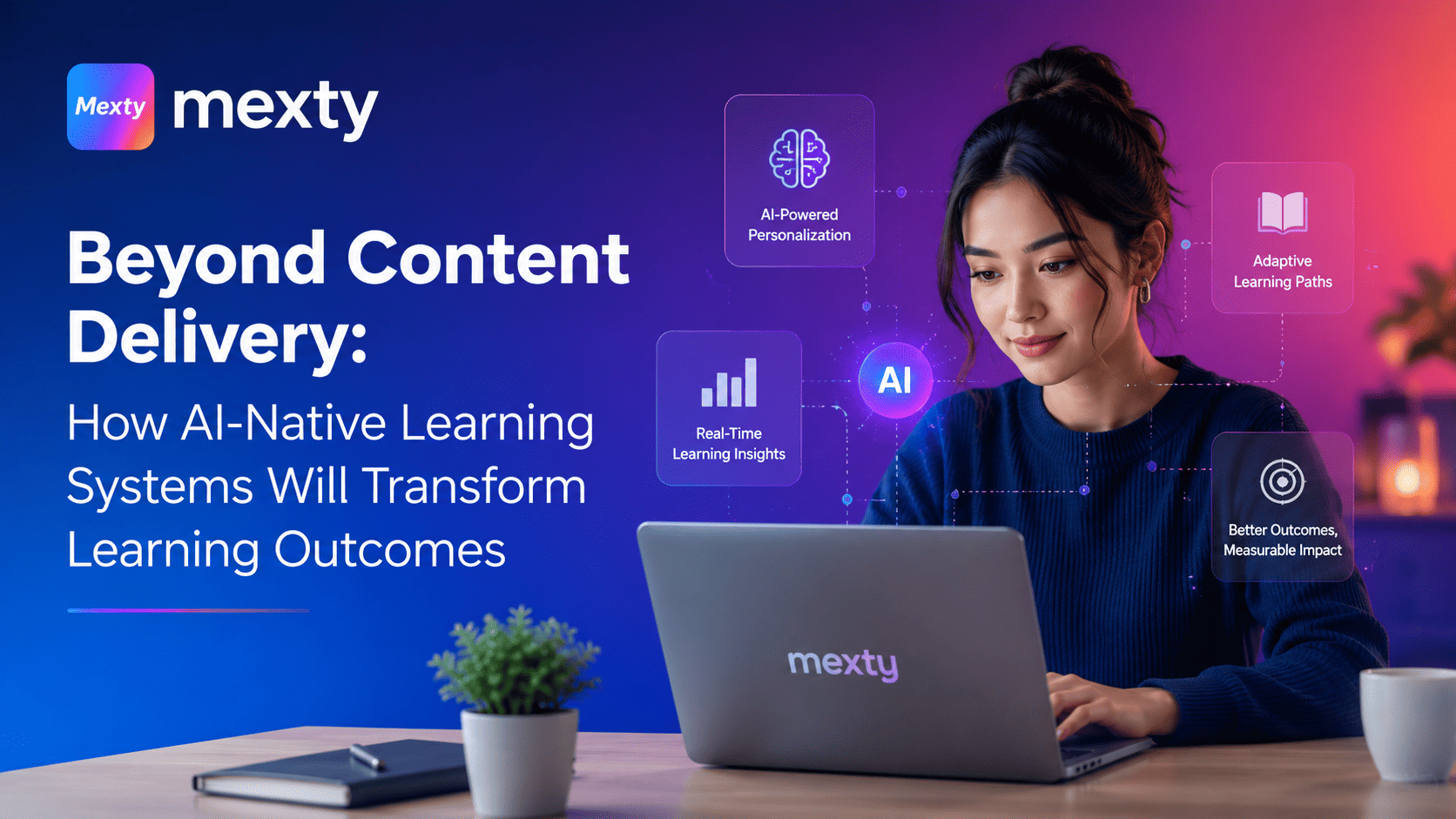
Beyond
Content Delivery: How AI-Native Learning Systems Will Transform Learning
Outcomes
For decades, learning technologies have focused on one primary goal:
delivering content.
Traditional Learning Management Systems (LMSs) helped organizations
distribute courses, track completions, manage certifications, and generate
reports. Authoring tools enabled instructional designers to create eLearning
modules and publish SCORM packages.
While these systems have been valuable, they were designed for a
different era: an era where creating content was difficult, expensive, and
time-consuming.
Today, Artificial Intelligence is changing everything.
The future of learning is no longer about delivering more content
faster. It is about building smarter learning systems that continuously adapt
to each learner, identify skill gaps, reinforce knowledge, and drive measurable
performance improvement.
At Mexty, we believe this future requires an entirely new approach:
an AI-native learning infrastructure built on learning science, adaptive
intelligence, and interactive learning experiences.
The Problem with
Traditional Learning Systems
Most
organizations still measure learning success using metrics such as:
·
Course completion rates
·
Quiz scores
·
Time spent learning
·
Certificates earned
While
these metrics are easy to track, they often fail to answer the most important
question:
Did learning actually improve performance?
A
learner can complete a course, pass a quiz, and receive a certificate while
still being unable to apply the knowledge effectively in real-world situations.
This
is because traditional LMS platforms and authoring tools were designed
primarily to manage learning administration rather than competency development.
Many
organizations continue to rely on PowerPoint-based content, static PDFs, and
linear courses that provide information but rarely create meaningful learning
experiences.
The
result is a significant gap between content consumption and behavior change.
Learning Science
Already Knows the Answer
The
good news is that educational research has spent decades studying how people
actually learn.
Several
proven theories provide the foundation for a modern adaptive learning system.
Bloom’s Taxonomy
Bloom’s Taxonomy helps
determine the cognitive level of learning activities:
·
Remember
·
Understand
·
Apply
·
Analyze
·
Evaluate
·
Create
Most traditional
eLearning focuses only on remembering and understanding.
Modern learning systems
should help learners progress toward applying, analyzing, and creating.
SOLO Taxonomy
SOLO measures the depth of
understanding and mastery.
Instead of asking whether a
learner completed a module, SOLO helps determine how deeply concepts have been
understood and connected.
Constructivism
Constructivist learning
theory suggests that learners build knowledge through active engagement rather
than passive consumption.
This explains why
interactive learning experiences consistently outperform static content.
Experiential Learning
Kolb’s Experiential
Learning model emphasizes learning through practice, reflection, and
experimentation.
Simulations,
branching scenarios, and role-playing activities allow learners to develop
real-world competence rather than simply acquiring information.
Cognitive Load Theory
Learners have
limited cognitive capacity.
Effective learning
systems must adapt complexity to avoid overwhelming learners while maintaining
sufficient challenge.
Spaced Repetition
Knowledge retention
improves dramatically when learning is reinforced over time rather than
delivered in a single session.
Retrieval Practice
The act of recalling
information strengthens memory and understanding far more effectively than
simply re-reading content.
Together, these
theories provide the blueprint for a smarter learning system.
Why AI Changes Everything
Historically,
implementing these learning theories at scale was difficult.
Creating
adaptive learning paths required significant instructional design effort.
Developing
branching scenarios was expensive.
Personalizing
content for individual learners was often impractical.
Artificial
Intelligence changes this equation.
Modern AI can
generate activities, create assessments, analyze learner behavior, identify
knowledge gaps, and adapt learning experiences dynamically.
However, simply
adding AI to existing systems is not enough.
The future
belongs to truly AI-native platforms.
What Is an
AI-Native Learning Platform?
An
AI-native platform is not a traditional LMS with AI added as a feature.
It
is a platform designed from the ground up around AI-powered workflows.
An
AI-native platform for creating interactive learning experiences uses AI across
the entire learning lifecycle:
·
Content creation
·
Assessment generation
·
Adaptive learning
·
Learner support
·
Analytics
·
Continuous improvement
This
is the vision behind Mexty.
Building the
Future Adaptive Learning Engine
The
future Mexty adaptive learning engine combines proven learning science with
advanced AI capabilities.
Bloom + AI
The system automatically
identifies cognitive objectives and generates activities aligned with
appropriate Bloom levels.
SOLO + Analytics
Learner responses are
analyzed to determine mastery depth rather than simple completion.
Constructivism +
Interactive Activities
AI
generates interactive experiences that encourage active participation.
Experiential Learning +
Simulations
Realistic
scenarios allow learners to practice decision-making in safe environments.
Cognitive Load Adaptation
Content
difficulty adapts dynamically based on learner performance.
Spaced Repetition
The system schedules
reinforcement activities automatically.
Retrieval Practice
AI continuously
generates adaptive questions designed to strengthen retention.
Learning Analytics
Advanced analytics
monitor progression and adjust learning paths accordingly.
The result is a system
focused on competency development rather than content delivery.
From Authoring
Tools to Learning Systems
Traditional
authoring tools often involve complex workflows.
Instructional
designers must:
·
Create storyboards
·
Build slides
·
Configure interactions
·
Manage branching logic
·
Publish SCORM packages
·
Test compatibility
This
process can take weeks or months.
Mexty
aims to simplify eLearning workflow through AI-native creation processes.
Instead
of spending time building technical structures, instructional designers can
focus on learning outcomes.
Vibe Coding for
Interactive Learning
One
of the most exciting developments is the emergence of vibe coding for
interactive learning.
Rather
than manually configuring every interaction, creators describe the learning
experience they want to build.
The
platform generates the underlying structure automatically.
This
enables:
·
Interactive course creation
with vibe coding
·
Vibe coding for SCORM
interactive courses
·
Simplified branching scenario
creation
·
Interactive course creation
without coding
·
Interactive learning without
technical complexity
The
goal is simple:
From
complex workflows to interactive learning in minutes.
A Modern
Alternative to Legacy Authoring Tools
Many
learning teams are searching for:
·
Articulate Storyline
alternatives
·
Genially alternatives
·
iSpring alternatives
Not
because these tools are ineffective, but because they were designed for a
pre-AI era.
Organizations
increasingly want:
·
An easier alternative to
Storyline
·
Storyline without complexity
·
Reduced Storyline dependency
·
An AI-powered alternative to
Storyline
·
A modern alternative to
Storyline workflows
·
A replacement for complex
authoring workflows
Mexty
is designed to address these challenges through AI-native workflows that
accelerate content creation while preserving instructional quality.
Converting
Existing Content into Interactive Learning
Organizations
already possess enormous amounts of knowledge stored in:
·
PDFs
·
PowerPoint presentations
·
Policies
·
Procedures
·
Manuals
·
Knowledge bases
Modern
AI can help convert PDFs into interactive learning experiences automatically.
Instead
of recreating content from scratch, learning teams can transform existing
knowledge into engaging learning experiences.
This
significantly reduces development time while increasing learner engagement.
Enterprise Security Matters
AI adoption
in learning cannot come at the expense of security and compliance.
Organizations
increasingly require:
·
Secure AI authoring platforms
·
Privacy-first AI authoring
tools
·
GDPR-compliant AI learning
platforms
·
Secure interactive learning
platforms
·
Enterprise-ready AI authoring
tools
·
Privacy-focused AI course
creators
·
Trusted AI authoring platforms
·
AI learning platforms with
privacy controls
At Mexty,
security, privacy, governance, and compliance are core principles rather than
afterthoughts.
As
organizations adopt AI-powered learning solutions, trust becomes a critical
competitive advantage.
LMS Compatibility
Remains Essential
While
learning experiences are evolving, interoperability remains important.
Organizations
need:
·
SCORM-compatible content
·
LMS-ready authoring platforms
·
LMS-compatible interactive
learning platforms
·
LMS-integrated authoring tools
·
LMS-compatible AI course
creators
This
is why Mexty combines modern AI capabilities with enterprise compatibility
requirements.
The
platform functions as an AI-native LMS and authoring platform while remaining
compatible with existing learning ecosystems.
The Future of
Learning Is Not More Content
The
learning industry has spent years optimizing content production.
But
more content does not automatically create better outcomes.
The
next generation of learning technology must focus on:
·
Competency development
·
Behavior change
·
Adaptive learning
·
Continuous reinforcement
·
Real-world performance
This
requires moving beyond traditional LMS thinking.
It
requires moving beyond static courses.
It
requires building intelligent systems that understand how people learn.
Conclusion
The future of learning belongs
to organizations that combine learning science, AI, and interactive experiences
into a unified system.
The best eLearning authoring
tool in 2026 will not simply generate content faster.
It will help learners achieve
measurable outcomes.
It will understand cognitive
progression.
It will adapt learning paths
automatically.
It will identify skill gaps.
It will reinforce learning
over time.
And most importantly, it will
help organizations move from content delivery to competency development.
This is the future Mexty is
building:
An AI-native SCORM authoring
platform for interactive learning creation.
A secure, privacy-first,
enterprise-ready interactive learning platform.
A smarter learning system
designed to help people learn, grow, and perform better.
Learn more at https://www.mexty.ai.
| If you enjoyed this, you’ll love our next articles The Biggest Mistake in AI Learning: Treating AI as a Feature Instead of Building a Learning Infrastructure |