

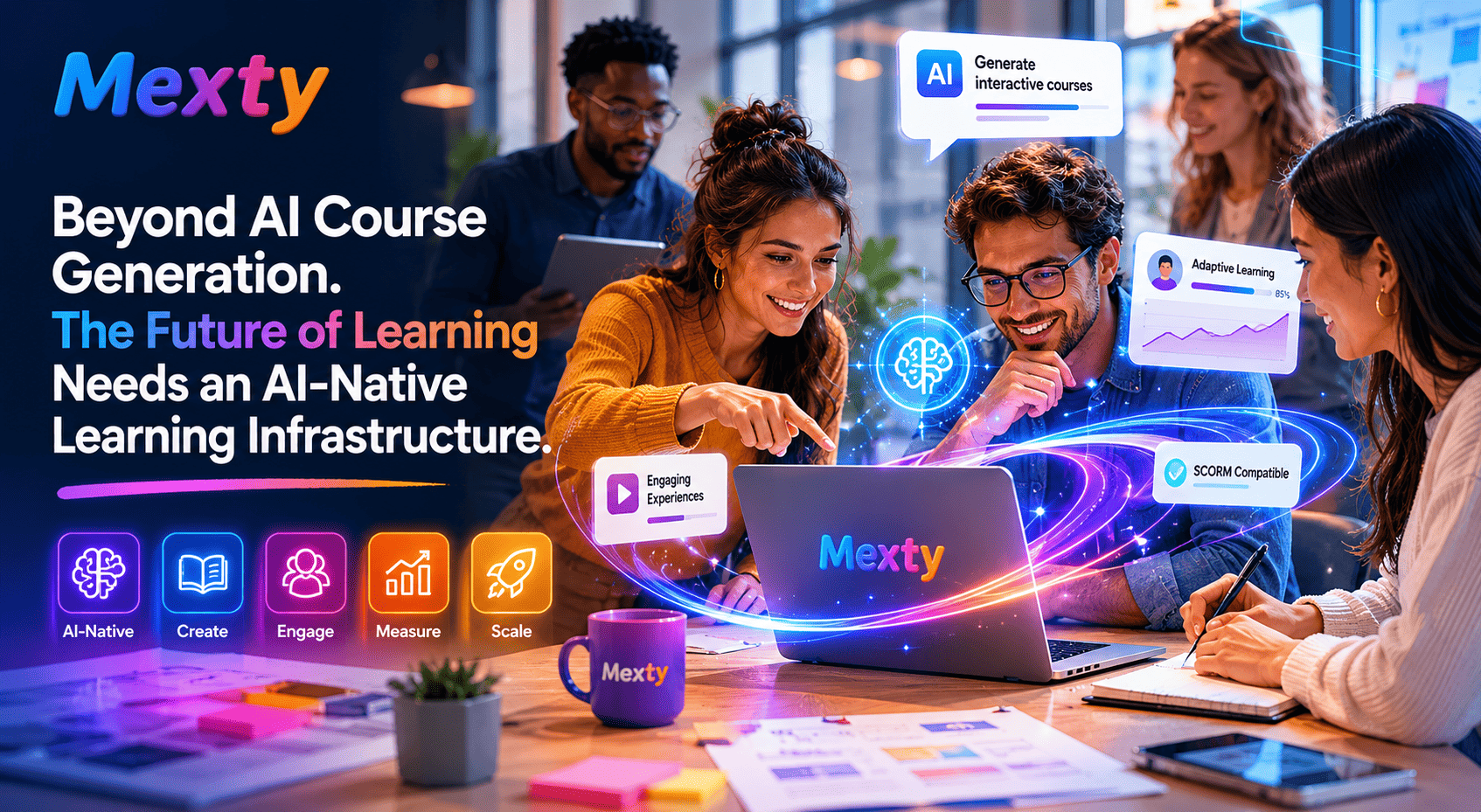
Beyond AI Course Generation: Why the Future of Learning Needs an AI-Native Learning Infrastructure
Artificial intelligence is transforming e-learning at incredible speed. Every week, a new tool promises to generate complete courses in minutes. A PDF becomes a lesson. A document becomes a quiz. A prompt becomes a training module.
The promise sounds compelling: "Create courses faster." And to be fair, AI is making content creation dramatically easier. But there is a problem. Most conversations about AI in learning stop at the demo.
People see an impressive generated lesson and immediately think: "This changes everything."
Yet creating content is only a small part of learning because organizations do not simply need tools that generate slides or text. They need systems that can create, deploy, maintain, govern, measure, and scale learning experiences.
This is why the future of e-learning is not just about AI generation. It is about combining AI with a complete learning infrastructure.
This is exactly where platforms like Mexty are changing the conversation. Not just an AI content generator but an AI-native platform for creating interactive learning experiences.
The Shift from “Content Creation” to “Learning Experience Creation”
For years, e-learning focused on formats and organizations asked:
Should we create videos?
Should we add quizzes?
Should we use microlearning?
Should we create simulations?
Should we add AI tutors?
But these questions often miss the point: Formats are containers when learning happens because of experiences. People learn through: practice, decisions, feedback, experimentation, repetition and reflection
The question should not be: "What format should we use?"
The question should become: "What should the learner experience?"
This shift is changing the role of every Interactive Course Creator. Instead of becoming content producers, they are becoming experience designers.
Why AI Course Generation Alone Is Not Enough
Today many AI tools can generate: lessons, quizzes, summaries, learning paths, videos and assessments. The results often look impressive until deployment begins.
Organizations immediately ask:
Can I deploy this in my LMS?
Can I trust where information comes from?
Can I reuse templates?
Can I track completion?
Can I maintain updates?
Can I comply with regulations?
Can I scale this?
Can I ensure AI governance?
This is where many platforms struggle because enterprise learning requires infrastructure.
What Is a Learning Infrastructure?
A learning infrastructure transforms content into a trusted and scalable learning system.
It includes:
Authoring and content creation: Teams need powerful creation tools.
LMS integration: Content must fit existing ecosystems.
SCORM/xAPI/cmi5 compatibility: Tracking matters.
Reporting and analytics: Learning needs measurable outcomes.
Governance: Who approved content? Who modified content? Which version is active?
Source of Truth: Can AI rely only on validated organizational knowledge?
Security: Learning systems require GDPR compliance, AI Act readiness, ISO 27001 certification, SOC2 certification and Cyber resilience
Reusability: Templates and assets should not be rebuilt repeatedly.
Scalability: Learning should work for 10 learners, 100 learners, 100,000 learners, ..
Without infrastructure, AI becomes another content generator.
With infrastructure, AI becomes a learning ecosystem.
Why AI-Native Matters
Many traditional authoring platforms are adding AI features. Usually this means: "Let's add AI to our existing workflow." But there is a difference between: AI-enhanced tools and AI-native platforms
An AI-native platform integrates AI into the entire workflow rather than simply adding it as an extra feature.
AI supports:
creation
editing
adaptation
interaction
deployment
governance
Instead of treating AI as an assistant sitting beside the workflow, AI becomes part of the workflow itself.
Vibe Coding for Interactive Learning: A New Way to Create Courses
Software development recently introduced the concept of "vibe coding." People describe an experience and AI helps build it.
Learning design is beginning to evolve similarly. This is where Vibe coding for interactive learning becomes powerful. Rather than spending weeks assembling slides manually, creators can describe: "Create a customer onboarding simulation where learners make decisions and receive feedback." Or: "Build an adaptive compliance course with branching scenarios and knowledge checks."
AI generates a starting point. The human refines the experience.
Interactive Course Creation with Vibe Coding
Traditional workflows often look like this:
Idea ⇒ Storyboard ⇒ Content ⇒ Slides ⇒ Interactions ⇒ Testing ⇒ Deployment ⇒ Corrections ⇒ Rework
The process can take weeks.
With Interactive course creation with vibe coding, the process changes:
Idea ⇒ Describe experience ⇒ AI generates structure ⇒ Human refines ⇒ Deploy ⇒ Measure ⇒ Iterate
The focus shifts from producing content to designing experiences.
Vibe Coding for SCORM Interactive Courses
Speed alone is not enough.
Many AI tools generate experiences that become difficult to deploy.
Organizations still need:
LMS compatibility
completion tracking
analytics
learner reporting
This is why Vibe coding for SCORM interactive courses matters.
Experiences should remain deployable.
A learning experience is only useful if it can live inside an existing learning ecosystem.
Why SCORM-Compatible Still Matters in 2026
People frequently ask: "Is SCORM still relevant?"
The answer is simple: Yes.
Many organizations still depend heavily on LMS ecosystems.
Being SCORM-compatible remains critical because organizations require:
completion tracking
learner records
reporting
certification
deployment consistency
AI generation without deployment capability creates friction.
Comparing Traditional Authoring Tools and AI-Native Platforms
The conversation around the Best authoring tools in 2026 is changing rapidly.
Traditional tools include:
Articulate Storyline
Genially
iSpring
They remain strong solutions but expectations are changing.
People increasingly search for:
Articulate Storyline Alternatives
Genially Alternatives
iSpring Alternatives
Why?
Because learning teams want:
faster workflows
AI assistance
interactive generation
easier updates
scalable systems
Best Elearning Authoring Tool 2026: What Should You Look For?
When evaluating the Best Elearning Authoring Tool 2026, organizations should ask:
Can it:
✔ Create experiences rather than static content?
✔ Support AI-native workflows?
✔ Reuse templates?
✔ Update efficiently?
✔ Connect to Source of Truth systems?
✔ Support compliance?
✔ Deploy through LMS environments?
✔ Scale globally?
Interactive Learning Platform vs Content Generator
A content generator produces assets when an Interactive Learning Platform creates systems.
There is a major difference.
Content generators focus on:
output
Interactive platforms focus on:
experience
learner progression
feedback
adaptation
measurement
The future belongs to platforms, not generators.
Why Mexty Takes a Different Approach
At Mexty, we believe learning should combine: The speed of AI with the reliability of learning infrastructure.
Mexty is an AI-native platform for creating interactive learning experiences designed around experience rather than content production.
Instead of simply generating lessons, Mexty helps teams:
create interactive experiences
reuse content
maintain templates
deploy through LMS environments
support SCORM workflows
align AI with Source of Truth content
maintain governance
scale learning
Because learning is not a document.
Learning is not a slide.
Learning is not even a course.
Learning is an experience.
Final Thoughts
AI will continue creating content faster.
That part is inevitable.
But the winners in learning technology will not be the platforms generating the largest amount of content.
They will be the platforms generating trust.
The future is not: "How many courses can AI create?"
The future is: "How many learning experiences can organizations trust, deploy, scale, and improve?"
That future belongs to AI combined with infrastructure.
That future belongs to experiences.