

Authoring Is Only the Beginning: Why AI-Native
Learning Infrastructure Is the Future of Learning
AI can generate courses in minutes
but the real transformation in learning is not about creating more content
faster. It is about connecting knowledge, creation, delivery, assessment,
learner support, and continuous improvement within one secure, governed
learning environment.
AI has solved the easiest part of the learning problem
Not long ago, creating an eLearning
course was a demanding process. Instructional designers spent days developing
content, building slides, creating assessments, integrating multimedia, and
preparing courses for delivery.
Today, AI can generate a course
outline, develop learning materials, suggest interactive activities, and
produce assessments in minutes.
That is a significant step forward
but it raises a more important question: If creating a course is becoming
easier than ever, why is delivering effective learning still so complicated?
The answer is simple. Content
creation was never the entire learning challenge.
The real complexity lies in
everything surrounding it:
- Where does the knowledge come from, and can
it be trusted?
- How do we
transform information into meaningful learning experiences?
- How is
learning delivered to the right people?
- How do we
assess understanding and practical application?
- How do
learners receive support when they struggle?
- How do we
measure whether learning actually makes a difference?
These questions define the next
stage of AI in education and corporate learning, and they cannot be answered by
an authoring tool alone.
The limitations of AI authoring tools
The market has seen rapid growth in
AI-powered content creation solutions.
An AI authoring tool for L&D
can dramatically accelerate course development. An Interactive Course Creator
can make it easier to produce engaging activities, quizzes, scenarios, and
multimedia learning experiences.
These capabilities are valuable.
They help instructional designers, educators, and subject-matter experts spend
less time on technical production and more time on pedagogy.
But there is a fundamental
limitation. Most authoring tools focus primarily on creating learning content,
not managing the complete learning lifecycle.
Once a course is generated,
organizations frequently need additional systems to publish it, manage
learners, track progress, conduct assessments, provide assistance, and analyze
outcomes.
A typical workflow might involve an AI content generator, a separate authoring environment, an LMS, assessment
tools, and analytics software.
Each system introduces its own
data, workflows, access controls, integrations, and administrative
responsibilities.
Even when individual tools work
well, the overall learning experience can remain fragmented.
A SCORM-compatible course may
transfer successfully between systems, but that does not automatically
guarantee connected learner data, continuous improvement, or consistent
governance.
Interoperability is important, but
interoperability alone does not create an integrated learning strategy because
organizations do not simply need more tools to produce courses. They need a
more coherent way to manage learning.
From AI authoring to AI-native learning infrastructure
This is where the distinction
between an AI authoring tool and AI-Native secure Learning Infrastructure
becomes important.
An authoring tool helps create
learning content.
An AI-native learning
infrastructure in addition to creating learning contents, it connects the
processes, systems, people, and data required to make learning effective.
AI is not simply added to an
existing tool to accelerate content production. It becomes part of the broader
learning environment, supporting activities across the entire lifecycle.
This does not mean removing human
expertise or allowing AI to make educational decisions independently. It is
quite the opposite.
A well-designed AI-native
infrastructure places teachers, instructional designers, subject-matter
experts, and learning administrators at the center of the process.
AI provides assistance, automation,
and insights, while humans retain responsibility for content quality, pedagogy,
governance, and decisions.
At Mexty, this is the vision behind our approach to an
AI-native LMS and authoring platform: connecting the different dimensions of
learning within one coherent environment.
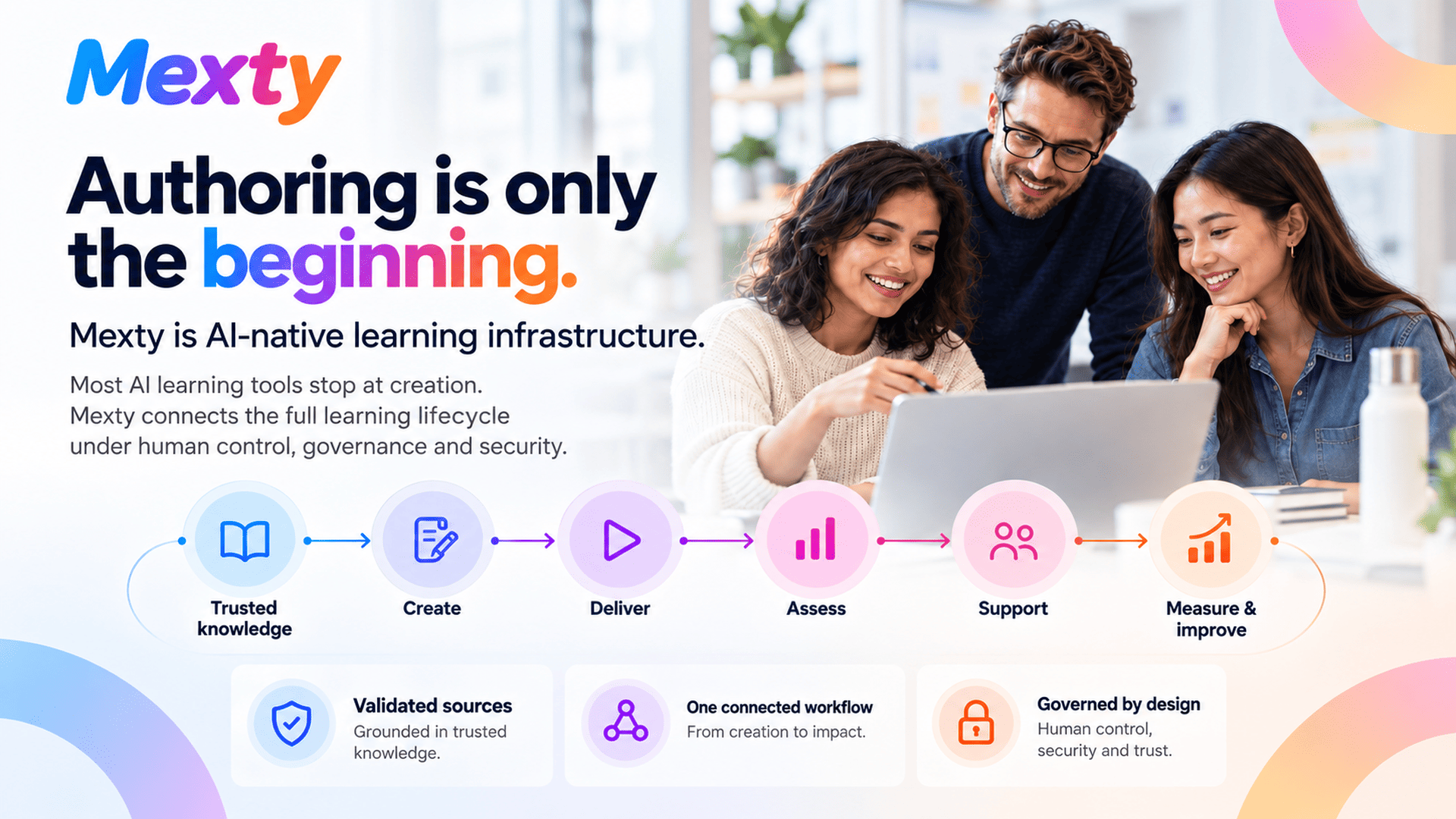
The six pillars of AI-native learning infrastructure

One
connected learning lifecycle, designed around human oversight, governance, and
security.
1.
Trusted knowledge: Start with reliable sources
AI-generated content is only as
reliable as the information behind it.
When learning materials are
generated from unverified information, outdated documents, or poorly structured
prompts, organizations risk introducing inaccuracies and inconsistencies.
In corporate training, this can
affect compliance, operational procedures, and employee performance.
In education, it can introduce
misconceptions or reinforce incorrect information.
An AI-native learning environment
should therefore begin with trusted knowledge.
This means connecting AI-generated
learning to validated resources, internal documentation, approved reference
materials, and organizational knowledge bases.
The objective is not simply to
generate plausible answers. It is to create learning content that can be
reviewed, validated, updated, and trusted.
Knowledge grounding also makes it
easier to maintain consistency across courses and learning programs as
information evolves.
2.
Create: Move from content generation to learning experience design
Faster content creation is
valuable, but speed alone does not guarantee better learning.
Effective learning requires
thoughtful instructional design, appropriate activities, meaningful
interactions, and opportunities to practise.
An AI-native platform for creating
interactive learning experiences should support both AI-assisted generation and
human creativity.
Teachers and instructional
designers should be able to create interactive scenarios, simulations,
exercises, assessments, and learning pathways without facing unnecessary
technical complexity.
The ability to create interactive
courses without coding can make sophisticated learning experiences accessible
to more educators and subject-matter experts.
For example, a trainer might
transform a technical document into an interactive learning module, then add
practice activities and assessments aligned with the organization's objectives.
AI accelerates production, but
human expertise determines what learners need to understand, practise, and
apply.
The goal is not to automate
pedagogy. It is to give educators better tools to express it.
3.
Deliver: Connect creation directly to learning
Learning content creates value only
when it reaches learners effectively.
A course sitting in an authoring
environment has limited impact until it becomes part of a structured learning
experience.
Delivery involves much more than
publishing a file.
Organizations need to manage users,
assign courses, organize learning paths, control access, monitor progress, and
support different learning environments.
An Interactive Learning Platform
should connect content creation with learner delivery, reducing unnecessary
transfers between systems.
This connection also makes it
easier to update learning materials.
When knowledge changes,
organizations should be able to revise content and manage its availability
without rebuilding complex workflows.
A connected environment helps
transform learning from a collection of separate courses into a continuously
maintained resource.
4.
Assess: Measure understanding, not simply completion
One of the persistent weaknesses of
digital learning is the tendency to measure participation rather than
understanding:
- A learner completes a course.
- A
certificate is issued.
- A
completion rate appears on a dashboard.
But what has actually been learned?
and can the learner apply that knowledge?
In fact, AI creates opportunities
to rethink assessment. Instead of relying exclusively on traditional
multiple-choice quizzes, learning teams can incorporate open-ended questions,
practical activities, scenarios, project-based evaluations, and competency
assessments.
AI can help generate and organize
assessments, identify areas requiring additional practice, and support
feedback. However, assessment criteria and consequential educational decisions
should remain subject to appropriate human oversight.
The objective is to move from
tracking course completion toward understanding learning progress and
demonstrated competence.
5.
Support: Learning does not stop when the course ends
Every learner progresses
differently. Some need additional explanations. Others benefit from examples,
repetition, practice, or guidance adapted to their context.
Traditional eLearning often
provides the same experience to everyone, with limited assistance once the
content has been published.
AI offers the possibility of more
continuous learning support.
An AI Agent for Learning can
potentially guide learners through activities, answer questions using trusted
knowledge sources, recommend relevant materials, and help explain difficult
concepts.
For a corporate learner, this could
mean receiving contextual assistance when reviewing an internal procedure.
For a student, it might involve
additional explanations or targeted practice after an incorrect answer.
The important distinction is that AI support should complement human teaching and mentoring, not replace them.
Teachers, managers, and
instructional designers remain responsible for learning objectives, educational
decisions, and the appropriate use of
6.
Measure and improve: Turn learning data into better outcomes
The final component of AI-native
learning infrastructure is also one of the most important: Continuous
improvement.
Traditional learning systems often
focus their analytics on registrations, attendance, completion rates, and
assessment scores.
These indicators are useful, but
they do not necessarily demonstrate learning impact.
Organizations increasingly need
answers to more meaningful questions:
Are learners improving their
knowledge and skills? Which activities are effective? Where do learners
encounter difficulties? How should content or assessments be improved? Can
changes in learning be connected to better performance?
Connecting authoring, delivery,
assessment, and analytics makes it easier to identify opportunities for
improvement.
In corporate environments, this can
also support a more rigorous approach to ROI in Learning.
For example, a sales training
program should ultimately be evaluated not only by course completion, but also
by whether participants demonstrate improved competencies and whether those
improvements contribute to measurable business outcomes.
Not every performance improvement
can be attributed directly to training. But connected learning data provides a
stronger foundation for evaluating its contribution.
This is how learning organizations
can move from producing content toward managing learning performance.
Governance and security must be built into the
infrastructure
The use of AI introduces important
responsibilities.
Learning platforms may process
internal corporate knowledge, employee information, educational content,
learner assessments, and other potentially sensitive data.
Security, privacy, access control,
and governance cannot be optional features added after deployment.
They must be considered from the
beginning.
For organizations operating in
Europe, this includes designing processes that support GDPR obligations and the
applicable requirements of the EU AI Act.
A Secure AI authoring platform
should provide appropriate mechanisms for controlling access, managing data,
reviewing AI-generated content, and maintaining accountability.
A GDPR-compliant AI learning
platform must also be supported by suitable organizational policies, contracts,
data-processing practices, and configurations. Technology alone cannot
guarantee compliance.
An AI-native approach brings these
concerns into the learning architecture rather than treating them as separate
administrative requirements.
Most importantly, it preserves
human oversight.
AI can assist with generating
content, suggesting assessments, providing guidance, and analyzing learning
data.
But responsibility for educational
quality, sensitive decisions, and governance remains with people.
Why connected learning infrastructure matters for
enterprises and education
The benefits extend beyond
operational efficiency.
For enterprises, integrated
infrastructure can help reduce tool fragmentation, improve consistency across
training programs, support knowledge management, and connect learning
activities to organizational objectives.
For schools and universities, it
can give educators more flexibility to create and personalize learning
experiences while preserving control over curriculum, assessments, and learner
progress.
For learning providers, it can
support more scalable course development, delivery, and maintenance.
And for instructional designers, it
offers an opportunity to focus less on transferring content between systems and
more on designing meaningful learning experiences.
The transformation is not about
replacing instructional design with automation.
It is about simplifying the
instructional design workflow while expanding what educators and learning teams
can achieve.
Instead of treating each course as
an isolated deliverable, organizations can begin to manage learning as an
evolving, connected system.
The next competitive advantage in learning is not
content production
As AI-generated content becomes
easier and less expensive to produce, content generation alone will become an
increasingly limited source of differentiation.
The ability to create a course in
minutes is impressive.
But creating a course is not the
same as delivering effective learning.
The organizations that gain the
most value from AI will be those that connect content to trusted knowledge,
human expertise, learner engagement, assessment, support, and measurable
improvement.
They will not necessarily be the
organizations producing the largest number of courses.
They will be the ones building
learning environments that can evolve continuously.
This is the strategic shift behind Mexty's positioning as AI-native
learning infrastructure.
Rather than viewing authoring as
the destination, Mexty
approaches it as one component of a broader, connected learning lifecycle.
An environment designed to bring
together knowledge, creation, delivery, assessment, learner support, and
analytics, while keeping human control, governance, and security at its core.
Conclusion: Authoring is only the beginning
AI has changed how quickly we can
create learning content.
Now it is time to rethink what
happens before and after creation.
The future of digital learning will
not be defined by how many courses AI can generate.
It will be defined by how
effectively organizations connect knowledge, people, technology, and measurable
outcomes.
The goal is not to generate more
content faster. It is to build learning that is connected, governed,
trustworthy, and continuously improving.
That is the difference between an AI authoring tool and AI-native learning infrastructure.
And that is the future we are
building at Mexty.
Where does your AI learning
workflow stop today: at creation, or beyond?
Explore how Mexty connects authoring, learning
delivery, assessments, and analytics within an AI-native learning environment.
If you enjoyed this, you’ll love our next articles
| If you enjoyed this, you’ll love our next articles |