

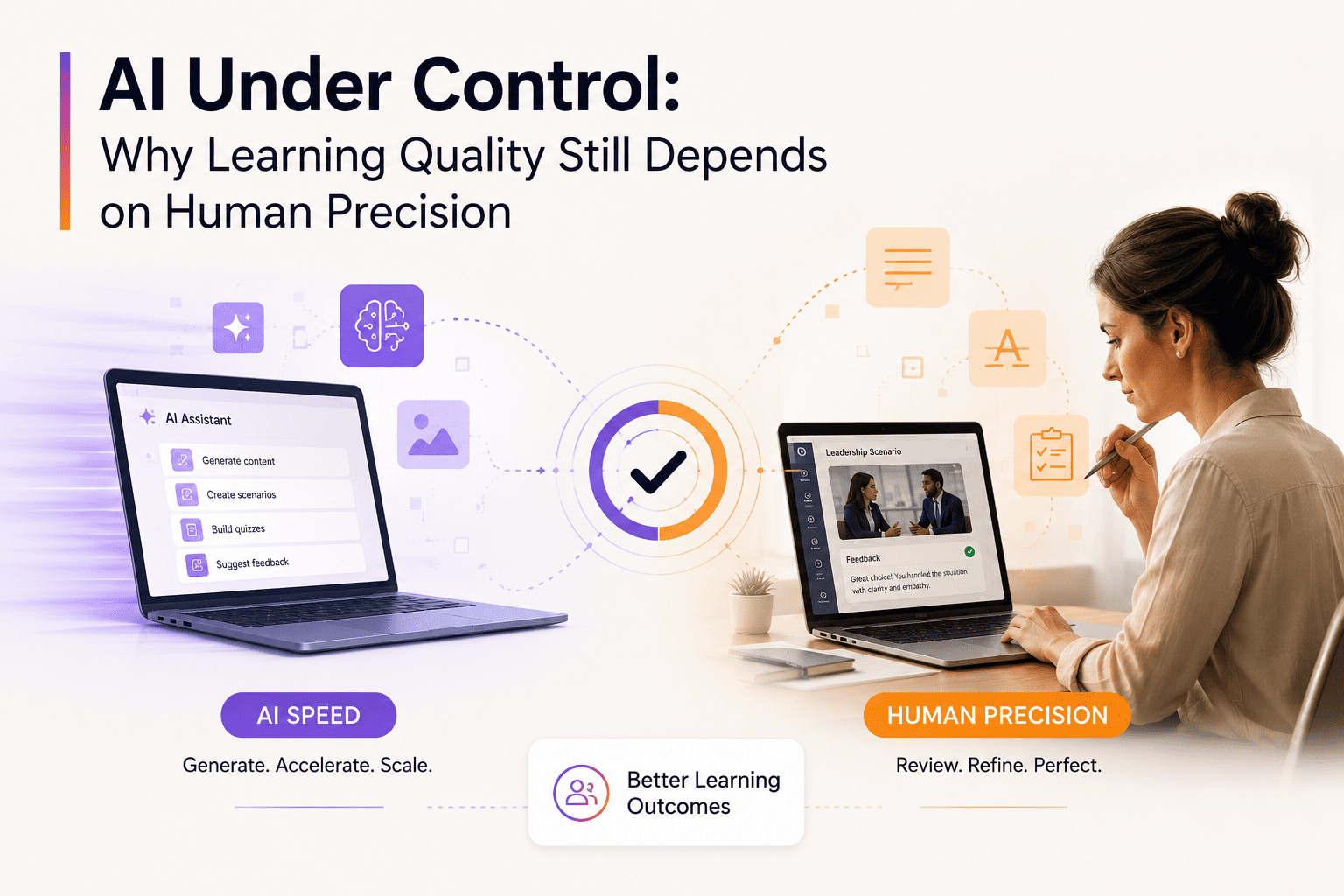
AI Under Control: Why Learning Quality Still Depends on Human Precision
Artificial intelligence is transforming the world of digital learning faster than almost anyone predicted.
Courses that once required weeks of production can now be generated in hours. Interactions can be created automatically. Scenarios can be drafted instantly. Quizzes, branching logic, and learning activities can emerge from a simple prompt.
This evolution is changing the role of the modern Interactive Course Creator.
But while AI dramatically accelerates production, one critical reality remains unchanged:
Learning quality still lives in the details.
A sentence can change understanding.
A feedback message can influence learner confidence.
A scenario choice can reinforce or weaken a behavior.
A layout adjustment can improve clarity.
A navigation flow can affect engagement.
A visual inconsistency can reduce trust.
This is why the future of digital learning is not about replacing humans with AI.
The future is about combining AI speed with human control.
This is the philosophy behind the new generation of AI-native learning systems emerging in the market today.
AI Is Accelerating Learning Production
There is no question that AI is reshaping the eLearning industry.
Modern tools can already:
- generate course structures,
- create quizzes,
- draft scenarios,
- produce interactive activities,
- summarize documents,
- convert presentations into learning content,
- and assist with instructional design workflows.
This is one reason why organizations are increasingly searching for:
- “Best Elearning Authoring Tool 2026,”
- “Best authoring tools in 2026,”
- “Articulate Storyline Alternatives,”
- “Genially Alternatives,”
- and “iSpring Alternatives.”
The market is evolving rapidly.
Traditional authoring workflows are being challenged by a new generation of AI-assisted systems designed to reduce production friction.
However, many organizations are now discovering an important limitation:
speed alone does not guarantee learning quality.
Why Learning Design Cannot Be Fully Automated
AI can generate content quickly.
But learning design is not only content generation.
Learning design involves:
- pedagogy,
- learner psychology,
- contextual decision-making,
- instructional flow,
- clarity,
- behavior change,
- and assessment quality.
A technically functional course can still fail as a learning experience.
Why?
Because learners do not experience courses as “generated outputs.”
They experience:
- clarity,
- feedback,
- emotional engagement,
- pacing,
- interaction quality,
- and cognitive flow.
This is where human oversight remains essential.
Small Details Shape Learning Outcomes
In learning design, tiny details often produce massive differences in learner performance.
For example:
- a confusing instruction can create cognitive friction,
- poorly written feedback can reduce learner confidence,
- an unclear interaction can break immersion,
- an inaccurate scenario can reduce realism,
- and inconsistent navigation can frustrate learners.
This is especially true in:
- compliance training,
- onboarding,
- simulations,
- leadership development,
- soft skills training,
- healthcare education,
- cybersecurity awareness,
- and decision-based learning.
Interactive learning depends heavily on precision.
And precision requires control.
AI Under Control: The Emerging Learning Design Philosophy
The future of eLearning is not:
“AI does everything automatically.”
The future is:
AI accelerates creation while humans refine the experience.
This is a major philosophical shift in the industry.
The goal of modern AI systems should not be:
“Generate final courses without human involvement.”
The goal should be:
“Reduce production friction while preserving instructional quality.”
This is where the concept of AI under control becomes critical.
The most effective systems are increasingly those that combine:
- AI-native generation,
- human refinement,
- reusable workflows,
- Source-of-Truth grounding,
- and deployment-ready infrastructure.
Why Editability Matters in AI-Native Learning Systems
One of the biggest frustrations with many AI content generators is rigidity.
The AI produces content quickly, but creators struggle to refine it precisely afterward.
This creates a dangerous situation:
speed without flexibility.
In learning design, editability is essential.
A modern AI-native platform for creating interactive learning experiences should allow creators to manually adjust:
- text,
- images,
- layouts,
- colors,
- interactions,
- branching scenarios,
- quizzes,
- feedback,
- navigation,
- and learning flow.
Because AI generation is only the beginning of the design process.
Real instructional quality emerges during refinement.
The Rise of AI-Native Interactive Learning Platforms
This is why the market is moving toward the Interactive Learning Platform model.
Traditional authoring tools were primarily production environments.
The new generation of platforms is becoming workflow ecosystems.
An AI-native learning platform increasingly combines:
- AI-assisted creation,
- interaction generation,
- manual editing,
- SCORM deployment,
- learner tracking,
- adaptive learning,
- reusable templates,
- and enterprise integration.
This shift is transforming how organizations think about authoring tools.
The question is no longer:
“Can the tool create content?”
The question becomes:
“Can the platform support the entire learning production lifecycle efficiently?”
Vibe Coding for Interactive Learning
One of the most important evolutions in this space is the emergence of Vibe coding for interactive learning.
The principle behind vibe coding is simple: instead of manually constructing every interaction through complex interfaces, creators describe the learning experience naturally.
For example:
- “Create a negotiation simulation.”
- “Generate a cybersecurity decision tree.”
- “Build a leadership branching scenario.”
- “Create adaptive learner feedback.”
The system interprets the intent and generates the interaction structure automatically.
This dramatically accelerates production.
But the real value appears when creators can continue refining the result manually afterward.
This is where interactive course creation with vibe coding becomes significantly more powerful than static AI generation.
Why Vibe Coding Alone Is Not Enough
Many people assume that AI-generated interactions automatically solve eLearning production challenges.
In reality, generation is only one layer of the workflow.
A deployable learning experience still requires:
- instructional consistency,
- visual coherence,
- learner-friendly navigation,
- pedagogical refinement,
- accurate assessments,
- SCORM compatibility,
- LMS deployment,
- and reporting functionality.
This is why vibe-coding for elearning must remain connected to human review and manual control.
AI can accelerate interaction generation.
But humans still shape the learning quality.
SCORM Compatibility Still Matters
Even in the age of AI, deployment standards remain critical.
Many organizations still depend on Learning Management Systems requiring:
- completion tracking,
- progress reporting,
- learner analytics,
- and SCORM packaging.
This is why SCORM-compatible authoring remains essential.
The future is not:
“AI replaces LMS standards.”
The future is:
AI-native creation integrated with enterprise deployment systems.
This is where vibe coding for SCORM interactive courses becomes especially important.
Organizations increasingly want workflows where:
- the interaction is generated,
- the course remains editable,
- the content aligns with approved knowledge,
- and the final package deploys seamlessly into LMS ecosystems.
The Importance of Source-of-Truth Grounding
One of the largest concerns surrounding AI-generated learning is reliability.
Organizations need confidence that training content:
- reflects official policies,
- respects regulatory requirements,
- aligns with institutional knowledge,
- and avoids hallucinations.
This is where Source-of-Truth grounding becomes critical.
Modern AI-native systems increasingly allow organizations to constrain AI generation using:
- internal documentation,
- approved learning materials,
- policy frameworks,
- educational standards,
- and verified knowledge bases.
This helps maintain:
- consistency,
- compliance,
- and instructional integrity.
AI becomes faster without becoming uncontrolled.
Mexty and the AI-Under-Control Philosophy
Mexty.ai was designed around this exact philosophy.
The objective was not simply to create another AI generator.
The goal was to build an AI-native platform for creating interactive learning experiences where AI accelerates production while humans retain full control over the final learning experience.
With Mexty:
- everything remains editable after generation,
- interactions can be refined manually,
- scenarios can be adjusted,
- quizzes can be modified,
- layouts can evolve,
- feedback can be rewritten,
- and navigation can be optimized.
This combination of:
- AI-native generation,
- manual editing,
- reusable templates,
- Source-of-Truth grounding,
- and SCORM/LMS-ready deployment
creates a workflow designed for real-world instructional production.
The objective is not simply:
“Generate courses faster.”
The objective is:
generate quickly, refine precisely, and deploy confidently.
Because learning quality is not only about AI speed.
Learning quality lives in the details.
And the future of eLearning belongs to platforms where AI remains powerful — but always under control.
If you enjoyed this, you’ll love our next articles