

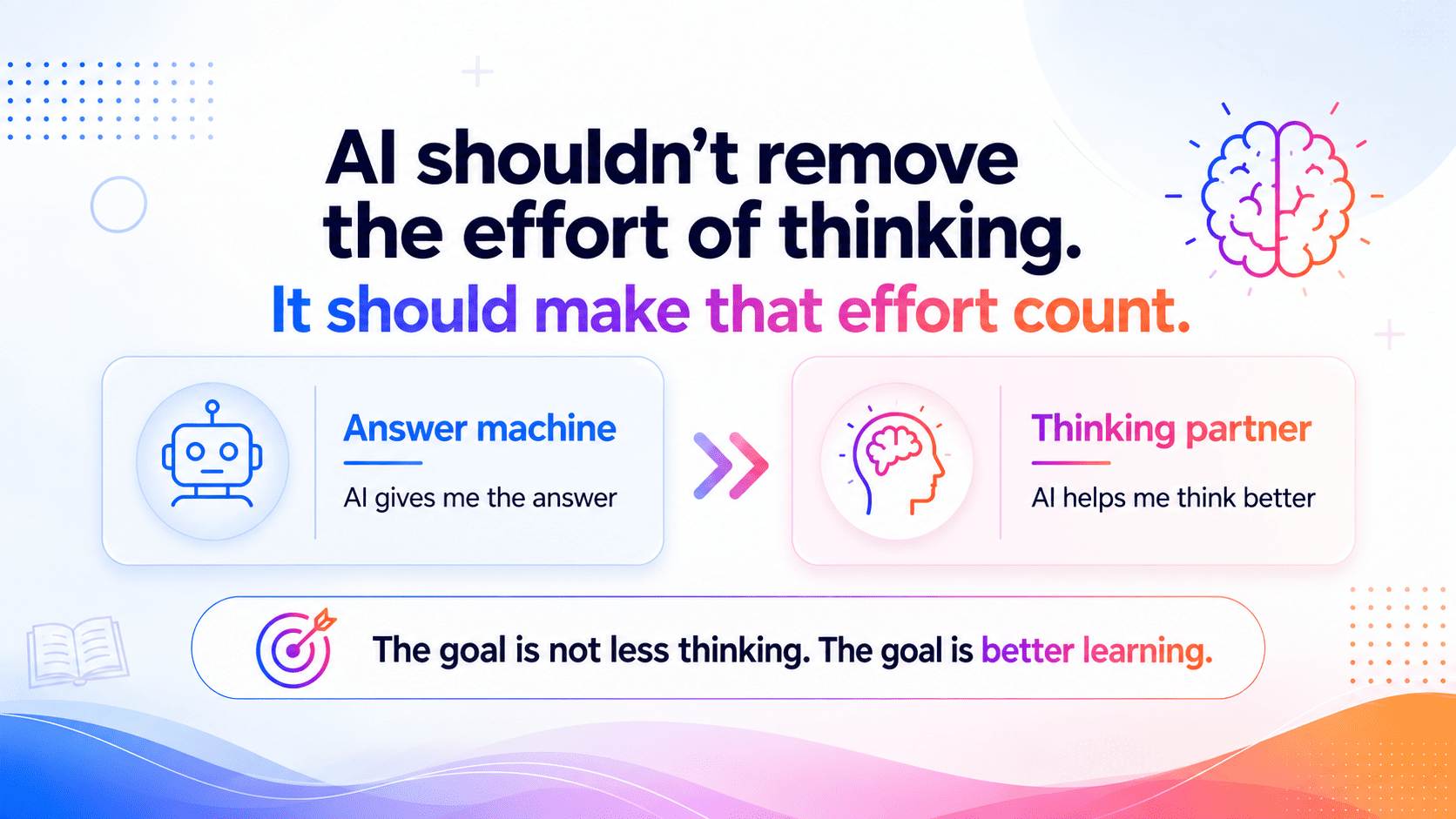
AI Shouldn't Remove the Effort of Thinking. It Should
Make That Effort Count.
There is a version of AI in
learning that looks very attractive on the surface.
Ask a question.
Get an answer.
Move on.
Less friction. Less effort. Faster
results.
But that version of AI creates a
serious risk: learners may become faster at obtaining answers without becoming
better at thinking.
The real opportunity for AI in
learning is not to eliminate cognitive effort. It is to make that effort more
productive.
That distinction matters enormously
for education, but it matters just as much for enterprise L&D.
Organizations do not invest in learning simply so employees can access
information faster. They invest because they need people who can make better
decisions, handle unfamiliar situations, solve problems, apply judgment and
perform more effectively.
AI should help build that
capability.
It should not quietly replace it.
The Difference Between Removing Friction and Removing
Thinking
Good learning has always involved
some degree of productive difficulty.
A learner has to retrieve something
from memory, make a decision, connect new information to prior knowledge, test
an idea, make a mistake, reconsider and try again.
That effort is not a flaw in the
learning experience.
It is often the learning
experience.
AIcan remove unnecessary friction
around that process. It can make content easier to access. It can simplify
complex authoring workflows. It can generate examples, translate content,
explain difficult concepts and provide immediate feedback.
That is valuable.
But there is an important boundary.
If AI removes the need to reason,
retrieve, decide or apply, then the learner may complete the task without
developing the capability the task was supposed to build.
The goal should therefore not be
frictionless learning.
It should be better-directed
effort.
Beyond Content Generation
Much of the current conversation
around AI in L&D still focuses on content production.
Generate a course.
Create an outline.
Summarize a document.
Produce a quiz.
Rewrite a lesson for another audience.
These capabilities can dramatically
reduce production time, and a good AI authoring tool for L&D should
absolutely make them easier.
But content generation is only the
beginning.
A course with automatically adapted
slides is still fundamentally a course. Information still moves mostly in one
direction: from the system to the learner.
An AI-native platform for
creating interactive learning experiences can establish a very different relationship.
Instead of only presenting
information, AI can:
- ask the learner questions;
- challenge
assumptions;
- present
realistic situations;
- require a
decision;
- give
targeted feedback;
- adjust
the difficulty;
- identify
misconceptions;
- recommend
another attempt;
- provide
hints without revealing the answer;
- create
additional practice based on performance.
Now AI is no longer simply
generating learning content.
It is helping orchestrate learning.
From Answer Machine to Thinking Partner
Imagine an employee preparing for a
difficult customer conversation.
The simplest AI experience is:
“What should I say to this
customer?”
The AI provides an answer.
Useful, perhaps. But the employee
has outsourced most of the reasoning.
Now imagine a different
interaction.
The AI presents the customer
situation and asks:
“What would you do first, and why ?”
The employee responds.
The AI challenges part of the
reasoning:
“What risk do you see with that
approach ?”
The employee reflects.
The AI introduces new information.
“The customer now says the
competitor is 15% cheaper. How does that change your response?”
The employee tries again.
Finally, the AI provides feedback,
highlights what was strong and identifies what should be reconsidered.
The employee has still benefited from AI.
But the cognitive work remained
with the learner.
That is a much more interesting
model for an Interactive Learning Platform.
One delivers an answer.
The other creates practice.
AI Should Generate More Practice, Not Just More
Content
This is one of the biggest opportunities created by generative AI.
Historically, realistic practice
has been expensive to design.
Branching scenarios require many
paths. Simulations require scripting. Personalized feedback requires
instructors. Multiple levels of difficulty require many versions of the same
exercise.
AIcan dramatically reduce that
production burden.
Through approaches such as Vibe
coding for interactive learning, a learning designer can describe the kind
of experience they want:
“Create a branching scenario where
a frontline manager must respond to an employee whose performance has
declined.”
Or :
“Generate a cybersecurity exercise
where the learner has to decide whether five different situations require
escalation.”
Or :
“Create three increasingly
difficult customer objection scenarios and provide feedback after each
decision.”
This makes it easier to create
interactive courses without coding and to simplify branching scenario
creation.
But the strategic value is not that
the organization can produce more activities.
The value is that learners can
receive more opportunities to think, decide, practise and improve.
AI should generate more practice,
not simply more pages.
The Real Test : More Capable or More Dependent ?
There is one question every
AI-native learning system should eventually have to answer:
Does the learner leave the
interaction more capable, or more dependent on the tool?
Those outcomes can look
surprisingly similar in the moment.
In both cases, the employee may
finish the task faster.
In both cases, they may report that
the AI was helpful.
In both cases, the immediate
problem may have been solved.
But the long-term outcomes are very
different.
One employee becomes increasingly
capable of handling the next situation independently.
The other becomes increasingly
dependent on having AI available every time.
For enterprise L&D, this
distinction is fundamental.
Consider a compliance decision.
If the employee always asks AI which action is permitted, the organization has created access to an answer.
If the employee practises
interpreting policy, recognising risk and knowing when escalation is required,
the organization has built capability.
Consider sales.
If AI writes every response, the
salesperson becomes faster at producing messages.
If AI helps the salesperson
practise objection handling, understand customer signals and reflect on the
consequences of different responses, the salesperson becomes more capable.
The same applies to leadership,
safety, cybersecurity, onboarding, technical training and customer support.
Practice Before Assistance
One useful design principle is
simple :
Think first. AI second.
Instead of immediately giving the
learner the solution, an AI Agent for Learning can first ask for an
attempt.
The workflow might become:
Situation → Learner decision → AI
feedback → Reflection → Retry → Support
rather than :
Question → AI answer → Next
This allows AI to provide
scaffolding without taking over the cognitive task.
The amount of assistance can also
adapt.
A beginner may need more guidance.
An experienced learner may need
more challenge.
Someone who repeatedly makes the
same error may receive a hint or explanation.
Someone demonstrating strong
understanding may receive a harder scenario.
This is where adaptive learning
becomes much more interesting than simply changing which content appears on
screen.
AI can adapt the level of support
while preserving the learner's responsibility to think.
Assessment Must Change Too
If learning becomes more
interactive, assessment should evolve with it.
Traditional digital learning often
ends with a knowledge quiz.
That can tell us whether someone
remembers information.
It tells us much less about whether
they can use it.
AI makes richer forms of assessment
easier to create.
Instead of :
“Which of these four statements is
correct ?”
we can ask :
“What would you do in this
situation, and why ?”
Instead of testing whether an
employee remembers the escalation policy, we can present an ambiguous case and
observe whether they recognize when escalation is necessary.
Instead of only recording correct
or incorrect answers, an AI-native system can potentially analyse:
- decisions;
- reasoning
patterns;
- repeated
errors;
- confidence;
- attempts;
- improvement;
- use of
hints;
- performance
across scenarios.
That creates a much stronger
connection between learning and real capability.
A modern AI workflow for
instructional design should therefore connect creation, practice and
assessment rather than treating them as separate production tasks.
The Importance of Feedback
Practice without useful feedback
can simply reinforce mistakes.
This is another area where AI can
add substantial value.
In traditional asynchronous
training, feedback is often limited to:
“Correct.”
or :
“Incorrect. The correct answer is
B.”
That is efficient, but not
especially instructive.
AI can provide feedback based on
the learner's actual response.
It can explain why a choice may
create risk.
It can identify what the learner
overlooked.
It can ask a follow-up question
rather than immediately revealing the answer.
It can connect the feedback to a
trusted policy or internal source.
It can then generate another
practice opportunity targeting the same weakness.
This is where a Trusted AI
authoring platform matters.
For enterprise learning, feedback
should not simply sound plausible. It should remain grounded in approved
company knowledge.
AI-Native Does Not Mean AI-Uncontrolled
There is another important
implication.
If AI becomes a tutor, coach,
challenger and practice partner, governance becomes more important, not less.
An AI-Native secure Learning
Infrastructure needs to control:
- which knowledge sources can be used;
- which AI
models are available;
- how
learner data is handled;
- who can
create or approve learning;
- what AI
is allowed to recommend;
- where
human review is required;
- how
outputs are edited;
- how
interactions are logged;
- how
content versions are maintained.
A Secure interactive learning
platform should enable more adaptive learning on the surface because the
infrastructure underneath is controlled.
The learner may experience fluid
dialogue and personalized practice.
The enterprise should still have
clear governance, traceability and human oversight.
What This Means for Mexty
This is central to how we think
about Mexty.
The goal is not to build a faster
answer machine for learning.
Mexty
is designed as an AI-Native secure Learning Infrastructure connecting
trusted organizational knowledge with creation, interactive practice,
assessment, learner support, analytics and continuous updates.
The model is :
Knowledge → Create → Practice →
Assess → Learn → Measure → Update
AI can participate across that
cycle.
But the learner should remain
active inside it.
The creator should remain in
control.
The organization should remain
responsible for the knowledge, the learning objectives and the decisions that
matter.
That is also why Mexty
combines AI-assisted creation with full manual editing, trusted Sources of
Truth, interactive activities, tailored assessments, learning paths, learner
management and AI Agents.
The aim is not just to accelerate
production.
It is to make it easier to design
the kind of learning that requires learners to actually think.
The Future Is Not Frictionless Learning
The phrase “frictionless learning”
sounds attractive.
Some friction absolutely should
disappear.
Learners should not spend ten
minutes searching for the right document.
Instructional designers should not
spend hours formatting repetitive screens.
Teams should not rebuild an entire
course because one procedure changed.
But the friction involved in
reasoning, retrieving, deciding, practising and reflecting should not
automatically disappear.
That is where capability develops.
The best AI learning systems will
know the difference.
They will remove the friction that
prevents people from learning while preserving, and even improving, the effort
that causes learning to happen.
That is the shift from:
“AI gives me the answer.”
to:
“AI helps me think better.”
And that may become one of the most
important tests for the next generation of enterprise learning technology.
The question is no longer simply
whether AI makes learning faster.
It is whether people leave the
experience more capable than when they entered it.
That is the outcome worth building
for.
About Mexty ….
Mexty turns learning into personalized experiences designed to drive real-world performance.
Discover how AI-native learning can turn knowledge into action with Mexty.
Meet Mexty: the AI-powered learning platform that turns knowledge into engaging experiences, real skills, lasting behavior change, and measurable results.
That’s where Mexty changes the way learning works.
Go beyond traditional e-learning with Mexty, where AI transforms your expertise into personalized learning journeys that engage, inspire, and drive real impact.
Once you’ve discovered and tried Mexty, we’d love to hear your thoughts!
Share your experience and impressions with us about this new, interactive way to learn and create. Your feedback is very valuable to us.
Don’t miss the latest news. Follow Mexty and visit www.mexty.ai to discover what’s next!
| If you enjoyed this, you’ll love our next articles |