

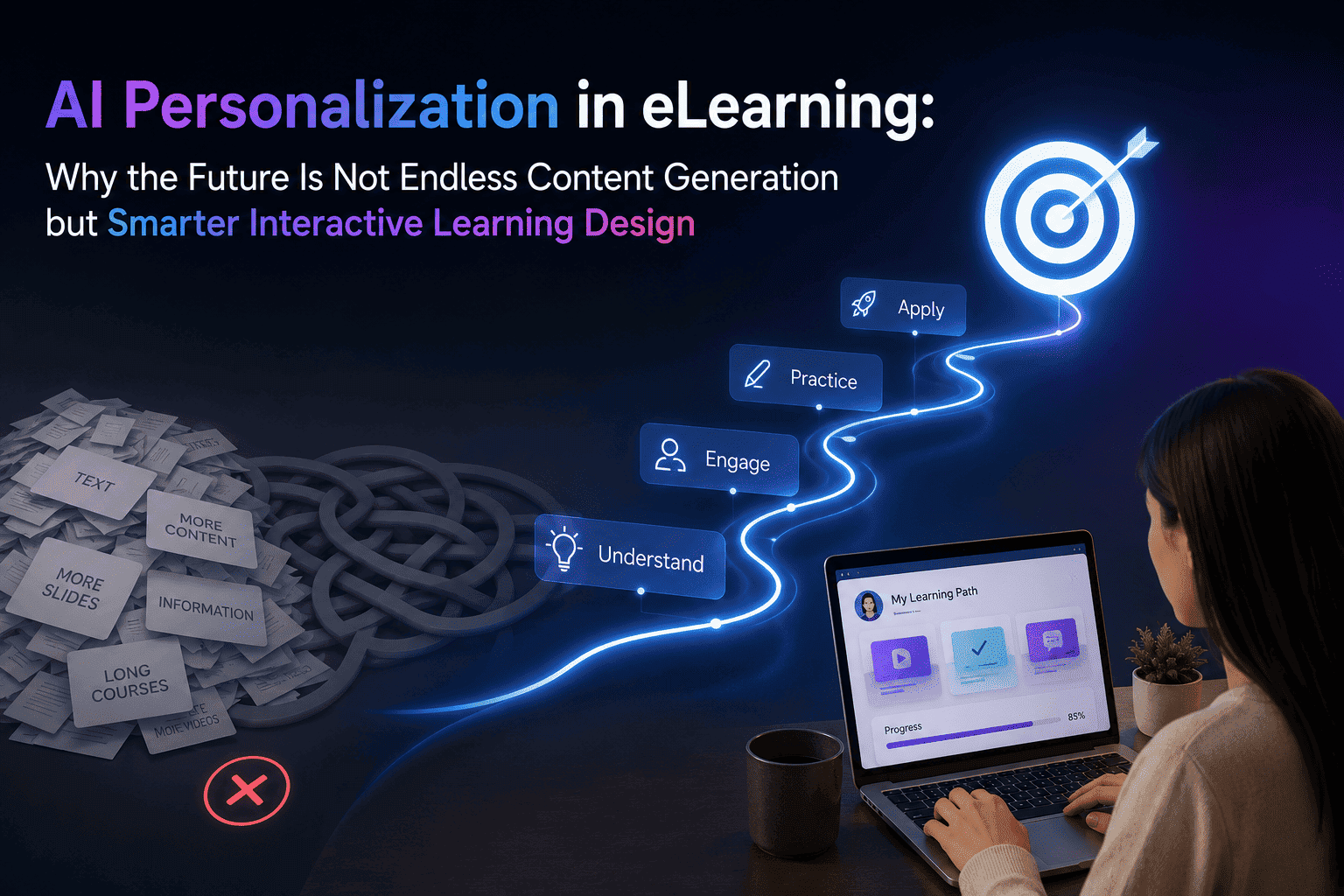
AI Personalization in eLearning: Why the Future Is Not Endless Content Generation but Smarter Interactive Learning Design
The conversation around AI in education often swings between two extremes.
On one side, some people claim AI will completely personalize learning for every learner automatically. On the other side, critics warn that personalization has become a buzzword disconnected from real pedagogy.
The reality is more nuanced.
A thoughtful perspective emerging across the Learning & Development and EdTech industries is that personalization is not the same thing as “learning styles.” Effective learning adaptation is not about assigning learners simplistic categories such as visual, auditory, or kinesthetic learners.
Instead, real personalization can involve:
- pacing
- cognitive load management
- adaptive feedback
- prior knowledge
- contextual examples
- differentiated practice
- scenario complexity
- learning support
The challenge is that while these adaptations are pedagogically valuable, they are often operationally unrealistic to build manually at scale.
That tension is exactly where AI becomes interesting. And it is also where caution becomes necessary.
Modern AI-native authoring tool platforms are changing the economics of personalization by making interactive learning production faster and more scalable. However, AI alone is not enough. Without strong instructional design logic, AI risks generating endless variations of content without meaningful learning impact.
The future of learning is not AI generating infinite permutations of content.
The future is AI helping organizations create more effective, interactive, adaptive, and scalable learning experiences while preserving pedagogy, structure, and human instructional control.
Why Personalization Has Historically Been Difficult
For decades, instructional designers understood that learners do not all need the exact same learning path.
Some learners require:
- more practice
- simpler explanations
- additional examples
- adaptive feedback
- reduced complexity
- more scaffolding
- different pacing
But implementing those variations manually inside traditional eLearning workflows has been extremely expensive.
A single adaptive scenario in traditional authoring tools may require:
- multiple storyboards
- branching logic
- variables
- triggers
- duplicated screens
- custom assessments
- manual testing
- separate feedback layers
This creates enormous production overhead.
That is one reason why many organizations still rely heavily on linear courses despite knowing that interactive learning is often more effective.
Traditional workflows simply do not scale well.
The Limits of Traditional Authoring Tools
Traditional eLearning authoring platforms such as Articulate Storyline, Adobe Captivate, and iSpring remain powerful because they provide:
- advanced interactivity
- SCORM-compatible deployment
- LMS integration
- branching scenarios
- assessment logic
However, these platforms were built primarily around manual production workflows.
As personalization demands increase, many teams begin searching for:
- Articulate Storyline Alternatives
- iSpring Alternatives
- Best authoring tools in 2026
The issue is not that traditional tools are obsolete.
The issue is that manual adaptation becomes increasingly difficult when organizations want:
- personalized pathways
- adaptive learning
- contextual feedback
- dynamic scenarios
- scalable interactive learning
This is where the industry is beginning to shift toward a new category:
AI-native interactive learning platforms
The Rise of AI-Native Interactive Learning Platforms
An AI-native interactive learning platform is fundamentally different from simply adding AI into existing tools.
Instead of treating AI as an external assistant, these platforms are built from the ground up around:
- AI-assisted workflows
- interactive learning design
- adaptive experiences
- reusable logic
- integrated authoring
- scalable deployment
This evolution is changing how organizations think about:
- Interactive Course Creator platforms
- interactive learning production
- adaptive learning
- SCORM-compatible deployment
- LMS integration
- instructional scalability
The market is moving from:
static course production → dynamic learning experience design
Why AI Changes the Economics of Personalization
One of the biggest opportunities with AI is reducing the production cost of personalization.
Historically, adapting learning experiences required massive manual effort.
Today, AI can help generate:
- alternative explanations
- contextual examples
- adaptive practice
- differentiated assessments
- multiple feedback styles
- branching pathways
- scenario variations
This dramatically changes scalability.
For example, an Interactive Learning Platform powered by AI can potentially generate:
- beginner explanations
- expert explanations
- simplified scenarios
- industry-specific examples
- adaptive remediation
- personalized practice activities
All without rebuilding the entire course manually.
This is where the future becomes exciting.
Not because AI replaces instructional designers.
But because AI amplifies their ability to create adaptive learning experiences more efficiently.
Why AI Alone Is Not Enough
However, there is also a major danger.
AI can easily generate variation without pedagogical value.
This is one of the biggest misconceptions in the AI learning market.
More content does not automatically mean:
- better learning
- better retention
- better decision-making
- better performance
Without instructional logic, AI risks producing:
- superficial personalization
- repetitive variations
- generic outputs
- cognitive overload
- fragmented learning experiences
This is why the future of AI in learning cannot simply be:
“generate more”
The real challenge is:
how to maintain structure, pedagogy, and instructional coherence while scaling adaptation
The Importance of Structured Interactivity
This is where AI-native authoring tool platforms become particularly important.
The strongest platforms are not simply content generators.
They are systems for:
- interactive learning design
- adaptive logic
- scenario generation
- structured assessments
- feedback orchestration
- experiential learning
This is a critical distinction.
The future of eLearning is not static AI-generated slides.
It is:
interactive learning experiences
What Is Vibe Coding for Interactive Learning?
One of the most interesting innovations in this space is:
Vibe coding for interactive learning
Instead of manually building every interaction, creators describe the desired experience in natural language.
For example:
- “Create a compliance scenario with adaptive consequences.”
- “Generate a customer service simulation with emotional feedback.”
- “Build differentiated cybersecurity practice based on learner performance.”
- “Create an onboarding simulation for healthcare professionals.”
The platform then generates:
- interactions
- branching logic
- feedback systems
- adaptive pathways
- assessments
- contextual scenarios
This process is known as:
- Interactive course creation with vibe coding
- Vibe-coding for elearning
- Vibe coding for SCORM interactive courses
The key difference is that the creator still retains instructional control.
The workflow becomes:
- Describe the learning experience
- Generate the structure
- Refine manually
- Deploy into LMS ecosystems
This dramatically reduces production friction while preserving instructional quality.
Why Human Control Still Matters
One of the most dangerous narratives around AI is the idea that learning design can become fully automated.
In reality, human instructional logic remains essential.
Because personalization is not just about generating variations.
It is about deciding:
- what should adapt
- why it should adapt
- when adaptation helps
- when consistency matters
- how feedback should evolve
- how cognitive load should be managed
AI can accelerate production.
But instructional designers still define:
- learning objectives
- pedagogical structure
- interaction quality
- assessment validity
- learning sequencing
That is why the most promising AI-native authoring tool platforms combine:
- AI-assisted generation
- manual editing
- reusable templates
- structured pedagogy
- adaptive workflows
- instructional control
Why Source of Truth Becomes Critical
As AI-generated learning becomes more sophisticated, reliability becomes a major issue.
Without governance, AI may:
- hallucinate information
- create inconsistencies
- generate inaccurate explanations
- introduce compliance risks
This becomes especially dangerous in:
- healthcare training
- compliance learning
- technical certification
- corporate onboarding
- regulated industries
That is why Source of Truth systems are becoming essential.
A Source of Truth framework restricts AI generation to:
- validated documents
- approved procedures
- organizational standards
- verified knowledge bases
This helps AI-native interactive learning platforms maintain:
- reliability
- consistency
- instructional accuracy
- compliance integrity
Why SCORM-Compatible Deployment Still Matters
Even as AI transforms learning production, organizations still depend heavily on LMS ecosystems.
That means modern platforms must remain:
- SCORM-compatible
- LMS-ready
- enterprise deployable
Many AI learning tools generate attractive content but struggle with:
- tracking
- reporting
- LMS integration
- deployment consistency
This is one reason organizations continue searching for:
- Best Elearning Authoring Tool 2026
- Genially Alternatives
- Articulate Storyline Alternatives
- iSpring Alternatives
The future is not just content generation.
The future is:
scalable deployment of adaptive learning experiences
Interactive Learning Is Becoming the Core Differentiator
Another important shift is happening in how organizations define quality learning.
The old model focused heavily on:
- information delivery
- slide-based courses
- passive consumption
The emerging model focuses more on:
- interaction
- practice
- decision-making
- contextual feedback
- adaptive pathways
- experiential learning
This is why Interactive Course Creator platforms are becoming more strategically important.
Organizations increasingly want:
- simulations
- branching scenarios
- adaptive assessments
- contextual learning
- personalized practice
And AI can make these experiences dramatically easier to produce.
Why the Future Is Cost-Effective Personalization
From a Mexty perspective, the real opportunity is not infinite AI-generated content.
The real opportunity is:
cost-effective personalization
That means:
- reducing production time
- lowering development complexity
- increasing interactivity
- preserving instructional structure
- maintaining deployment readiness
- keeping human control
This is fundamentally different from the “AI replaces instructional design” narrative.
The future belongs to systems that help learning teams:
- scale adaptation
- preserve pedagogy
- improve interactivity
- accelerate workflows
- reduce operational costs
Without sacrificing learning quality.
The Future of AI in eLearning
The future of eLearning is not fully automated course factories.
It is:
AI-assisted learning experience design
That future will likely combine:
- AI-native authoring tool workflows
- interactive learning logic
- adaptive pathways
- scenario-based learning
- Source of Truth governance
- SCORM-compatible deployment
- manual instructional control
The strongest platforms will not simply generate more content.
They will help organizations create:
- better learning experiences
- more adaptive learning journeys
- more meaningful practice
- more scalable personalization
And they will do it without forcing instructional designers to manually rebuild every variation from scratch.
That is probably the real evolution of the Interactive Learning Platform market.
Not endless AI-generated permutations, but intelligent systems helping humans create more effective learning experiences at scale.
If you enjoyed this, you’ll love our next articles