

AI
Literacy in Schools: Why Students Need More Than a Curriculum to Think
Critically About AI
AI is already part of
students' lives. The challenge for schools is no longer whether to teach AI
Literacy, but how to develop critical thinking, responsible AI use, and
independent judgment through interactive learning experiences that evolve with
technology.
AI is
already in the classroom. Are schools ready to teach students how to think with
it?
Artificial intelligence is
changing how students search for information, complete assignments, solve
problems, and interact with knowledge.
Whether schools formally
introduce AI or not, many students will encounter AI-powered systems throughout
their education and daily lives.
This creates an important
responsibility for educators.
Teaching students how to
use AI is no longer enough. We must teach them how to understand it, question
it, verify its outputs, and recognize when not to rely on it.
Yet schools face a
practical challenge.
Teachers are increasingly
expected to introduce AI concepts, explain their limitations, encourage
responsible use, and develop students' critical thinking. Often, they must do
so without sufficient time, ready-made resources, practical training, or age-appropriate
learning activities.
Simply introducing an AI Literacy curriculum does not solve these challenges.
Schools need something
more comprehensive: a flexible learning environment that supports teachers,
engages students through experimentation, and adapts as AI evolves.
This is the philosophy
behind Mexty's
approach to AI Literacy in schools.
AI
Literacy is not simply about learning how to use AI tools
There is a common
misconception that AI Literacy means teaching students how to write prompts or
use generative AI applications.
Those skills have value,
but they represent only a small part of what students need.
A meaningful AI Literacy
education should help learners understand how AI systems work, recognize what
they can and cannot do, critically evaluate their outputs, and make responsible
decisions about their use.
Consider a student who
asks an AI system to explain a historical event.
The AI produces a fluent
and convincing answer.
But is the answer correct?
Are the sources reliable? Does it omit important perspectives? Could it contain
fabricated information?
A student who simply
copies the answer has learned to use a tool.
A student who questions
the answer, verifies the information, identifies possible errors, and explains
their own conclusions is developing AI Literacy.
The difference is not
technological proficiency. It is independent judgment.
That distinction should
shape how we design AI education from the earliest grades.
Why AI
Literacy should begin with experimentation
Critical thinking cannot
be developed through definitions and theoretical explanations alone.
Students need
opportunities to explore, test, question, make mistakes, and reflect on what
they discover.
Imagine teaching students
that AI can produce incorrect information.
A traditional lesson might
explain hallucinations and provide examples.
An interactive approach
would go further.
Students could ask an AI
system the same question in different ways, compare the results, check them
against trusted sources, and identify unsupported claims.
Instead of being told that
AI is not always reliable, students experience its limitations themselves.
This is where interactive
learning becomes particularly valuable.
Practical activities can
help learners:
- Compare AI-generated answers and identify inconsistencies.
- Recognize
possible biases and unfair outcomes.
- Distinguish
verified facts from unsupported statements.
- Explore how
changing context or instructions affects AI responses.
- Evaluate when AI assistance is useful and when independent reasoning is preferable.
- Explain and
justify their decisions.
These activities move
students beyond passive content consumption.
They transform AI Literacy
from learning about AI into learning how to think critically in the presence of
AI.
And they give teachers
opportunities to observe how students reason, not simply whether they select
the correct answer.
One AI
Literacy curriculum cannot fit every age group
AI Literacy should be
introduced progressively, using developmentally appropriate activities.
What a kindergarten
student needs to understand is very different from what a secondary school
student should be able to analyze.
A well-designed K–12
learning progression can gradually move from observation and basic concepts
toward critical evaluation, responsible use, and ethical decision-making.
Kindergarten
to Grade 2: Discover and question
At this stage, students
can begin exploring the difference between humans and machines through simple,
playful experiences.
For example, a teacher can
act as a robot and follow instructions literally, helping children discover why
instructions must be clear.
Students can also explore
how computers recognize patterns or make predictions through guided visual
activities.
The objective is not
technical mastery.
It is to develop
curiosity, observation, reasoning, and the understanding that machines do not
think or understand the world in the same way humans do.
Grades
3–5: Understand AI and recognize its limitations
Students can begin
exploring how AI learns from examples, identifies patterns, and produces
predictions.
Interactive activities
might include classifying images, identifying errors in AI-generated content,
or comparing human and machine decisions.
Students can also begin
discussing fairness, privacy, and why AI-generated information should be
questioned.
Grades
6–8: Experiment, compare, and verify
At this level, students
can investigate how data influences AI systems and why outputs may be
inaccurate or biased.
Practical experiments can
introduce the importance of context, source reliability, and the limitations of
generative AI.
Students should
increasingly be asked to explain their reasoning and justify their conclusions.
Grades
9–12: Evaluate, design, and use AI responsibly
Older students can engage
with more complex questions involving generative AI, data quality, algorithmic
bias, transparency, accountability, and ethical decision-making.
They can compare AI systems, evaluate outputs, investigate real-world applications, and design
responsible AI-supported projects.
The objective is to
prepare students not only to use AI effectively, but also to make informed
decisions about its appropriate use.
This progression
illustrates why an Editable AI-Literacy curriculum is so important.
Teachers must be able to
adapt the activities, difficulty, examples, and learning objectives to their
students' needs and their school's educational framework.
Why a
static AI Literacy curriculum is not enough
There is another major
challenge.
AIis evolving faster than
traditional curriculum development cycles.
New models, capabilities,
risks, and applications emerge continuously.
A curriculum designed
around today's technology may require significant updates within a relatively
short period.
This creates a fundamental
question for schools:
How can we teach a rapidly
evolving subject using learning materials that are difficult to update?
The solution is not to
abandon structured curricula.
Schools still need clear
learning objectives, age-appropriate progression, and consistent educational
standards.
But they also need the
flexibility to adapt how those objectives are taught.
This is where a connected Interactive
Learning Platform becomes valuable.
Rather than treating
curriculum materials as fixed documents, schools can maintain editable lessons,
update examples, introduce new experiments, adapt assessments, and incorporate
emerging AI developments.
Teachers can personalize
learning activities without rebuilding entire courses.
School leaders can
maintain consistency across grades while allowing pedagogical flexibility.
AI Literacy needs both
structure and adaptability: clear educational objectives supported by learning
experiences that can continuously evolve.
How Mexty helps schools deliver
interactive AI Literacy
Mexty brings
together editable curriculum templates, AI-assisted authoring, interactive
learning activities, assessments, learning delivery, and progress tracking.
Its approach goes beyond
providing a collection of ready-made lessons.
Mexty is
designed as an AI-native platform for creating interactive learning
experiences, allowing educators to adapt and develop their own learning
materials.
Ready-to-use,
fully editable K–12 templates
Mexty's AI
Literacy templates provide schools with a starting point for building
structured learning experiences from Kindergarten through Grade 12.
Instead of beginning with
a blank page, teachers can work with prepared content and activities covering
AI concepts, responsible use, critical thinking, and practical experimentation.
The templates can be
edited, reorganized, extended, and adapted to local educational requirements.
This is important because
every school has its own curriculum, teaching methods, resources, and student
population.
The templates are there to
accelerate preparation, not to replace teachers' pedagogical decisions.
Interactive
and experimental learning activities
Mexty
supports interactive lessons, simulations, practical exercises, and activities
designed to encourage exploration.
Teachers can create
experiences where students compare AI responses, test assumptions, investigate
possible bias, or evaluate the reliability of information.
Rather than simply
memorizing definitions, students learn through experimentation.
Mexty also
provides capabilities to Create interactive courses without coding,
making it easier for teachers to develop activities without specialized
technical skills.
An AI lesson creator
for teachers can accelerate content preparation while allowing educators to
remain responsible for educational quality.
The goal is Interactive
learning without technical complexity, so technology supports teaching
instead of becoming an additional burden.
Assessment
that goes beyond multiple-choice quizzes
One of the most important
challenges in AI Literacy is determining whether students have developed
critical thinking.
A student might correctly
define an AI hallucination without being able to recognize one in practice.
Similarly, knowing the
definition of algorithmic bias does not necessarily mean the student can
identify unfair outcomes.
Effective assessment
should therefore go beyond factual recall.
Mexty
supports learning activities and evaluations that can include decision
scenarios, visual recognition, categorization, comparison exercises, and
confidence checks.
For example, students
might be asked to identify which claims require verification, choose between
responses based on evidence, or explain why an AI recommendation may be
unreliable.
These activities provide
more meaningful evidence of student understanding.
The objective is not simply to test what students know about AI.
It is to understand how
they reason when they interact with it.
Teachers
must remain in control of AI education
Technology alone cannot
deliver meaningful AI Literacy.
Teachers play an essential
role in helping students interpret what they experience, challenge
misconceptions, develop reasoning skills, and understand ethical implications.
That is why AI-native
education should strengthen teachers' capabilities rather than replace their
judgment.
Mexty's
approach keeps educators in control of content selection, instructional design,
activities, assessments, and learning objectives.
AI can assist with
preparation, content generation, and activity design.
But teachers determine
what is appropriate for their students and what ultimately reaches the
classroom.
This distinction is
fundamental.
AI should help teachers
create better learning experiences, not make pedagogical decisions on their
behalf.
Teacher training is
therefore an essential part of implementing AI Literacy successfully.
Educators need
opportunities to understand AI systems, experience their strengths and
limitations, practise critical evaluation, and become confident in designing
AI-supported learning activities.
Without this preparation,
even well-designed curriculum materials may be difficult to implement
effectively.
Learning
progress should be visible across classes and grades
Schools also need to
understand whether AI Literacy programs are achieving their educational
objectives.
Completing lessons is not
necessarily proof of understanding.
A connected learning
environment can help teachers assign activities, review assessment results,
monitor progress, and identify areas where students may need additional
support.
At the school level,
structured learning pathways can support consistency across classrooms and
grades.
This creates opportunities
for continuous improvement.
Teachers can identify
activities that students find difficult, review misconceptions, and adjust
their instruction.
Curriculum coordinators
can refine learning sequences based on feedback and assessment evidence.
Rather than treating AI Literacy as a one-time course, schools can progressively develop and improve
their educational approach.
Privacy
and responsible AI must be part of the foundation
Introducing AI into
schools also raises important questions about student privacy, data protection,
security, and accountability.
Educational institutions
must consider how information is collected, stored, processed, and shared.
This is especially
important when learning environments involve children.
A Secure educational AI
platform should be designed with appropriate safeguards, access controls,
and governance mechanisms.
Mexty's
privacy-oriented approach includes projects that are private by default and a
commitment not to use customer content to train AI models.
These principles support
the broader objective of an AI learning platform with privacy controls,
where schools retain oversight of their educational resources and learning
activities.
However, technology
safeguards must always be complemented by appropriate school policies,
age-sensitive access arrangements, teacher supervision, and compliance with
applicable data protection requirements.
Responsible AI education
should demonstrate the same principles it teaches.
From AI
Literacy curriculum to AI-native learning infrastructure
The long-term opportunity
is larger than creating AI Literacy lessons.
Schools need an
environment where trusted content, interactive activities, assessments, teacher
support, learning delivery, and analytics work together.
This is the difference
between a standalone curriculum and AI-Native secure Learning Infrastructure.
A curriculum defines what
students should learn.
The infrastructure gives
educators the tools to teach it, adapt it, evaluate it, and improve it over
time.
For schools, this creates
greater flexibility and continuity.
For teachers, it reduces
the burden of creating everything from scratch.
For students, it supports
more interactive, relevant, and engaging learning experiences.
And for school leaders, it
provides a more structured foundation for implementing AI Literacy across grade
levels.
Most importantly, it keeps
education focused on developing human capabilities, not simply introducing new
technologies.
Conclusion:
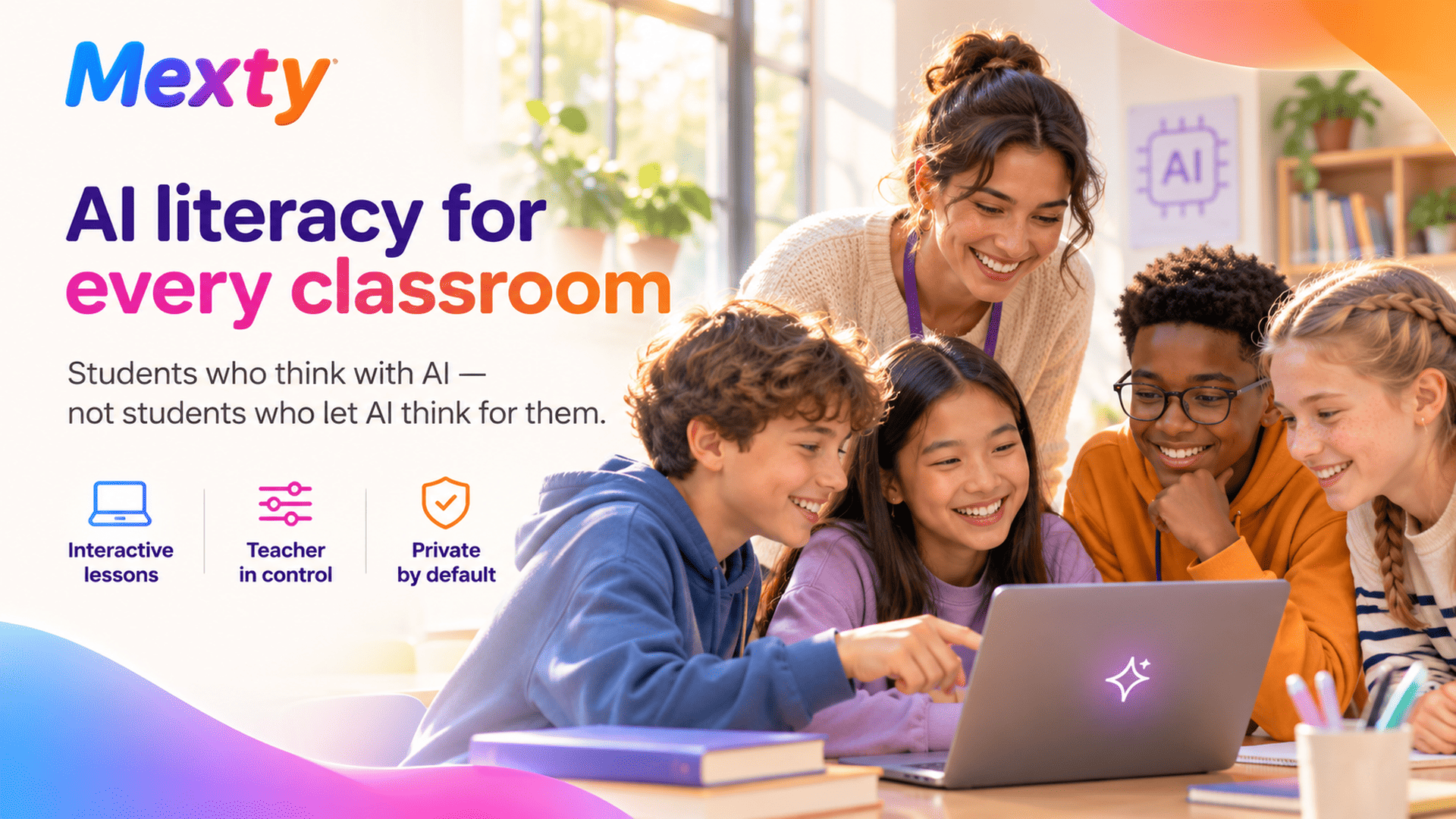
Students who think with AI, not students who let AI think for them
AI is already transforming
education.
Schools cannot prepare
students for an AI-driven world by teaching them only how to operate today's
tools.
They must help students
develop the critical thinking, curiosity, creativity, ethical awareness, and
independent judgment needed to navigate technologies that will continue
evolving.
This requires more than
static lessons or a collection of prompting exercises.
It requires
experimentation, reflection, meaningful assessment, teacher empowerment, and
curricula that can adapt over time.
The goal of AI Literacy is
not to produce students who are better at getting answers from AI. It is to
develop students who know when to question those answers, how to evaluate them,
and when to think independently.
That is the vision behind Mexty's approach to AI Literacy education.
Ready-to-use templates.
Interactive experiments. Editable learning experiences. Teacher control.
Assessment and progress tracking. A connected environment that evolves with the
needs of schools and learners.
Because the future of
education should not be about students letting AI do the thinking.
It should be about
students learning to think more deeply, critically, and responsibly with AI.
Bring
interactive AI Literacy to your school
Explore how Mexty can help your school build, adapt,
deliver, and continuously improve its AI Literacy program, from Kindergarten
through Grade 12.
How is your school
approaching AI Literacy today?
| If you enjoyed this, you’ll love our next articles Authoring Is Only the Beginning: Why AI-Native Learning Infrastructure Is the Future of Learning |