

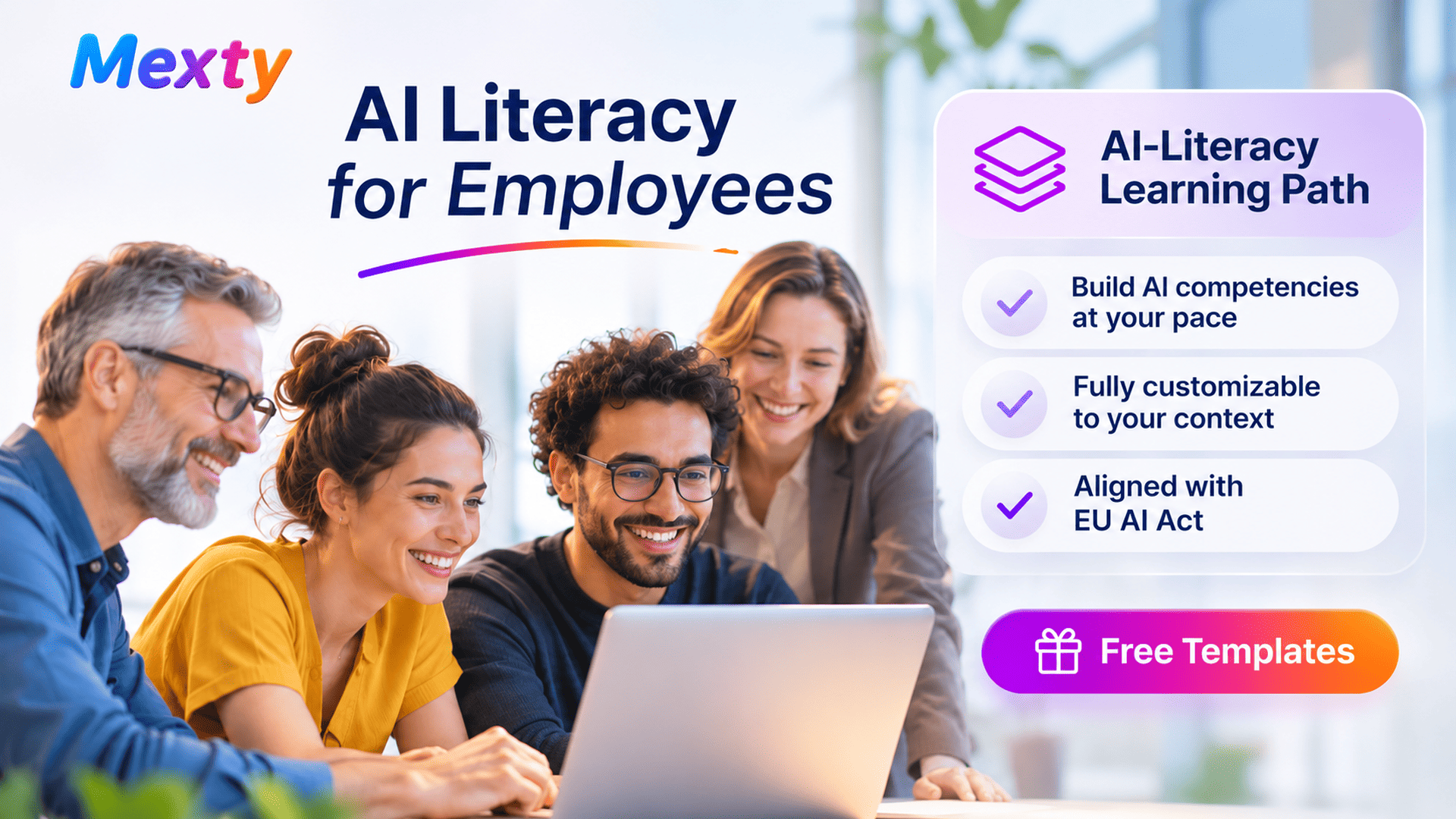
AI
Literacy for Employees : Why It Must Become an Ongoing Business Capability
AI Literacy is quickly
becoming a core workplace capability.
Employees are already
using artificial intelligence to write, summarize, analyze, search, generate
ideas and support decision-making. But access to AI does not automatically mean
people know how to use it well.
The real challenge for
organizations is no longer simply : “ Should our employees use AI ? ”
It is : “ How do we
help them use AI safely, critically and effectively ? ”
That requires more than a
prompt-writing workshop.
Employees need to
understand what information can be shared, how AI-generated answers should be
checked, where hallucinations and bias can appear, when human judgment remains
essential, and how company-specific rules apply to their role.
In other words, AI Literacy should become a continuous business capability.
AI
Literacy is more than learning how to prompt
A common mistake is to
reduce AI Literacy to a few lessons on how large language models work and how
to write better prompts.
Those skills matter, but
they are only the beginning.
An AI-literate employee
should also understand:
- when AI is appropriate ;
- when it should
not be used ;
- what
confidential or personal information must be protected ;
- how to question
AI-generated outputs ;
- how to verify
important claims ;
- how bias can
influence results ;
- how to
recognize hallucinations ;
- when human
review is required ;
- which AI tools
are approved by the organization.
This is especially
important as AI becomes integrated into everyday workflows.
The goal is not simply to
make employees faster.
It is to help them develop
judgment.
Why AI
Literacy should be learned progressively
AI is evolving too quickly
for a static one-time course.
The tools change.
The capabilities change.
The risks change.
Regulation evolves.
And organizations
continuously adapt their own AI policies.
This means AI Literacy
needs to develop over time.
A new employee might begin
with basic concepts around privacy, verification and responsible use.
A more experienced
employee may need to understand how to evaluate AI outputs in a specific
professional context.
Managers may need
additional competencies around governance, approval processes and human
oversight.
Technical teams may
require deeper knowledge of models, data and risk.
A structured Learning Path
is therefore more useful than a single isolated course.
It allows employees to
build AI competencies progressively and at their own pace.
A
ready-to-use AI Literacy Learning Path
Mexty
provides a ready-to-use AI Literacy Learning Path template designed to
help organizations get started quickly.
Instead of creating an
entire program from a blank page, companies can use the template as a
foundation and adapt it to their own needs.
This is particularly
useful for organizations that want to introduce AI Literacy without building a
complex learning program from scratch.
The Learning Path can
include:
- AI fundamentals ;
- responsible use
;
- data privacy ;
- hallucinations
and verification ;
- bias and
critical thinking ;
- company AI policies ;
- approved tools ;
- role-specific
use cases ;
- assessments ;
- practical
activities.
Employees can progress
through the path at their own pace while the organization can structure
learning according to different roles and levels of maturity.
Fully
customizable to your business context
Every organization uses AI differently.
A generic AI Literacy
course can therefore only go so far.
Employees need to
understand how AI applies to the actual environment in which they work.
This is why Mexty AI Literacy templates are fully
customizable.
Organizations can adapt:
- content ;
- structure ;
- activities ;
- examples ;
- assessments ;
- terminology ;
- company
policies ;
- approved AI
tools ;
- privacy rules ;
- sector-specific
scenarios.
For example, a healthcare
organization may emphasize patient data and human oversight.
A financial company may
focus more heavily on verification, traceability and regulatory risk.
A manufacturing company
may build scenarios around technical documentation, quality control or
operational decision-making.
The same Learning Path can
therefore become highly specific to each organization.
Ground
learning in trusted internal knowledge
AI Literacy becomes much
more useful when employees learn from the rules and knowledge that actually
apply to their workplace.
Mexty can
support this through trusted knowledge sources and Source of Truth
capabilities.
Organizations can
incorporate :
- internal AI policies ;
- security rules ;
- regulatory
guidance ;
- approved
procedures ;
- governance
frameworks ;
- company-specific
examples.
This creates a much more
relevant learning experience than generic AI training.
It also supports a more
structured approach through an AI-Native secure Learning Infrastructure
designed to connect learning content with trusted organizational knowledge.
From
passive content to interactive practice
AILiteracy should not be
taught through slides alone because employees need to practise to retain the
information and be more efficient. Typically, they need to practice ;
- What would you do if an employee pasted confidential information
into a public AI tool ?
- Would you trust
this generated answer ?
- Can you
identify which part needs verification ?
- Which prompt
creates a safer result ?
- When should you
escalate to a human expert ?
These types of questions
turn AI Literacy into a practical capability.
Using an Interactive
Course Creator, organizations can build scenarios, decision activities,
simulations and assessments rather than relying only on passive content.
Mexty also
supports interactive learning without technical complexity, allowing
learning teams and subject-matter experts to create more active experiences
without heavy development workflows.
This matters because real AI competence is demonstrated through decisions, not simply through course
completion.
AI
Literacy and the EU AI Act
AI Literacy is also
becoming increasingly important from a governance perspective.
The EU AI Act reinforces
the expectation that organizations using AI should support appropriate AI understanding and responsible use among the people involved.
For organizations, this
means AI Literacy is becoming more than a “nice-to-have” training initiative.
It is increasingly
connected to responsible AI governance.
Mexty’s AI
Literacy templates are designed around EU AI Act AI Literacy recommendations,
helping organizations build a structured approach that can be adapted to their
own context.
Technology alone cannot
make an organization fully compliant, however a structured learning program can
help companies document and support how employees are trained to use AI responsibly.
For European
organizations, using a GDPR-compliant AI learning platform also helps
ensure that the learning environment itself reflects the same privacy
principles being taught.
Security
matters when training employees about AI
There is an obvious
contradiction in asking employees to protect sensitive information while
delivering AI training through uncontrolled tools.
Organizations need
learning environments where security, governance and privacy are part of the
architecture.
A Secure AI authoring
platform can help organizations create AI-powered learning without forcing
teams to move sensitive knowledge across multiple uncontrolled environments.
Mexty
combines AI-assisted learning creation with security and governance principles
and is supported by ISO/IEC 27001 certification and SOC 2 Type II attestation.
This makes security part
of the learning strategy, not an afterthought.
AI
Literacy inside a broader learning environment
AILiteracy should not
live in isolation.
The same organization also
needs to manage:
- onboarding;
- compliance;
- product
training;
- customer
education;
- upskilling;
- knowledge
transfer.
This is why an AI-native LMS and authoring platform can be more useful than a stand-alone AI Literacy
tool.
Mexty allows
organizations to create, assign, assess and track AI Literacy alongside other
learning programs.
As an LMS-integrated
authoring tool, it connects course creation with learner management and
progress tracking.
Organizations can
therefore move from: creating AI Literacy content to: building an
ongoing AI capability program.
Free
templates lower the barrier to getting started
One of the biggest
barriers to employee training is not always technology.
It is simply knowing where
to start.
Building objectives,
modules, activities, scenarios and assessments takes time.
Mexty’s AI
Literacy templates are therefore free to use.
Organizations can start
with an existing structure, customize it, add their own context and evolve it
over time.
This helps simplify
instructional design workflow and reduces the need to build every element
from scratch.
The templates are
particularly useful for companies beginning their AI journey but can also
support more mature organizations looking to formalize and scale existing
practices.
AI
Literacy should keep evolving
The most important point
is that AI Literacy is not static.
A course created today
will eventually need to evolve because:
- New AI systems will appear.
- Existing tools
will gain new capabilities.
- Policies will
change.
- New risks will
emerge.
- New business
use cases will become possible.
This is why organizations
need an Interactive Learning Platform where learning can be continuously
updated rather than published once and forgotten.
An AI authoring tool
for L&D can help accelerate these updates while keeping humans
responsible for reviewing and approving the result.
The goal is not automation
for its own sake. It is to make continuous learning practical.
From AI
access to AI capability
Providing employees with AI tools is easy however, building real AI capability is harder.
That capability requires: knowledge
+ practice + judgment + governance + continuous learning.
Mexty’s AI
Literacy Learning Path gives organizations a practical place to start.
It is :
- free to use,
- fully
customizable,
- adaptable to
company policies and roles,
- designed around
EU AI Act AI Literacy recommendations,
- and built
within a secure learning environment.
Most importantly, it can
evolve with the organization.
Because AI Literacy should
not be a one-time course completed and forgotten.
It should become a
capability that grows with your people, your technology and your business.
|
If you enjoyed this, you’ll love our next articles |