

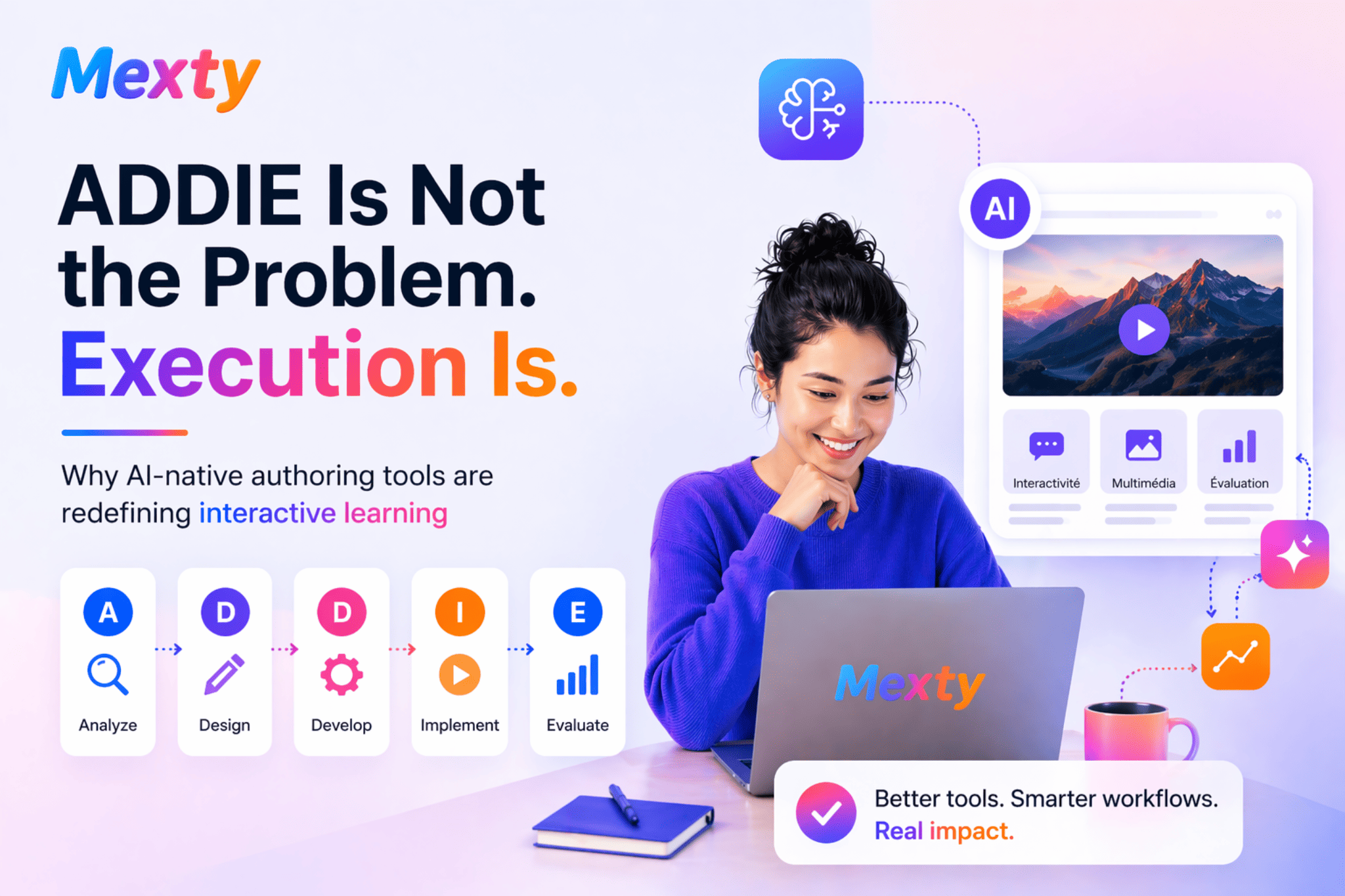
ADDIE Is Not the Problem, Execution Is: How AI-Native Authoring Tools Are Redefining Interactive Learning
For decades, instructional design has relied on structured methodologies to ensure learning effectiveness. Among them, ADDIE (Analyze, Design, Develop, Implement, Evaluate) remains one of the most widely used frameworks.
And for good reason. ADDIE provides clarity, structure, rigor, and a logical learning journey.
Yet, despite following ADDIE correctly, many organizations still end up with:
- content-heavy courses
- low engagement
- poor retention
- limited learning impact
So the real question is not whether ADDIE is outdated, but rather:
Why does good design still lead to poor learning outcomes?
The Hidden Gap in ADDIE: Development
In theory, ADDIE ensures strong analysis, clear objectives, and structured learning.
But in practice, the gap appears in one critical phase:
👉 Development
This is where learning design often turns into slide production instead of experience design.
Content Is Not Learning
Content is:
- information
- slides
- explanations
Learning is:
- decisions
- interaction
- feedback
- real-world application
This is where many teams struggle.
Even with strong analysis and clear objectives, they end up with passive, linear courses due to:
- time constraints
- budget pressure
- lack of tools to build interactivity
The Tool Problem Behind ADDIE
Teams don’t fail because of ADDIE.
They fail because they lack the right tools to translate design into experience.
The eLearning Tools Landscape Today
Today, four main categories of tools dominate the market:
- Traditional authoring tools
- Interactive content tools
- AI course creators
- AI-native authoring tools
Comparison of Authoring Tool Categories
| Criteria | Traditional Tools | Interactive Tools | AI Course Creators | AI-Native Authoring |
|---|---|---|---|---|
| Primary focus | Course production | Visual content | Content generation | Learning experience design |
| Speed | Slow | Fast | Very fast | Fast |
| Ease of use | Complex | Easy | Very easy | Easy |
| Interactivity | Advanced | Basic | Limited | Advanced |
| Workflow | Fragmented | Fragmented | Fragmented | Integrated |
| Scenario-based learning | Manual | Limited | No | Yes |
| Assessment | Advanced | Basic | Basic | Advanced + adaptive |
| Adaptive learning | Manual | No | No | Yes |
| SCORM compatibility | Yes | Limited | Sometimes | Yes |
| LMS integration | Full | Limited | Limited | Full |
| Scalability | Low | Medium | High (content) | High (experience) |
Key Insight
This comparison highlights a critical reality:
👉 No existing category fully solves the challenge of learning experience design—until now.
Why Traditional Tools Are Not Enough
Tools like Articulate Storyline, Adobe Captivate, and iSpring remain powerful but are often:
- complex
- time-consuming
- expensive
This is why many teams explore alternatives to simplify production.
Why Interactive Tools Are Not Enough
Tools like Genially and Canva are excellent for visuals and engagement but fall short when it comes to:
- full learning experiences
- structured pedagogy
- SCORM-compatible training
Why AI Course Creators Are Not Enough
AI tools solve the speed problem—but not the learning problem.
They generate content, but not structured learning experiences.
The Real Shift: AI-Native Authoring
This is where everything changes.
AI-native authoring is not about adding AI to existing tools.
It is about redesigning the entire workflow.
Platforms such as <a href="https://mexty.ai/">AI-native authoring tools</a> illustrate how structured learning experiences can be generated rather than manually built.
What Is an AI-Native Authoring Tool?
An AI-native authoring tool is designed to:
- transform objectives into interactive learning
- simplify production
- reduce costs
- scale learning creation
Vibe Coding for Interactive Learning
This is the core innovation.
Instead of building manually, you describe:
- objectives
- context
- learning experience
And the system generates a structured draft including:
- interactions
- scenarios
- learning flow
This approach—often referred to as vibe coding—changes how courses are created.
What This Enables
- faster course production
- interactive scenario-based learning
- adaptive learning experiences
- improved instructional design execution
Some environments, such as <a href="https://workspace.mexty.ai/lms/chat">interactive learning platforms</a>, demonstrate how these workflows can be applied in real use cases.
Key Capabilities of AI-Native Authoring
AI-native tools enable teams to:
- create interactive scenarios
- design decision-based learning
- build adaptive assessments
- structure feedback loops
- maintain full control over editing
- ensure reliability through controlled content sources
- export SCORM-compatible content
Augmenting ADDIE, Not Replacing It
AI-native tools do not replace ADDIE.
They enhance it.
ADDIE helps structure thinking.
Tools define the experience.
With modern approaches and resources such as <a href="https://mexty.ai/ressources/getting-started">AI-based authoring guides</a>, teams can bridge the gap between design and execution.
Why This Matters
Today, most L&D teams do not lack strategy.
They lack execution capabilities.
They know what good learning looks like—but struggle to build it.
The Future of Authoring Tools
The next generation of authoring tools will:
- combine AI and pedagogy
- simplify creation
- enable deeper interactivity
- scale learning efficiently
Conclusion
ADDIE is not broken.
Execution is.
And execution depends on the tools we use.
The real opportunity is not to rethink instructional design frameworks, but to elevate how they are brought to life.
With AI-native authoring, organizations can finally:
- transform design into experience
- scale interactive learning
- reduce complexity while increasing impact
- If you enjoyed this, you’ll love our next articles
From Slides to Scenarios: Why Turning 10 Slides Into 1 Interactive Experience Changes Everything (2026)