
Adaptive Learning Without the Labyrinth: Rethinking Personalization in Modern Learning Design
Adaptive learning has been one of the most promising ideas in eLearning for years.
Personalized paths.
Tailored content.
Learning experiences that adapt to each individual.
On paper, it sounds ideal.
In practice, many instructional designers know a very different reality:
- complex logic
- fragile structures
- difficult maintenance
- courses that slowly turn into… labyrinths
If you have ever built a multi-branch course, you have probably experienced this moment:
You zoom out… and suddenly, your course does not look like a learning experience anymore.
It looks like a labyrinth.
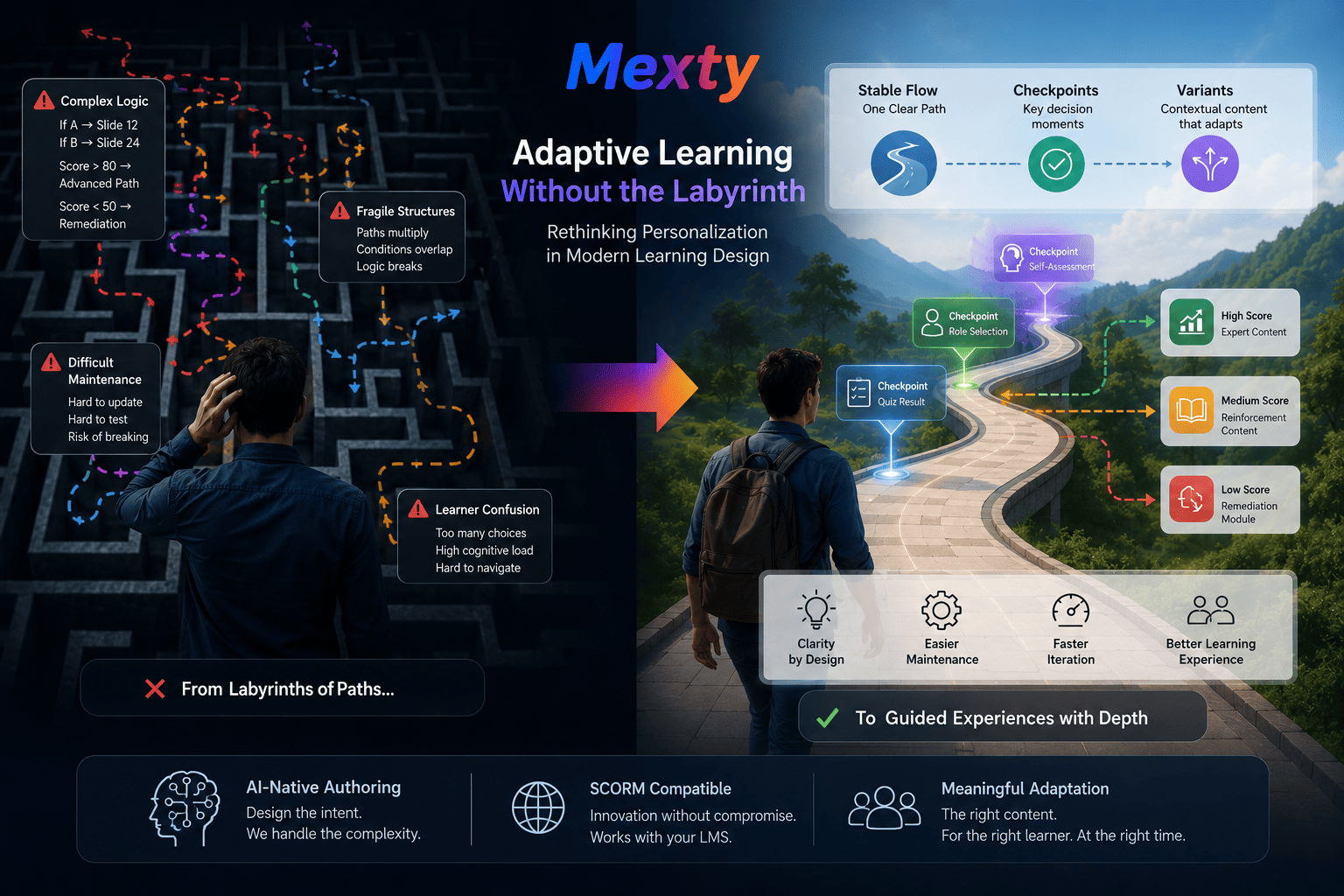
When adaptive learning becomes a labyrinth
The original idea behind adaptive learning is simple:
- If the learner struggles → provide support
- If the learner succeeds → offer more challenge
- If the context changes → adapt the content
To achieve this, many tools rely on branching logic:
- If A → go to slide 12
- If B → go to slide 24
- If score > 80 → unlock advanced path
- If score < 50 → redirect to remediation
At first, it works.
But as the course grows:
- the number of paths multiplies
- conditions overlap
- content gets duplicated
- logic becomes harder to follow
And step by step…
the course becomes a maze.
The hidden cost of labyrinth design
Labyrinths may be fascinating in mythology.
In learning design? Not so much.
Because this complexity creates real problems.
1. You lose control
At some point, even the designer struggles to answer:
- What does the learner actually see?
- How many paths exist?
- What triggers what?
The system becomes opaque.
2. You stop iterating
When logic becomes fragile, teams hesitate to change anything.
“If we touch this, something might break.”
So courses stay frozen.
3. You slow everything down
Every new variation means:
- more paths
- more testing
- more debugging
Production time increases rapidly.
4. You create confusion for learners
Ironically, adaptive learning meant to personalize the experience can:
- increase cognitive load
- reduce clarity
- make navigation harder
The learner is no longer guided.
They are navigating a maze.
The real question: do we need the labyrinth?
Adaptive learning is valuable.
But the way we implement it is not always.
So instead of asking:
How can we create more paths?
We should ask:
How can we adapt learning without losing clarity?
A different model: stable flow, adaptive content
What if adaptive learning did not rely on navigation complexity?
What if, instead of changing the path, we changed the content?
This is where a different approach emerges.
Introducing checkpoints and variants
Instead of building multiple routes, adaptive learning can be structured around:
- checkpoints
- variants
Checkpoints: key decision moments
Checkpoints are moments where the system evaluates something:
- a quiz result
- a decision
- a role selection
- a self-assessment
They answer:
Where is the learner right now?
Variants: contextual responses
Variants are content adaptations triggered by checkpoints.
For example:
- low score → remediation module
- high score → expert content
- selected role → tailored content
They answer:
What does the learner need next?
The key shift: no more maze, just depth
This approach changes everything.
Instead of building a labyrinth of paths, you keep a clear, stable flow and enrich the content within it.
Nothing disappears.
Nothing becomes hidden.
The learner never feels lost.
But the experience becomes:
- more relevant
- more contextual
- more effective
Why this approach is more sustainable
1. Clarity by design
No hidden logic.
No invisible paths.
No maze to navigate.
Everything is visible and understandable.
2. Easier maintenance
Because:
- structure is stable
- logic is explicit
- content is modular
Updating becomes simple.
3. Faster iteration
You can:
- test variations
- adjust content
- improve feedback
without breaking the entire system.
4. Better learning experience
Learners are not navigating complexity.
They are engaging with content that adapts naturally.
Adaptive learning meets AI-native authoring
This approach becomes even more powerful with AI-native authoring tools.
Instead of manually configuring every condition, designers can:
- define the objective
- describe the context
- outline the experience
And the system supports:
- checkpoint creation
- variant generation
- feedback loops
- scenario design
Platforms like Mexty help move adaptive learning away from complex branching logic and toward clearer, more interactive learning experiences.
Vibe coding for adaptive learning
This is where vibe coding for interactive learning becomes interesting.
Instead of building mechanics manually, designers focus on:
- intent
- pedagogy
- experience
And the system helps structure it.
This shifts the role of the instructional designer:
from building paths
to designing learning.
SCORM compatibility: innovation within constraints
Of course, reality matters.
Most organizations still rely on SCORM-compatible LMS platforms.
Which means:
- tracking must work
- reporting must remain consistent
- deployment must fit existing systems
The challenge is clear:
creating modern adaptive experiences without breaking compatibility.
The best platforms manage to:
- support interactive learning
- remain SCORM-compatible
Why traditional tools struggle
Most traditional authoring tools were not designed for this model.
They rely on:
- slide-based logic
- manual branching
- explicit navigation
Which often leads to:
- complexity
- rigidity
- maintenance issues
This is why many teams are now exploring alternatives to:
- Articulate Storyline
- Genially
- iSpring
Not because these tools are ineffective.
But because expectations have changed.
What defines the best authoring tools in 2026
The best eLearning authoring tools in 2026 will not be the ones that:
- generate the most slides
- offer the most templates
They will be the ones that:
- make adaptive learning simple
- support interactive course creation
- enable AI-native workflows
- remain compatible with LMS ecosystems
The real goal: meaningful adaptation
Adaptive learning is not about complexity.
It is about relevance.
You do not need infinite paths.
You need:
- the right level of challenge
- the right feedback
- the right progression
Avoiding over-engineering
One common trap is trying to personalize everything.
This leads to:
- unnecessary complexity
- slower production
- diminishing returns
The goal is not maximum adaptation.
The goal is effective adaptation.
From labyrinth to learning
The shift is simple, but powerful:
From building labyrinths
to designing guided experiences.
From complex navigation
to contextual content.
From hidden logic
to transparent systems.
Conclusion
Adaptive learning should not feel like navigating a maze.
It should feel like being guided through a meaningful experience.
Where:
- the learner progresses
- the content adapts
- the system remains clear
Because in the end, the goal is not to impress with complexity.
The goal is to make learning work.
If you enjoyed this, you’ll love our next articles