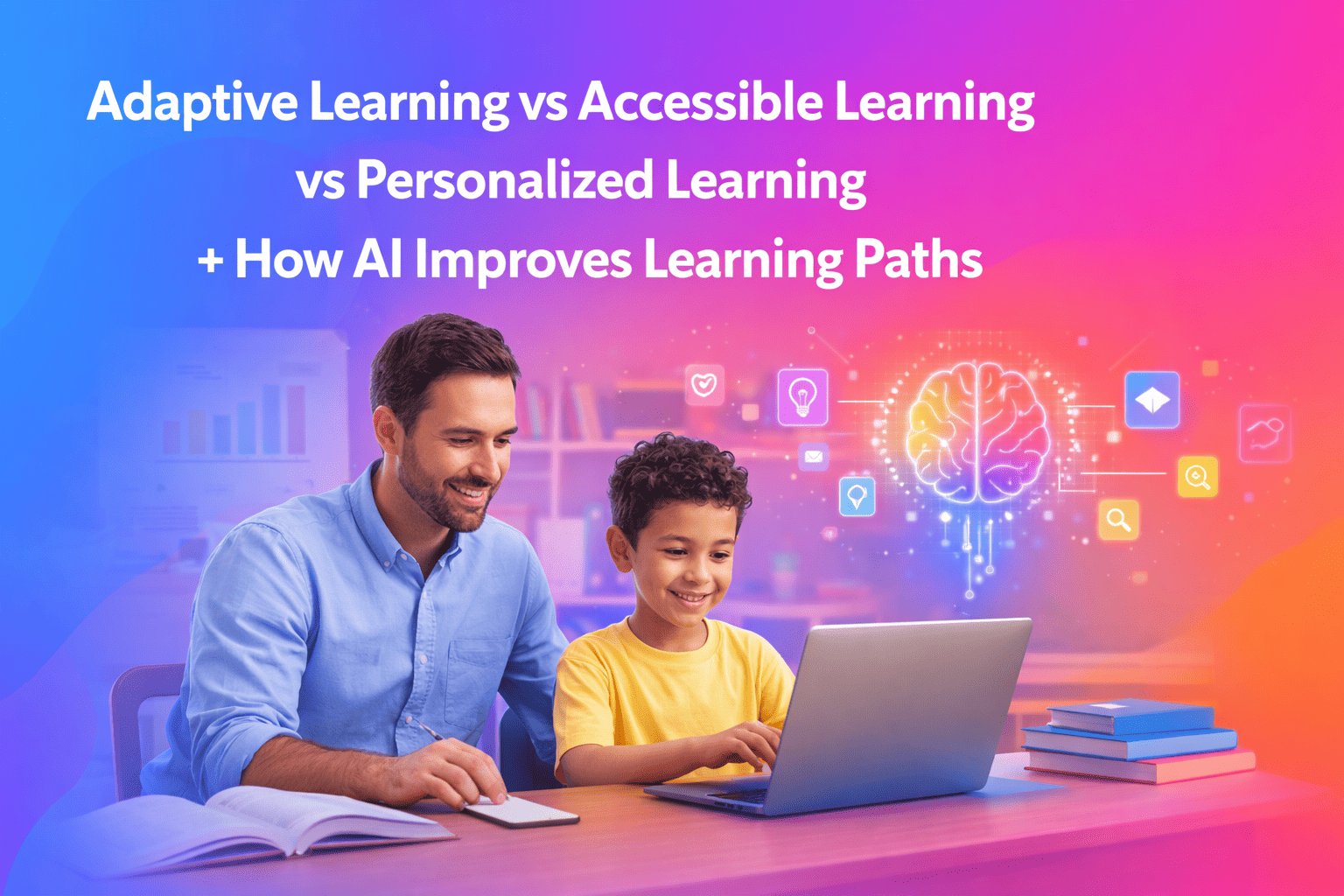
Adaptive Learning vs Accessible Learning vs Personalized Learning + How AI Improves Learning Paths
Understanding three essential approaches shaping the future of education and how AI unlocks scalable transformation.
Education today is undergoing a major shift. Classrooms and corporate training environments are more diverse than ever, and traditional one-size-fits-all instruction is no longer effective. As teaching models evolve, three important concepts are shaping the future: adaptive learning, accessible learning, and personalized learning.
These terms are often confused or used interchangeably but they represent different strategies, technologies, and benefits. To build high-performing learning experiences, educators must understand how each works and how AI-driven adaptive learning can dramatically improve outcomes.
What Is Personalized Learning?
Learning designed around each student’s preferences, goals, and learning profile
Personalized learning tailors instruction, pace, format, and activities to fit individual learners. It focuses on choice, autonomy, and meaningful pathways.
Core characteristics
Flexible pacing and differentiated difficulty
Student choice in how to learn and demonstrate knowledge
Multiple content formats: video, audio, hands-on, interactive learning activities
Educator-designed learning paths aligned to interests and strengths
Ideal for
✔ Increasing motivation and ownership
✔ Diverse learning styles
✔ Building confidence and deep understanding
What Is Adaptive Learning?
Learning that adjusts automatically in real time based on performance
Adaptive learning uses data and AI algorithms to continuously evaluate progress and alter the learning sequence, difficulty, and support level instantly.
Core characteristics
Automated recommendations and targeted reinforcement
Real-time analysis of correctness, time-on-task, skill mastery, and behavior
Mastery-based progression and personalized challenges
Reduced frustration and improved learning efficiency
Ideal for
✔ Skill development and remediation
✔ Closing learning gaps
✔ Supporting both struggling and advanced learners
What Is Accessible Learning?
Learning designed so every student can participate fully
Accessible learning ensures equal access regardless of disability, neurodiversity, or language needs.
Key components
WCAG-compliant design & universal learning principles
Assistive tools: text-to-speech, captions, translation, alternative navigation
Flexible media formats and sensory-friendly environments
Ideal for
✔ Dyslexia, ADHD, ASD, visual/hearing impairments
✔ ESL learners
✔ Universal access & equity
How AI Can Support Adaptive Learning Paths
The power of adaptive learning AI to personalize instruction at scale
AI is transforming education by enabling adaptive learning paths that automatically adjust based on student responses, speed, comprehension, and engagement behavior.
With adaptive learning AI, educators can:
✔ Create learning sequences that change dynamically based on performance
✔ Offer additional support or advanced challenges automatically
✔ Personalize learning without manual workload
✔ Provide instant feedback and guidance
✔ Reduce frustration for struggling learners & boredom for fast learners
✔ Track mastery through real-time analytics
Example
A student struggling with fractions receives guided practice and interactive simulations, while an advanced learner moves directly to applications such as 3D problem-solving or gamified activities.
AI doesn’t replace educators
✨ it frees them to focus on real instruction, mentorship, and emotional support.
Key Differences at a Glance
| Feature | Personalized Learning | Adaptive Learning AI | Accessible Learning |
|---|---|---|---|
| Focus | Preferences & pathways | Performance-based real-time adjustment | Equal access for all |
| Driven by | Educator & learner choice | AI + analytics automation | Universal design & assistive tools |
| Customization | Manual | Automated | Structural |
| Goal | Motivation & autonomy | Mastery & efficiency | Inclusion & equity |
Why Modern Learning Needs All Three
Together, these elements create future-ready learning environments that are inclusive, engaging, and results-driven.
| Combined Outcome | Impact |
|---|---|
| Personalized + Adaptive + Accessible | Every learner succeeds confidently |
How Mexty Supports Adaptive Learning, Accessibility & Personalization
Mexty is a no-code, AI-powered interactive lesson creator designed to support educators and training teams.
With Mexty, you can:
✔ Create interactive learning activities & immersive 3D experiences
✔ Use adaptive learning AI to create dynamic learning paths
✔ Personalize lessons and assessments for different learner profiles
✔ Add accessibility features such as voice, captions, overlays & translations
✔ Gamify training experiences for higher engagement
✔ Export SCORM for any LMS (Moodle, Canvas, Blackboard, TalentLMS, Docebo, etc.)
✔ Track engagement and mastery in real time
✔ Design immersive 3D experiences when relevant
🚀 Technology doesn’t replace teaching it amplifies it.
Final Thought
Adaptive learning, accessible learning, and personalized learning are not trends
✨ they are the foundation of modern education and corporate training.
When learning is interactive, inclusive, and AI-adaptive, students and employees don’t just participate
they engage, succeed, and grow.
👉 Ready to build adaptive learning paths using AI?
CTA: Try adaptive path
Explore it now on 👉 https://mexty.ai
If you enjoyed this, you’ll love our next articles
AI for Teachers: How Artificial Intelligence Is Transforming Education |